The Materials Space: Infinite and Unexplored
The batteries in electric cars. The chips in your smartphone. The solar panels on rooftops. The catalysts for producing green hydrogen. All these technologies depend on advanced materials, and all need better ones. But the space of possibilities is gigantic: take the elements of the periodic table, combine them in every possible way, with every possible crystal structure, and you get an astronomical number of candidates.
Before GNoME, exploring this space was largely done through trial and error guided by intuition. Researchers started from known materials, substituted one element for another, and hoped to stumble upon something interesting. GNoME (Graph Networks for Materials Exploration) changed the game: predicting the stability of millions of virtual crystals in a few days, selecting the most promising ones, and only validating those through expensive calculations. It's going from fishing with a net to fishing with a harpoon.
The paper introducing GNoME, published in Nature (vol. 624). There is no arXiv preprint: the journal article is the reference.
Advanced materials are the building blocks of key technologies. Better batteries accelerate the energy transition. Better solar panels make renewable energy more competitive. Better catalysts make green hydrogen viable. Accelerating materials discovery means accelerating the technological transition the world needs.
GNoME: The Project That Multiplied Known Materials by 45
In November 2023, Google DeepMind made a resounding announcement: 2.2 million new stable crystals discovered by AI. To put this in perspective: before GNoME, materials science had accumulated roughly 48,000 known stable crystals over decades. GNoME multiplied that number by 45 in one stroke.
Architecture: GNoME uses Graph Neural Networks (GNNs) applied to crystal structures. Each atom is a node in the graph, and chemical bonds are the edges. The model learns to predict a crystal's formation energy, which is the primary indicator of its thermodynamic stability: a negative formation energy means the crystal is stable and can exist in nature.
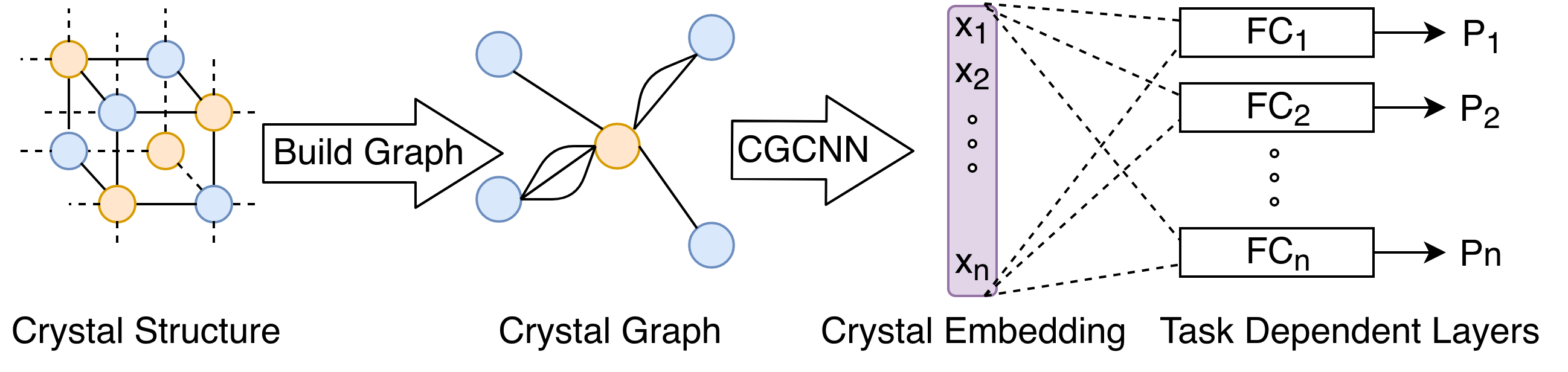
E(3) equivariance is a crucial ingredient. A crystal is the same physical object regardless of how you orient it in space. If you rotate the entire crystal by 90 degrees, its properties don't change. The E(3)-equivariant network integrates this symmetry directly into its architecture, making it much more efficient: it doesn't need to learn that rotation changes nothing, it knows this by construction.
GNoME works in an iterative loop: it proposes candidate crystals, DFT calculations (quantum chemistry) validate the most promising ones, the results are used to retrain the model, and the cycle repeats. With each cycle, the model becomes better and more efficient in its proposals. This is active learning: AI intelligently chooses which (computational) experiments are worth running.
Discovery Pipeline
GNoME's pipeline works in four steps:
- Candidate generation: two complementary strategies. Element substitution in known structures (replacing iron with cobalt in an existing crystal) and random generation of new structures
- AI filtering: GNoME predicts the stability of each candidate in milliseconds. The millions of unstable candidates are eliminated
- DFT validation: ab initio calculations (based on first principles of quantum mechanics) validate the promising candidates. This is the "gold standard" verification but expensive
- Retraining: DFT results enrich the dataset, and GNoME improves
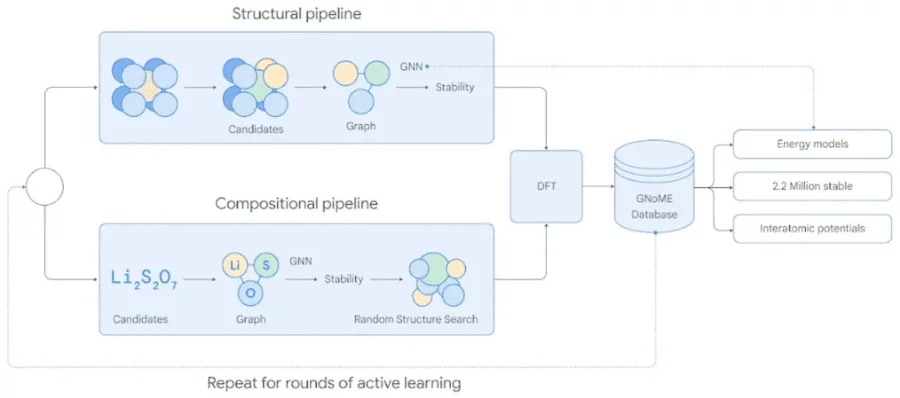
Final result: 2.2 million crystals predicted as stable, of which 381,000 validated by independent DFT. Accuracy rate: about 80%. Among the discoveries: 52,000 layered compounds (graphene-like, potentially revolutionary for electronics) and 528 potential lithium-ion conductors (for next-generation batteries).
Experimental Validation: From Virtual to Real
Computational prediction is great. But a material that exists only in a computer is useless. The A-Lab at Lawrence Berkeley National Laboratory closed the loop: it's a fully autonomous robotic laboratory that synthesizes materials without human intervention.
Result: 71 materials predicted by GNoME were successfully synthesized in just 17 days. The success rate matches the predictions. This is proof that the pipeline works end to end: AI identifies, robots make.
The GNoME (AI that predicts) + A-Lab (robots that synthesize) loop illustrates the future of materials science. AI identifies promising candidates, robots synthesize and test them, all in a largely automated fashion. The discovery cycle is accelerated by a factor of 10 to 100 compared to the traditional approach.
Other AI Approaches in Materials Science
MACE and M3GNet: machine learning-based interatomic potentials. They replace expensive DFT calculations for molecular dynamics, enabling material behavior simulation at a fraction of the cost. It's like switching from a taxi to a bicycle for short trips: less precise but infinitely faster.
CDVAE (Crystal Diffusion VAE): a generative model that designs new crystals from scratch. You can condition it on target properties (desired conductivity, optimal optical gap) and it generates crystal structures that should possess them.
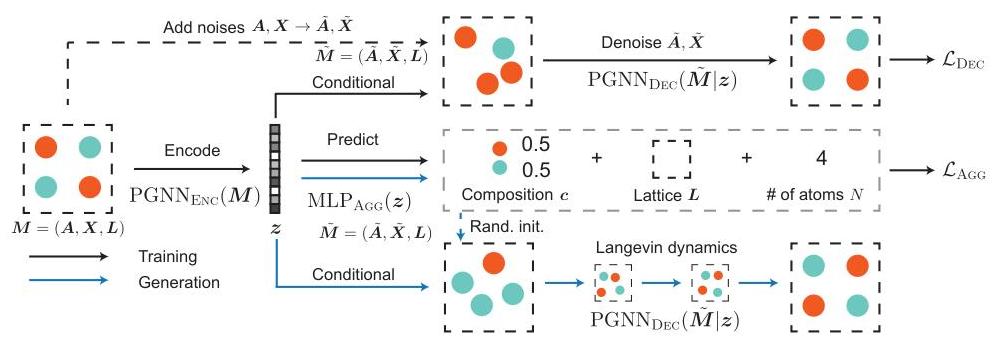
MEGNet and ALIGNN: material property prediction models (optical gap, Young's modulus, thermal conductivity) directly from the crystal structure, without going through expensive simulations.
Concrete Applications by Sector
Batteries: searching for solid electrolytes for solid-state lithium-ion batteries (safer, higher energy density), and high-density cathode materials. Solar energy: optimizing stable perovskites for next-generation solar cells, with a targeted optical gap to maximize light absorption. Catalysis: designing catalysts for water electrolysis (green hydrogen production) and replacing rare, expensive metals (platinum, iridium) with more abundant alternatives.
Important Limitations
The thermodynamic stability predicted by GNoME is a necessary but insufficient condition. A predicted stable material may be:
- Impossible to synthesize: the required temperature and pressure conditions may be unrealistic
- Mechanically fragile: thermodynamically stable but brittle as glass
- Degraded under use conditions: stable in a computer but not in a battery at 60 degrees
The path from computational prediction to industrial product remains long and fraught with obstacles. AI shortens exploration, not development.
Thermodynamic stability is a necessary condition, not a sufficient one. A stable crystal may be impossible to manufacture, mechanically fragile, or degrade in real use. AI provides direction and massively accelerates exploration. But experimental chemistry and materials engineering do the rest of the journey.
Outlook
The future lies in complete integration: AI (prediction) + DFT (computational validation) + robots (synthesis) + automated characterization (testing). This cyclical and automated discovery pipeline aims to reduce the time to discover a new material from 20 years to a few months. A few pioneering teams are already achieving this for certain types of materials.
1. GNoME predicts that a crystal is thermodynamically stable. What does that guarantee?
2. In the GNoME pipeline, how do the neural network and the DFT calculations divide the work?
3. Why impose E(3) equivariance on a model that handles crystals?
4. Seventy-one GNoME-predicted materials were synthesised at the A-Lab in seventeen days. What does that establish?