The Analogy: An Instruction Manual With No Table of Contents
Imagine an instruction manual three billion letters long, written with only four characters (A, T, G, C). That manual is your genome: the entirety of your DNA. DNA is the long molecule, present in nearly every one of your cells, that holds the instructions for building and running a living thing.
A gene is a passage in that manual describing how to build a specific protein (recall that a protein is a molecular machine, see the AlphaFold page). Gene expression is the act of a gene being "read" and switched on: depending on the moment and the cell type, some genes are turned on and others off. This fine-grained tuning is why a skin cell and a neuron, which share the very same DNA, end up so different.
The problem: we have long been able to read the letters (sequencing DNA now costs a few hundred dollars), but reading the letters does not tell you what they do. It's exactly the same wall as for proteins: the sequence is known, the function stays a mystery.
Only about 2% of human DNA directly codes for proteins. The remaining 98% was once dismissed as "junk DNA." We now know this "dark matter" holds the regulatory regions: switches and dimmers that decide which genes turn on, when, and how strongly. Most disease-associated mutations fall precisely in these non-coding zones, long unreadable.
The "Before": A Patchwork of Specialized Tools
Before AlphaGenome, understanding the function of a stretch of DNA required a mosaic of lab experiments and specialized models, each answering only one question: is this fragment accessible? is this gene expressed? does this regulatory protein bind here? Each answer demanded its own protocol, slow and expensive.
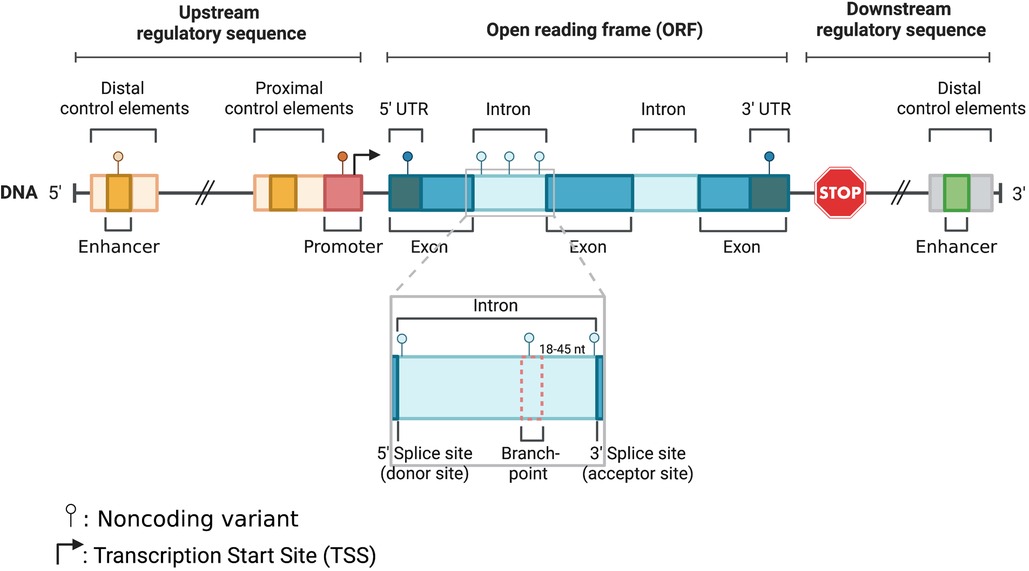
Worse: these tools had their nose pressed against the page. They looked at short windows of DNA. Yet in the genome, a switch can drive a gene located very far away on the molecule, sometimes hundreds of thousands of letters apart. A model that only sees a small patch misses that long-range relationship entirely.
How It Works: Sequence to Function, Across a Million Letters
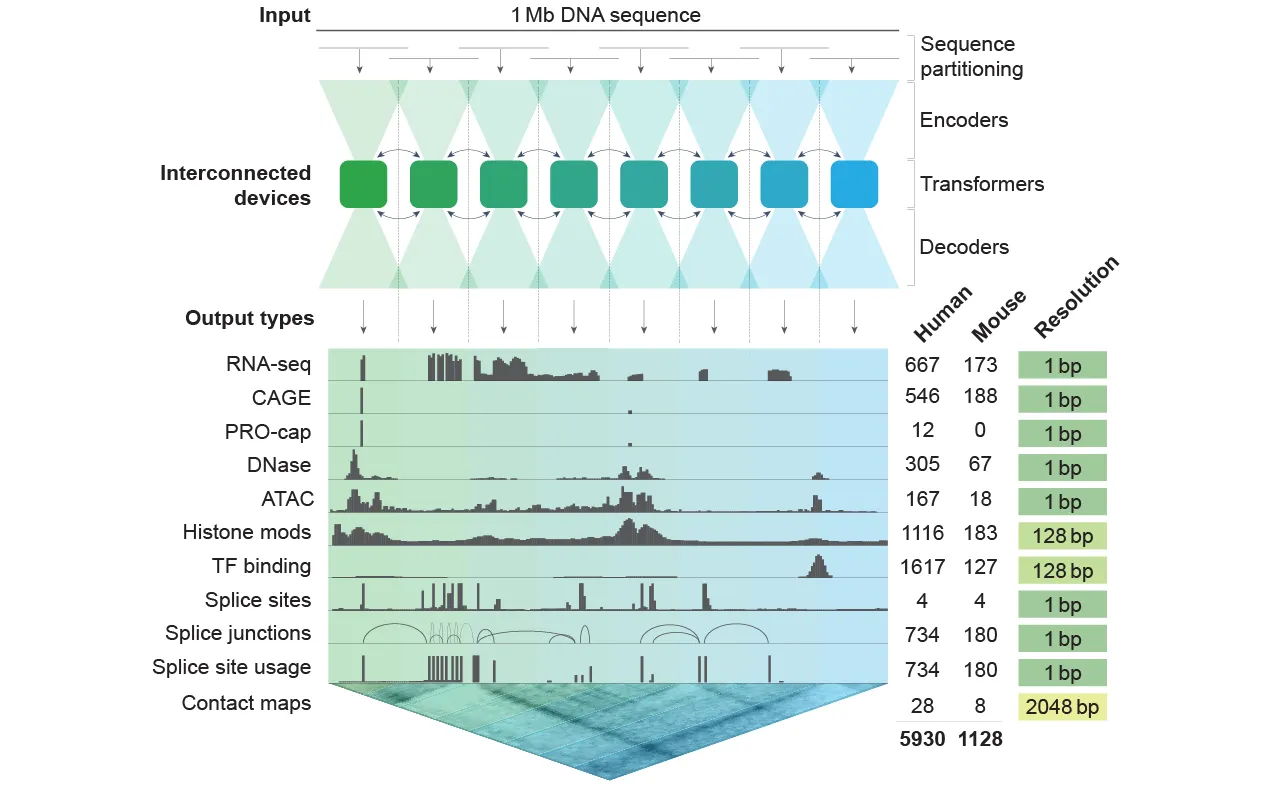
AlphaGenome takes a long DNA sequence as input and predicts, in one pass, a battery of functional properties along that sequence:
- gene expression (which genes are on, and at what level);
- chromatin accessibility: DNA is wound around proteins like thread around spools; the "unwound," accessible regions are the ones the cell can read;
- transcription factor binding: the regulatory proteins that land on DNA to turn genes on or off;
- splicing: how the text of a gene is cut and stitched back together before the protein is built.
The decisive advance is context length: the model processes sequences on the order of one million base pairs (~1 Mb) at once. This is what lets it link a distant regulatory region to the gene it controls, exactly the connection that short-window tools missed.
The Most Useful Move: Predicting a Mutation's Effect
Because the model maps a sequence to a function, you can ask it a question of great practical value. You show it a "healthy" DNA sequence and record its predictions. Then you change a single letter (you simulate a mutation) and watch how much the predictions move.
If changing that letter crashes the expression of a vital gene or breaks a splice site, you have a strong clue that the mutation is harmful, without touching a single cell in a lab. This matters for interpreting the thousands of mutations a sequencing run reveals in a patient, the vast majority of which fall in the "dark matter" and were until now undecipherable.
The Parallel With AlphaFold
AlphaGenome is often described as "the AlphaFold of DNA," and the kinship is first of all architectural:
| AlphaFold | AlphaGenome | |
|---|---|---|
| Input | amino acid sequence | DNA sequence |
| Output | 3D structure / interactions | functional tracks (expression, chromatin…) |
| Core challenge | function isn't readable in the raw sequence | same |
| Long dependencies | contacts between residues far apart in the chain | regulators far from the gene on the DNA strand |
| Promise | from sequence to protein function | from sequence to genome function |
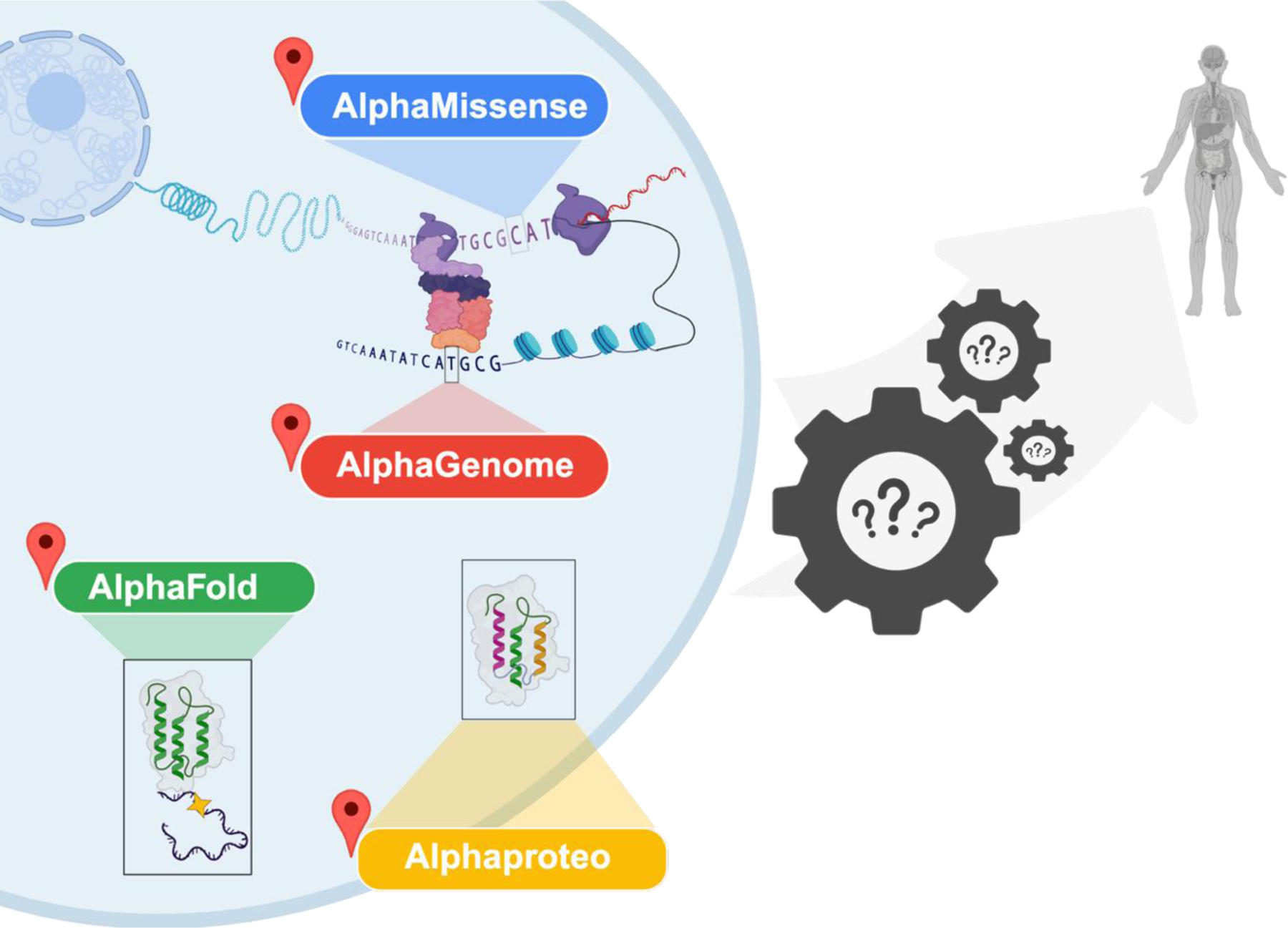
Both models solve the same class of problem (biological sequence → function) by taming long-range dependencies. AlphaFold links two amino acids far apart in the chain but neighbors in the folded structure; AlphaGenome links a switch and its gene far apart on the DNA strand. In both cases, the key is a model able to hold a very long context in memory and spot the right correlations within it.
Finding the right target is the starting point of any drug discovery effort (see the course's "drug discovery" page). By linking non-coding mutations to specific genes, AlphaGenome helps reveal which gene drives a disease, and therefore which protein to target. It's the upstream link before AlphaFold (the target's structure) and the molecule-design models (building the candidate).
Timeline and Openness
A preprint describing AlphaGenome was released by Google DeepMind in June 2025. The work was then published in Nature on January 28, 2026, alongside the release of the model's code and weights for non-commercial use. The model has been widely adopted by the scientific community. (Reference: Google DeepMind, Nature, 2026.)
This openness matters as much as the model itself: like the AlphaFold database before it, it puts a cutting-edge tool into the hands of academic labs, which have neither the compute nor the data to train such a model on their own.
The Limitations: A Map, Not an Oracle
- Correlation is not confirmed causation. The model predicts likely effects; a strong prediction is still a hypothesis to validate in the lab, especially before any clinical conclusion.
- A snapshot, not a movie. Like AlphaFold for proteins, AlphaGenome describes states, not the full living dynamics of the cell over time.
- Data bias. The model learns from the species, tissues, and conditions that were measured; it extrapolates less well beyond what it has seen.
Why It Matters
For decades, we could read DNA without understanding the 98% that doesn't code for proteins. AlphaGenome offers a first functional reading of that dark matter, at the scale where regulators actually act. For research on genetic diseases, for interpreting patient sequencing, and for drug discovery, it is a change of tooling comparable to what AlphaFold brought to proteins.
Key Takeaways
- AlphaGenome = "the AlphaFold of DNA": from a DNA sequence it predicts functional properties (expression, chromatin accessibility, transcription factor binding, splicing).
- Very long context (~1 Mb): it processes a million base pairs at once, letting it link distant regulatory regions to their genes, where older, short-sighted tools failed.
- The genome's "dark matter": it tackles the ~98% of non-coding, regulatory DNA where most disease-linked mutations fall.
- Mutation effects: change one letter and measure how the predictions shift to get a fast clue about harmfulness, with no lab experiment.
- Same recipe as AlphaFold: biological sequence → function, by taming long-range dependencies; it's the upstream link of drug discovery.
- Preprint June 2025, published in Nature on January 28, 2026, code and weights open (non-commercial use), broad scientific adoption.
1. Why is a context length of roughly one million base pairs the decisive advance in AlphaGenome?
2. What sits in the 98% of human DNA that codes for no protein?
3. How do you get a danger signal for a single-letter mutation out of AlphaGenome?
4. AlphaGenome predicts that a non-coding mutation sharply lowers the expression of a vital gene. What follows from that?