The Problem: How Do You Test an Agent?
Evaluating a classic language model is relatively straightforward: you ask a question, it answers, it's right or wrong. You compare the answer to a reference and compute a score. But an AI agent? That's a whole different story.
An agent produces a succession of tool calls in an environment that changes with every call. It explores, searches, picks a tool, changes tack when a call fails. Evaluating that is like evaluating a surgeon: the question is not "can you hold a scalpel?" but "what do you do when a complication appears mid-operation?"
Two practical difficulties follow. First, there is no single right answer to compare against, only a final state to inspect, hence the verification scripts you will find in every benchmark below. Second, the result depends as much on the program running the loop as on the model. You never evaluate a model on its own; you evaluate a model + scaffold pair. That is what makes most published figures incomparable with one another.
Four dimensions. Success: is the task accomplished? Efficiency: how many steps and how many tokens were consumed? Robustness: does the result hold across variants of the same task, or across repeated identical runs? Safety: did the agent do anything destructive or unauthorised along the way?
The fourth is the least often measured and the most important in operation: an agent that completes the task while deleting a file on the way still scores a perfect success rate.
A rule to apply without exception in everything that follows. The same agent, on the same benchmark, shows very different scores depending on how you count: one attempt kept (pass@1), or several attempts of which you keep the majority or the best (maj@N, pass@N). Both notations are explained in the reference box in self-consistency.
For an agent, add variables that do not exist for a bare model: the maximum number of steps allowed, the tools supplied, the program running the loop. The same model with two different scaffolds gives two different scores. A figure quoted without those elements is not comparable, that is the main trap in this field.
SWE-bench: Testing Code Agents
The Mission
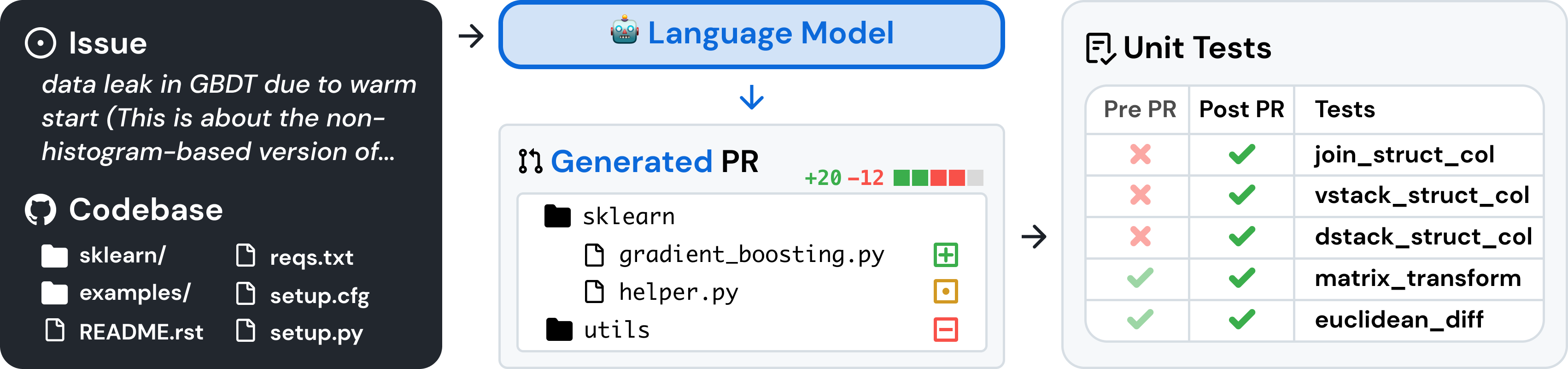
SWE-bench evaluates agents on their ability to fix real defects in real open-source projects. Not fabricated exercises: real GitHub issues drawn from widely used Python projects.
Each task consists of a GitHub issue along with the corresponding human fix commit. The agent doesn't know this fix, it must rediscover it on its own. This is testing at real-world difficulty, in complex codebases of hundreds of thousands of lines.
How It Works
- An issue is selected (for example: "The dependency graph breaks when...")
- The agent receives the issue description and full access to the repository
- It must navigate the code, understand the bug, and produce a corrective patch
- The patch is automatically evaluated by running the project's test suite
It's objective, reproducible, and unforgiving, tests don't forgive partial fixes.
Three Versions
- Full (2,294 tasks): including very difficult cases, sometimes barely solvable even for an experienced developer
- Lite (300 tasks): a selection of solvable tasks, faster to run
- Verified: a manually verified subset to guarantee test quality
Current Results (2025-2026)
| System | Success Rate (%) |
|---|---|
| Simple RAG | ~2 |
| Claude 3.5 Sonnet (with agent, 2024) | ~49 |
| OpenAI o1 (2024) | ~69 |
| Claude Sonnet 4.6 (2026) | ~80.8 |
| Best system | ~81 |
(2026 update: Claude Sonnet 4.6 reaches 80.8% on SWE-bench.)
In 12 months, scores went from 3% to 75%. This progression comes from the combination of better foundation models and more sophisticated agent frameworks (better code search, better planning, better iterative testing). But the curve is flattening: the remaining tasks are the truly difficult ones, those requiring deep architectural understanding or coordinated changes across many files.
WebArena: Web Agents
The Mission
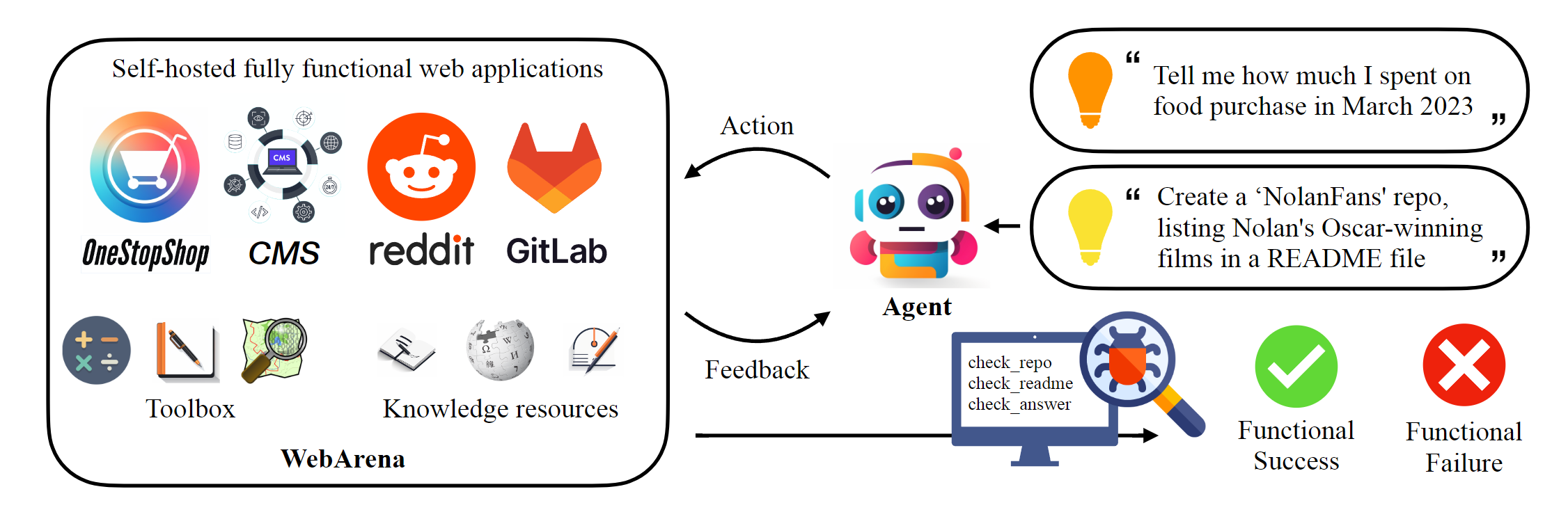
WebArena evaluates agents on web navigation tasks in realistic, locally hosted environments, which makes measurements reproducible, since the sites do not change under the agent's feet. Not "click the red button," but complete tasks: moving between pages, reading an interface, finding information, filling in a form.
The environments include:
- A forum (Reddit-like)
- An e-commerce site (Amazon-like)
- A CMS (content management system)
- A GitLab server
Example Tasks
- "Find the cheapest product in the electronics category and add it to the cart"
- "Create a new post in the forum with this title and content"
- "Solve issue #42 on GitLab by submitting a merge request"
Each task involves multiple navigation steps, contextual decisions, and sometimes handling unexpected elements (pop-ups, redirects, ambiguous forms).
Metrics
- Success rate: is the task completed correctly end-to-end?
- Step efficiency: number of actions required (clicks, inputs, navigations)
- Functional correctness: is the final result truly functional?
Results
The paper gives the two figures that matter: its best agent, built on GPT-4, completes 14.41% of tasks end-to-end, against 78.24% for humans on the same tasks. That gap is the headline result, and it is enormous.
WebArena: A Realistic Web Environment for Building Autonomous Agents (Zhou et al., 2023)Higher scores have been reported since by various systems; they depend so heavily on the scaffold and step budget that they cannot be usefully quoted without their protocol. What remains true, and what the paper establishes, is that autonomous web navigation is far from human level. The most frequent errors:
- Misinterpreting the interface (clicking the wrong button because the text is ambiguous)
- Losing spatial context (forgetting which page you're on in a multi-step workflow)
- Inability to recover from an error (a missed click that leads to a dead end)
Other Important Benchmarks
GAIA
GAIA evaluates assistants on general tasks that require combining several skills: web search, computation, multi-step reasoning, document reading.
Per the paper: 466 questions across three difficulty levels, with the answers to 300 of them withheld by the authors to power a public leaderboard. The two reference figures are the paper's own: 92% success for the human respondents, against 15% for GPT-4 equipped with plugins, at the time of publication.
GAIA: a benchmark for General AI Assistants (Mialon et al., 2023)The benchmark's stated intent is itself interesting: to target questions that are easy for a human and hard for a machine, the opposite of the trend towards ever harder exams for humans. Scores well above 15% have since been reported on the public leaderboard; because that leaderboard accepts complete systems, with their tools and scaffolds, those figures are not comparable with one another, nor with the paper's.
AgentBench
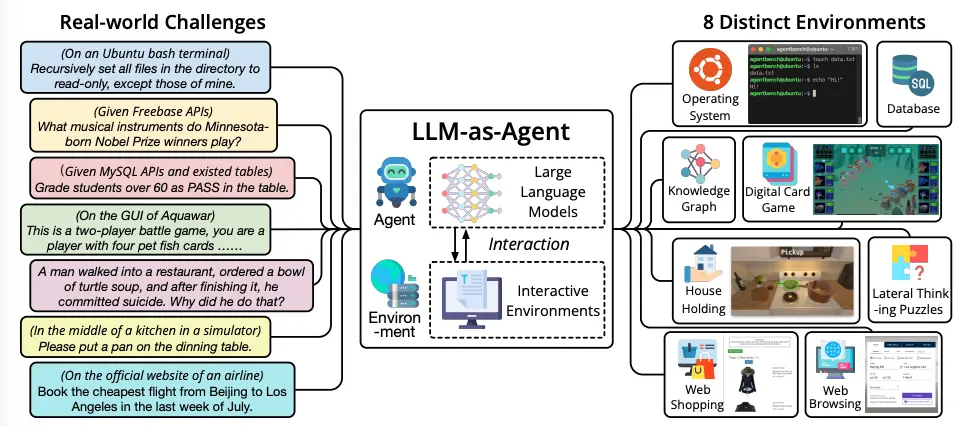
AgentBench spreads the test across eight distinct environments, which is its main value:
- command line (running commands in a terminal)
- database (querying in SQL)
- knowledge graph (walking relations between entities)
- card games, puzzles, household simulator (planning)
- web shopping and web browsing
ToolBench
ToolBench measures the ability to use real APIs, with their actual documentation and quirks. The accompanying paper, ToolLLM, reports more than 16,000 real-world APIs collected from an API marketplace. Tasks are concrete (book a hotel under a given price) and what is measured is the coherent chaining of several calls.
ToolLLM: Facilitating Large Language Models to Master 16000+ Real-world APIs (Qin et al., 2023)OSWorld
OSWorld pushes evaluation into complete desktop environments, Ubuntu, Windows, macOS. The agent has to edit documents, organise files, use applications as a human would. The paper describes 369 tasks, each with a verification script that inspects the result on the machine. It is the benchmark closest to real usage, and the one where scores are lowest.
OSWorld: Benchmarking Multimodal Agents for Open-Ended Tasks in Real Computer Environments (Xie et al., 2024)Designing Your Own Benchmark
To Evaluate an Agent on Your Use Case
Public benchmarks will never cover your specific case. If you're deploying an agent in production, you must build your own evaluation:
- Define the tasks: fifty to two hundred tasks representative of what the agent will actually do
- Write the success criteria: automatic wherever possible, verification scripts, assertions, comparisons. A criterion that needs human judgment will not be applied regularly
- Vary the difficulty: easy tasks (as a low reference), common cases, and edge cases
- Include traps: wrong data, ambiguous wording, missing information
- Measure cost: tokens consumed and API calls per task. An agent that succeeds but costs $10 per task is not deployable
- Fix the protocol once and for all: attempts counted, maximum steps, tools supplied. Without that, two measurements a month apart do not compare
Metrics to Track
| Metric | What it counts | What it is for |
|---|---|---|
| Success rate | Tasks completed correctly | The primary criterion |
| Number of steps | Tool calls per successful task | Cost and efficiency |
| Cost per task | Tokens consumed × token price | Budget |
| Recovery rate | Tasks completed after an initial tool failure | Robustness |
| Safety violations | Unauthorized or destructive actions | Safety, liability |
| End-to-end duration | Elapsed time, waits included | User experience |
An evaluation you cannot launch with a single command will not be re-run regularly, and an evaluation you don't re-run is useless, since its whole point is to catch a regression. Invest from the start in automatic checks, reproducible scripts, and a trigger on every code change (continuous integration). The target is one command and a result in minutes.
Limitations of Current Benchmarks
Data Contamination
A public benchmark is published on the internet; model training data is collected from the internet. So a recent model may have seen the solutions during training, in which case its score measures memorisation rather than competence. This is contamination, and it is hard to detect from outside, the training data is not public.
This is not hypothetical: it is one of the two grounds OpenAI cited in February 2026 for dropping SWE-bench Verified. The general mechanism, its remedies and their limits are covered in benchmark limits and benchmaxxing.
The Gap with Reality
Even the most elaborate benchmarks remain simpler than daily work. A benchmark task is well defined, its result objective, its environment controlled. Real operation brings noise, ambiguous requests, systems that fall over, and users who change their minds halfway.
There is also a dimension none of these benchmarks measures: behaviour when facing hostile content. An agent can score excellently on SWE-bench and still be hijacked by a sentence planted in an issue it reads, see tool use patterns. Adversarial robustness is evaluated separately, through dedicated exercises (safety and red-teaming).
Five questions, in this order, for any agent performance figure, in a paper, a sales deck, or a technical document.
- Which benchmark exactly? SWE-bench Full, Lite, Verified and Pro give very different numbers for the same system.
- Which counting protocol? One attempt or several; see self-consistency.
- Which scaffold? The score measures the model + program pair, never the model alone.
- Who measured it? A figure published by the vendor of the system under test does not have the same standing as one reproduced by a third party.
- On what date, and is the benchmark still credible? See the February 2026 SWE-bench Verified controversy.
If any one of those five answers is missing, the figure establishes nothing. And an excellent score, even when established, still does not guarantee reliability in a given environment: you have to add monitoring in operation, result tracking, user feedback, failure analysis.
The Future of Evaluations
Agent evaluation is a rapidly evolving field. The most promising directions:
- More realistic: open-ended tasks spread over several sessions, instead of isolated single-attempt exams
- More diverse: covering medicine, law, finance, not just code and the web
- Contamination-resistant: benchmarks renewed regularly, or evaluation sets kept private, the direction SWE-bench Pro takes
- Continuous: no longer a single snapshot, but ongoing monitoring in operation
Combining fixed benchmarks, to situate progress over time, with monitoring in operation, to measure real reliability, remains the best available approach. Neither suffices alone: the first is comparable but artificial, the second realistic but specific to one deployment.
1. Two vendors announce 40% and 60% on the same agent benchmark. Can you conclude that the second model is better?
2. Why did OpenAI stop reporting SWE-bench Verified as an official metric in February 2026?
3. An agent completes its task but deletes an unrelated file along the way. What will its success score say?
4. What is benchmark « contamination », and why is it hard to detect?
5. When building the evaluation for your own agent deployment, why does the page insist on automatic success criteria?