Artificial Imagination: The Robot That Thinks Before Acting
When you imagine grabbing a glass of water, your brain mentally simulates the movement, anticipates the glass's weight, predicts what will happen if you grip too hard or not hard enough. You don't perform the gesture to see what happens: you simulate it in your head first. World models give robots this same ability: a learned "internal simulator" that allows reasoning about the consequences of actions without physically executing them.
This is a profound paradigm shift. Instead of reacting to the world in real time (observe, act, hope), the robot can plan by mentally simulating multiple scenarios and choosing the best one.
Your brain constantly simulates the consequences of your actions before executing them. You don't need to knock over a glass to know that pushing it would make it fall. World models give robots a similar ability: planning by simulating in a learned model of the world, rather than through trial and error in the real world.
Foundations: Model-Based vs Model-Free RL
To understand world models, you need to distinguish two families of reinforcement learning:
Model-free (PPO, SAC): the agent learns a policy directly (a mapping from observed state to action) without ever building a representation of the environment. Simple, but very hungry for attempts. The robot learns by pure trial and error, never asking "what would happen if...?". These algorithms are described on Reinforcement learning for robotics.
Model-based: the agent first learns the environment's dynamics (if I take action A in state S, I arrive at state S') then uses that model to plan. Far more economical in attempts, but the learned model is inexact, and its errors compound as the mental simulation runs on.
World models are the mature form of the second family, where the model is a deep neural network able to predict complex observations (whole images) and not just abstract states.
The General Framework
A world model learns three complementary functions:
- Transition model: predicts the next state given the current state and chosen action. This is the learned physics of the world
- Observation model: generates the observations (images) the robot would see from the latent state. This is the decoder that translates imagination into vision
- Reward model: predicts the reward associated with each transition. This is the evaluation that says whether the imagined scenario is good or bad
Key Architectures
World Models (Ha & Schmidhuber, 2018): the foundational work that gave the field its name. The architecture consists of three modules:
- V, for vision: a variational autoencoder (VAE) that compresses each image into a small vector of a few dozen numbers, called a latent vector, "latent" simply meaning an internal description nobody specified by hand, which the network invented while learning to reconstruct images
- M, for memory: a recurrent neural network (RNN, a network that carries state from one moment to the next) that predicts how the vector will evolve. It holds the learned dynamics of the world
- C, for controller: a tiny linear network that picks the action from the latent vector and the memory
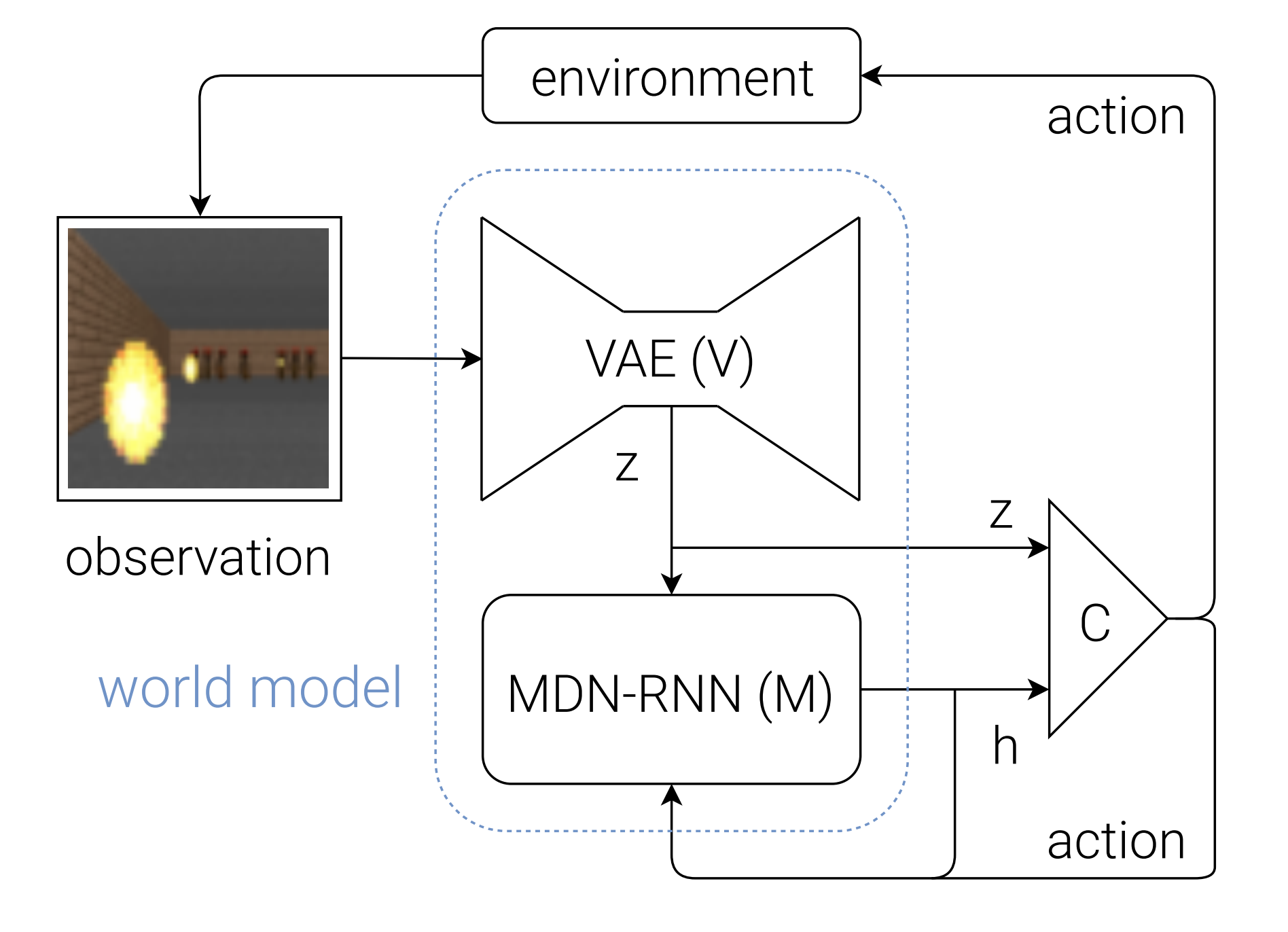
The fundamental insight: the agent can be trained entirely "in its dream," interacting with the world model rather than the real environment. It's pure imagination: the robot learns by dreaming.
Dreamer (Danijar Hafner): the most accomplished family of world models currently:
- DreamerV1 (2020): learns the policy by propagating gradients through the world model, which is possible only because that model is itself differentiable
- DreamerV2 (2021): the first agent to reach human-level performance on the 55-game Atari benchmark by learning its behaviour inside a separately trained world model. The paper says "human-level", not "superhuman", the distinction matters
- DreamerV3 (2023): outperforms specialized methods across over 150 diverse tasks with one single configuration, and is the first algorithm to collect diamonds in Minecraft with no human data and no imposed curriculum
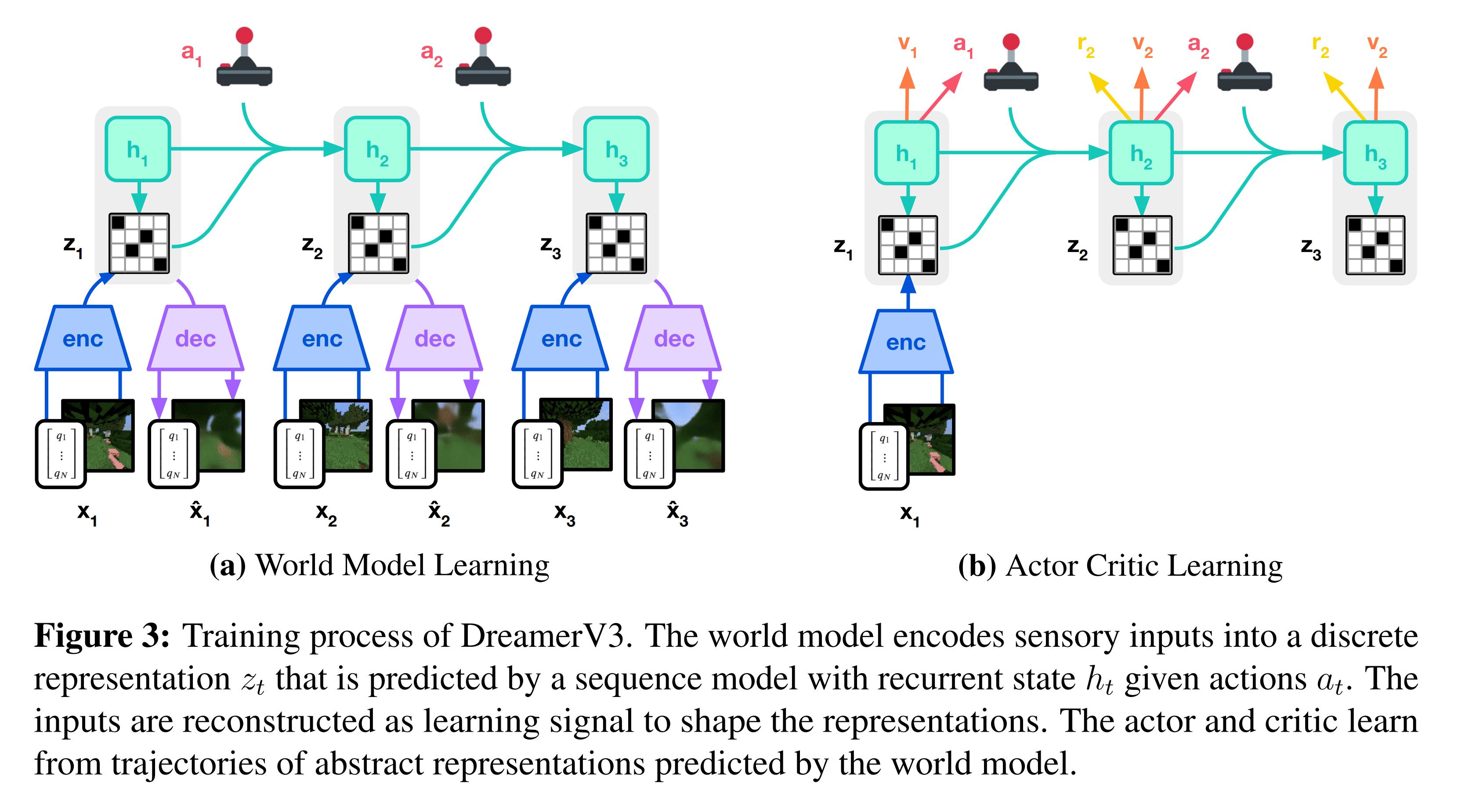
The notable result is not a score, it is an absence of tuning. The same algorithm, with exactly the same constants, runs from Minecraft to robotic locomotion to Atari. That contrasts with classical RL, where each task demands hours of hand-adjustment, and where, consequently, a comparison between two methods often mostly measures how long each team spent tuning its own.
TD-MPC2: the name combines temporal difference (how a value estimate corrects itself from one step to the next) and model predictive control (MPC), a classical control technique where you simulate a few steps into the future, pick the best sequence, execute only its first step, and start over.
- It learns the dynamics in a compact latent space, never reconstructing images
- The authors report results on 104 tasks across four domains with a single set of hyperparameters, and a single 317-million-parameter agent that performs 80 of them on its own, across several embodiments and action spaces
- Particularly suited to precision robotic tasks (insertion, assembly)
Applications in Robotics
Manipulation planning: the robot mentally simulates different grasping strategies before choosing the best one. It predicts an object's trajectory when pushed, anticipates potential collisions, and evaluates grasp stability. All of this before moving a single motor.
Navigation: predicting the consequences of movements enables anticipatory obstacle avoidance (instead of reactive), path planning in dynamic environments (with moving humans), and terrain adaptation.
Video generators as world models: it is often claimed that video generation models (Sora, Runway) are implicitly world models, on the grounds that producing a credible video of a bouncing ball requires having learned something about physics. The argument is appealing and should be handled carefully: producing a plausible image and correctly predicting a consequence are not the same skill. A generator can make a ball bounce convincingly to the eye while being wrong about the height of the bounce, and the height is what the robot cares about.
The decisive difference between a video and a world model is action: in a world model you can intervene and see what changes. A video you watch.
UniSim is a generative video model trained to simulate the consequences of an action, presented by teams from UC Berkeley, Google DeepMind, MIT and the University of Alberta. It is the ultimate direction of world models: a simulator learned from data rather than programmed by hand, which might one day stand in for MuJoCo or Isaac Sim. We are far from that; the appeal of the route is that a learned simulator could contain phenomena nobody thought to write down, precisely the weakness of programmed simulators (Sim-to-real).
Learning Interactive Real-World Simulators (UniSim, 2023)Advantages of World Models
- Sample efficiency: learning a world model then planning within it is much more data-efficient than pure model-free RL. The robot learns faster with fewer real interactions
- Safety: trying an action in the mental model before executing it lets you rule out obviously dangerous moves. With the same caveat as for any simulation: the model can only warn about dangers it is able to represent (Sim-to-real)
- Transfer: a good world model is reusable for new tasks without complete re-learning. The physics of the world doesn't change between tasks
- Interpretability: you can visualize what the robot "imagines," which helps understand and debug its behavior
Limitations
- Compounding error: predictions drift from reality as the horizon lengthens. It is the structural limit of the field, and it can be computed (see the box below)
- Environmental complexity: rich, dynamic environments (a kitchen full of objects with humans) are hard to model faithfully
- Computational cost: planning within the model adds latency, which can be problematic for real-time control
- Novel objects: the model cannot predict the behavior of objects it has never seen (an unknown material, a novel mechanism)
This is the structural limit of world models, and it derives in one line.
The model predicts one step at a time, and each prediction starts from the previous one. Suppose it is right 99 times out of 100 at each step. After 50 steps, the probability that no error has crept into the chain is
so roughly 60% odds that the imagined scenario still holds, hence 40% odds that it has already drifted. Here 0.99 is the reliability of a single step, 50 the number of steps, and the exponent simply reflects that the steps chain together.
The point is not the number but the shape: reliability decays geometrically with the horizon. Doubling the horizon does not double the error, it worsens it far faster. That is why world models are used to plan over a few steps rather than long trajectories, and why they are constantly re-anchored on real observations.
Project Genie (2026)
A reminder: a "world model" is a learned simulator that predicts what would happen next, in other words, a generative environment you can act inside and observe the consequences, rather than a passive video clip.
On 29 January 2026, Google DeepMind opened Project Genie, a research prototype available to subscribers of its top tier. It is the first world model broadly accessible as a product. It runs on Genie 3: you describe an environment, in text or with an image, and it produces a three-dimensional world you can move through, at 720p and about 24 frames per second. The worlds are not precomputed: they are generated on the fly as you explore, and can be modified along the way.
One limitation ships with the product, and it is exactly the one from the previous section: the world stays coherent for a few minutes. Beyond that, it drifts. Compounding error, made visible.
Until now, world models were research tools (Dreamer, UniSim) or supposed by-products of video generators. Genie marks the moment a world model becomes something you can handle yourself. For robotics, the promise is a learned simulator, general-purpose and explorable, rather than a physics engine written by hand. A promise, not a result: as of today, no robot is trained inside Genie.
For robotics, a few minutes of coherence is both a lot and very little. A lot, because a manipulation task lasts seconds. Very little, because a model that drifts after three minutes cannot serve as a safety test bench: the failures you are trying to rule out are rare, and finding them means simulating for a long time.
Outlook
The convergence between world models and generative models (diffusion, flow matching) is the most promising direction. Large video models learn very rich representations of the world's apparent physics, gravity, collisions, fluids, deformations. Those representations could underpin general-purpose robotic world models.
Two obstacles remain, of the same kind as elsewhere in this module. Compounding error caps the useful horizon at seconds or minutes. And a model learned from video learns what the video shows: it will reproduce frequent phenomena and ignore rare ones, and it is the rare ones that cause accidents.
1. What is the difference between model-free reinforcement learning (PPO, SAC) and a world model?
2. A world model is right 99 times out of 100 at each prediction step. Why can it not plan over long trajectories?
3. Sora produces videos where a ball bounces very convincingly. Can you conclude it is a world model a robot could use?
4. What makes DreamerV3 remarkable, according to the page?
5. DeepMind's Genie generates explorable 3D worlds that stay coherent for a few minutes. For robotics, why is that both a lot and very little?