The Problem: Speech Recognition Was Fragile
This page is about automatic speech recognition, turning a recording into written text. The phrase is almost always shortened to ASR, and that is the abbreviation used throughout the field.
For three decades, ASR systems suffered from the same flaw: they worked well in lab conditions but fell apart in the real world. Dictate into a quality mic, alone in a quiet room, and the transcription was accurate. But add background noise, a regional accent, or an uncommon language, and errors skyrocketed.
A first turning point came with Deep Speech 2 from Baidu Research in 2015: by combining a simple architecture with a massive volume of data, they showed you could match or even beat the far more complex traditional pipelines. Their recipe paired a recurrent neural network (RNN, a network that reads the signal moment by moment while keeping a memory of what came before) with Connectionist Temporal Classification (CTC), a training method that learns from nothing more than an "audio plus sentence" pair, without anyone having to say which millisecond each word starts at. It is the paper that launched the end-to-end philosophy in speech recognition, the idea Whisper would perfect a few years later.
Deep Speech 2 (Amodei et al., 2015)Whisper radically changes the game. By training on 680,000 hours of audio collected from the web, OpenAI created a universally robust model. Background noise in a cafe? No problem. Quebec or Southern French accent? Handled. Roughly a hundred languages? Recognised. It's robustness through volume.
Robust Speech Recognition via Large-Scale Weak Supervision (Radford et al., 2022)Remember this before anything else. Whisper introduces no new architecture: it is a 2017 encoder-decoder Transformer pointed at sound. What is new is the training material.
Instead of using ASR datasets carefully annotated by humans (expensive, therefore small), OpenAI harvested the web at scale for pairs of "recording plus an already-existing transcript": video subtitles, podcast transcripts, and so on. This is called weak supervision, approximate labels, produced for some other purpose, sometimes plainly wrong. The bet: sheer volume, 680,000 hours, per the paper's abstract, drowns out the noise in those labels.
That bet is what explains Whisper's robustness to accents, background noise and under-resourced languages. Not a clever piece of maths: the diversity of what happens to be lying around on the internet. It is the large-language-model philosophy applied to sound.
Three figures, all from the body of the Whisper paper (section 1):
- 680,000 hours of labelled audio in total;
- of which 117,000 hours cover 96 languages other than English;
- plus 125,000 hours of X-to-English translation data.
The "99 languages" count you see everywhere does not come from the paper but from the released model: Whisper's vocabulary contains 99 language tags (100 since Cantonese was added for large-v3). So the model can name about a hundred languages, but quality varies enormously between them, OpenAI publishes the per-language breakdown.
These are the 2022 paper's figures. For large-v3 (November 2023), the official repository states training on about 5 million hours: 1 million weakly labelled hours, as before, and 4 million pseudo-labelled hours, that is, transcribed automatically by the previous version, large-v2. The model thus learns partly from its predecessor's transcripts, a form of distillation (see Model Distillation).
Architecture: A Standard Encoder-Decoder Transformer
A Deliberately Simple Design
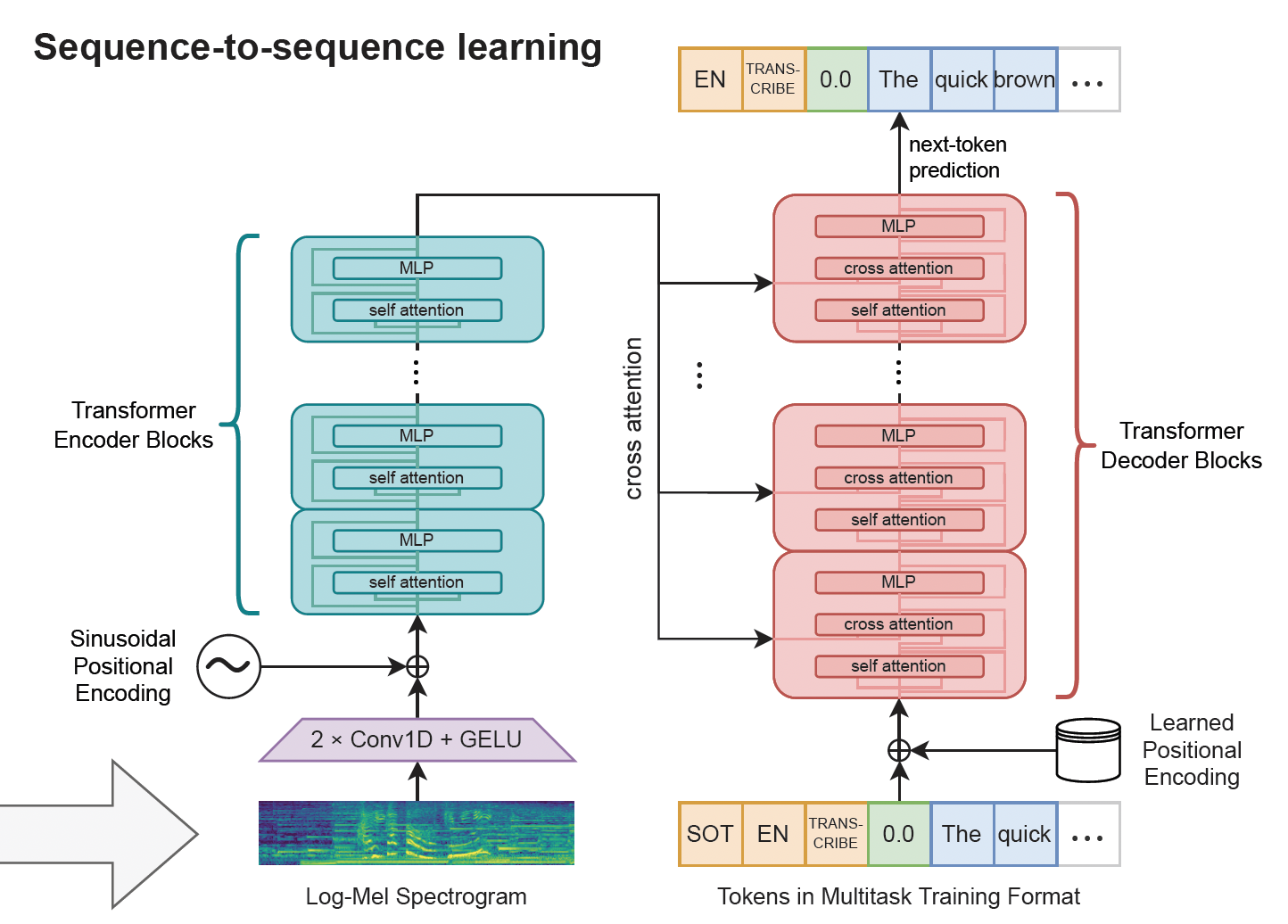
Whisper doesn't reinvent the architectural wheel. It uses a standard encoder-decoder Transformer:
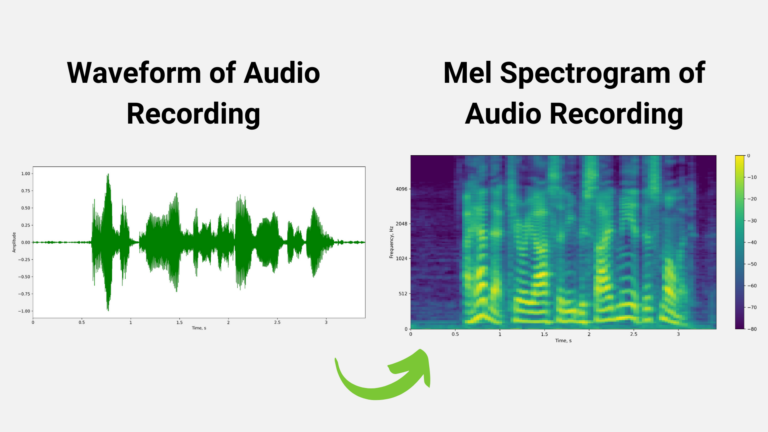
- an audio encoder: a Transformer encoder that processes the mel spectrogram of the audio (the "picture" of the sound);
- a text decoder: an auto-regressive Transformer decoder that generates the transcription word by word, each word it emits becomes part of the input for the next one.
It's the same architecture as the original 2017 Transformer, simply applied to speech. The novelty isn't in the architecture, but in the scale and the nature of the training data.
How Audio Is Prepared
The preprocessing pipeline is simple and well thought out:
- Raw audio is resampled to 16 kHz (the standard for human speech)
- An 80-channel mel spectrogram (128 for
large-v3, a finer image along the frequency axis) is computed over 25-millisecond windows, this is the transformation from sound to "image" - The spectrogram is split into 30-second segments (the context limit)
- Each segment is processed independently by the model
Model Sizes: Choose Based on Your Resources
The table below keeps only the columns the official Whisper repository actually publishes: parameter count, video memory needed, and relative speed.
| Model | Parameters | Required VRAM | Relative speed |
|---|---|---|---|
| tiny | 39 M | ~1 GB | ~10× |
| base | 74 M | ~1 GB | ~7× |
| small | 244 M | ~2 GB | ~4× |
| medium | 769 M | ~5 GB | ~2× |
| large | 1,550 M | ~10 GB | 1× (reference) |
| turbo | 809 M | ~6 GB | ~8× |
How to read the last column: "~8×" means the model transcribes roughly eight times faster than large. The repository states the protocol: measured on English speech, on an NVIDIA A100, and real-world speed varies a lot with language, speaking rate and hardware.
An earlier version of this page added a "relative quality" column to the table (60%, 70%, 82%… 97% for turbo). Those numbers exist nowhere. OpenAI publishes no per-size quality score in that form; the repository only says that turbo is an optimised version of large-v3 offering faster transcription "with a minimal degradation in accuracy", and puts no number behind "minimal".
What OpenAI does publish is the word error rate language by language for large-v3 and large-v2 (appendices D.1 to D.4 of the paper). That is where a number should be taken from, and it has to be read for the language and dataset that concern you. See how to read a benchmark score.
Practical advice: turbo is the sensible compromise for the vast majority of use cases, roughly the memory footprint of medium, close to the speed of the small models. Reserve large-v3 for situations where a single error is expensive (medical transcription, legal record) and you have the GPU for it.
One Model, Four Tasks
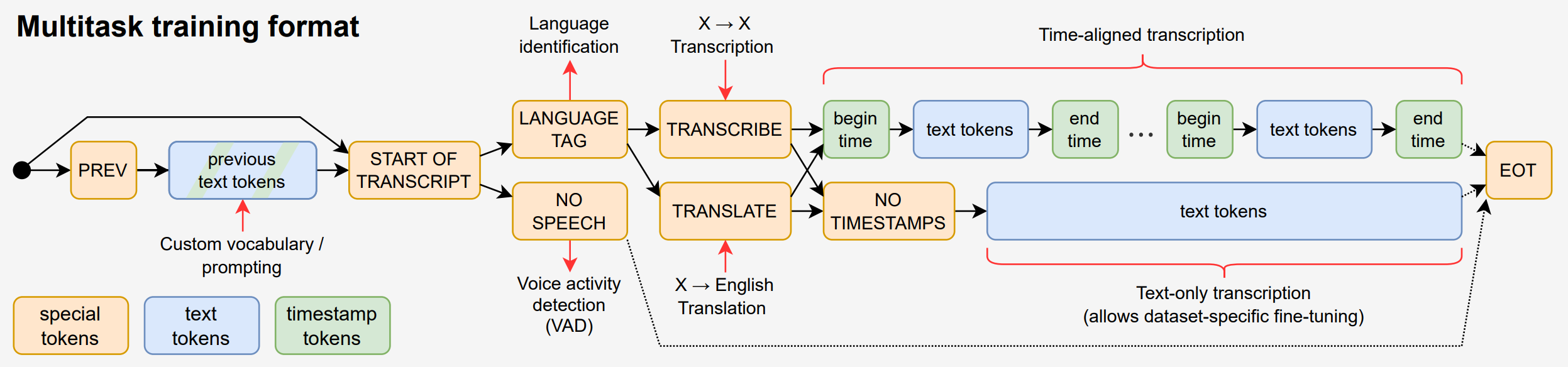
Whisper is trained simultaneously on multiple tasks, controlled by special input tokens:
- Transcription: converting audio to its source language (the most common case)
- Translation: converting audio to English, regardless of the source language
- Language detection: identifying which language is spoken in the clip
- Voice activity detection: distinguishing segments with speech from silence or noise segments
A single model doing four distinct things, simply by changing the command token. That's the elegance of the multi-task approach.
For most use cases, Whisper turbo (large-v3-turbo, October 2024) is the right choice: the official repository measures it at roughly 8 times the speed of large, and describes it as an optimised version of large-v3 whose accuracy degrades "minimally", OpenAI's own wording, and they put no number on it. Only use large-v3 when transcription must be as accurate as possible (medical transcription, legal proceedings) and you have the GPU budget.
Turbo's trick is instructive. OpenAI kept large-v3's encoder intact and cut the decoder from 32 layers down to 4. Why the decoder? Because the encoder runs once per 30-second segment, while the decoder runs once per token produced, tens or hundreds of times. That is where the cost lies. The listening stays just as fine; it is the writing that gets lighter.
Performance: How Reliable Is It?
Word Error Rate (WER): Read It Backwards
The reference measure in speech recognition is the word error rate, almost always shortened to WER. The important word is error. It is not an accuracy, it is a fault rate: lower is better. A WER of 5% is good; a WER of 60% is a disaster. That is the opposite of the reflex most people have in front of a percentage.
Here is how it is computed. You line the machine's transcript up against the reference transcript and count three kinds of fault:
Each symbol, spelled out:
- , substitutions: a word was replaced by another one ("boat" heard as "coat");
- , deletions: a word in the reference is missing from the transcript;
- , insertions: a word appears in the transcript that was never said;
- , the total number of words in the reference, that is, in what was actually spoken.
In one sentence: WER is the number of corrections a proofreader would have to make, divided by the length of the original text.
This is the part that always surprises people, and it follows straight from the formula. The denominator counts the words in the reference. The numerator counts corrections, insertions included, and nothing caps the number of insertions.
A worked example. The reference is 3 words long: "I'll come tomorrow" (). On a noisy recording the system produces eight wrong words: "the wind of hand it is nice here". A proofreader must substitute the 3 reference words () and delete the 5 extra ones (). So .
An "accuracy" cannot exceed 100%; an error rate can. This is exactly what happens when a model hallucinates over a silent passage: it adds text, therefore insertions, therefore a WER with no ceiling. Never translate "30% WER" into "70% correct".
What Whisper Actually Buys You: The Numbers
Table 2 of the Whisper paper is the best evidence that the robustness comes from the data rather than the architecture. It compares Whisper large-v2 with a wav2vec 2.0 Large model specifically fine-tuned on LibriSpeech, a corpus of cleanly read audiobooks.
| Dataset | wav2vec 2.0 Large (WER) | Whisper large-v2 (WER) |
|---|---|---|
| LibriSpeech Clean (wav2vec's home turf) | 2.7% | 2.7% |
| Tedlium (conference talks) | 10.5% | 4.0% |
| Common Voice (crowd voices, mixed accents) | 29.9% | 9.0% |
| CHiME6 (recorded dinner party, very noisy) | 65.8% | 25.5% |
| Average over the 13 other datasets | 29.3% | 12.8% |
Read the first row, then the rest. On its competitor's home turf Whisper draws exactly level: 2.7% against 2.7%. Step off that turf and the gap becomes enormous, the paper puts the average relative error reduction at 55.2%, and Whisper had seen none of these datasets during training.
That is what robustness means: not being better in the lab, but not collapsing once the sound stops resembling the lab. And note the CHiME6 row: 65.8% WER, roughly two words in three needing correction. That is what the real world looked like to a model fine-tuned on audiobooks.
And Compared With a Human?
The paper devotes a section to this (3.9), with a precise protocol: 25 recordings from the Kincaid46 set, transcribed by Whisper, by 4 commercial ASR services, by one computer-assisted human transcription service, and by 4 purely human transcription services.
The reported result: the computer-assisted human service has the best aggregate WER, 1.15 percentage points better than Whisper; the four purely human services beat Whisper only by a fraction of a point. The authors' conclusion, in substance: Whisper's English ASR is not perfect, but it is very close to human-level accuracy.
None of these figures is "Whisper's WER". A WER only exists attached to three things: a specific model, a specific dataset, and a text normalisation (capitals, punctuation, numbers written as digits or as words, the paper applies its own normaliser, which moves the result by several points). Two WERs measured differently are not comparable. See how to read a benchmark score.
The Strengths That Set It Apart
- Noise robustness: the table above shows it with numbers, on the noisy CHiME6 dinner recording, WER drops from 65.8% to 25.5%
- Natively multilingual: about a hundred language tags in a single model, no switching required, with very uneven quality across those languages
- No setup required: works as shipped, without adapting the vocabulary or retraining on your own data
- Varied accents: handles regional and non-native accents precisely because the web-scraped data is full of them
The Weaknesses to Know About
- 30-second segments: context is limited to 30 seconds, which can cause problems when a sentence straddles two segments
- Hallucinations: Whisper can generate text that doesn't exist in the audio, especially on silent or very noisy passages, and as shown above, those insertions push WER up with no ceiling
- No native streaming: the model processes complete segments, not a live audio stream. Live transcription needs an architecture built for it, see the section "Transcribing in Real Time" below
Practical Implementation
With Transformers (The Simplest)
from transformers import pipeline

transcriber = pipeline("automatic-speech-recognition",
                      model="openai/whisper-large-v3")
result = transcriber("audio.mp3", return_timestamps=True)
print(result["text"])
Two lines to load the model and transcribe a complete audio file.
Faster Whisper (Optimized for Production)
A reimplementation of Whisper on the CTranslate2 engine, which claims roughly 4 times the speed of the reference implementation at equal accuracy, largely thanks to INT8 quantization (a figure published by the project itself, with no independent protocol):
from faster_whisper import WhisperModel

model = WhisperModel("large-v3", compute_type="int8")
segments, info = model.transcribe("audio.mp3")
for segment in segments:
    print(f"[{segment.start:.2f}s → {segment.end:.2f}s] {segment.text}")
Recommended for production: faster, less memory-hungry, same results.
Whisper.cpp
A C++ port for pure CPU inference. Ideal for embedded devices: phones, Raspberry Pi, desktop applications without a GPU.
Whisper can "hallucinate": inventing text that isn't in the audio, especially on silent or very noisy segments. The model, trained to always produce text, fills gaps with invention. Practical solutions:
- Use a voice activity detector (VAD, a small model that answers only "speech" or "not speech", window by window) to filter out segments without speech before sending them to Whisper
- Monitor token confidence scores: abnormally low probabilities often signal a hallucination
- Systematically double-check low-confidence segments
Evolutions and Alternatives
Distil-Whisper
Distilled versions of Whisper: a small model is trained to imitate the outputs of the large one, a technique called knowledge distillation. The figures from the paper's abstract: 5.8 times faster, 51% fewer parameters, and a WER that stays within one point of Whisper's on out-of-distribution test data. The authors also note it hallucinates less than Whisper on long-form audio.
Distil-Whisper (Gandhi et al., 2023)Fine-Tuning on Your Domain
Fine-tuning Whisper on domain-specific data clearly improves quality for specialised vocabulary. In medicine, law and engineering, technical terms are often poorly transcribed by the generalist model. One caveat: how much you gain depends entirely on your data, and no general figure means anything here, it has to be measured on your own recordings.
The Competitors of 2025-2026
The Reference Ranking: the Open ASR Leaderboard
To compare ASR models, the reflex has become Hugging Face's Open ASR Leaderboard, opened in 2023 and described in a paper in October 2025. It applies the same protocol to every model: one text normalisation, and the average WER over a set of varied English datasets (audiobooks, TED talks, meetings, earnings calls, parliamentary speeches), plus a speed measurement. Multilingual and long-form tracks were added, then in 2026 a private track whose recordings are not public, to limit the risk that models saw the tests during training.
That is exactly what the callout above was asking for: one model, one dataset, one normalisation, for everyone. The orders of magnitude, in November 2026:
- Whisper large-v3 sits at around 7.4% average WER;
- the top of the table is around 5.3 to 5.5%, held by open models of 1 to 3 billion parameters: Alibaba's Qwen3-ASR, IBM's Granite Speech, Cohere Transcribe (released in March 2026 under Apache 2.0, top at launch with 5.42%), NVIDIA's Canary-Qwen.
The gaps between the leaders come down to a few tenths of a point, and the top spot changes hands from one update to the next. Keep the trend, not the ranking: Whisper is no longer the most accurate open model, but it set the reference everyone measures against.
Open ASR Leaderboard: Towards Reproducible and Transparent Multilingual and Long-Form Speech Recognition Evaluation (Srivastav et al., 2025)The Families That Matter
- NVIDIA Parakeet and Canary: Parakeet is a small (600 million parameters), extremely fast model, built for English and then, with its v3 release (August 2025), for 25 European languages. Its decoder does not write word by word the way Whisper's does: at each step it predicts a token and how much audio to skip, which avoids recomputing at every instant. Canary adds speech translation, and Canary-Qwen (2025) grafts NVIDIA's audio encoder onto a Qwen language model.
- Voxtral (Mistral): released in July 2025 in two sizes under Apache 2.0, it can transcribe and also answer questions about the audio. In February 2026 Mistral added two specialised transcription models, one for files (with "who spoke when") and one for live audio. Details on the Voxtral page; its audio encoder belongs to Whisper's family.
- Qwen3-ASR (Alibaba) and Granite Speech (IBM): open models built on the same principle of an audio encoder connected to a language model, among the leaders of the table in 2026.
- Proprietary APIs: in March 2025 OpenAI launched gpt-4o-transcribe and its mini version, built on GPT-4o and announced as more accurate than Whisper on its own measurements; ElevenLabs Scribe (February 2025), then Scribe v2 and its real-time variant; Deepgram and AssemblyAI remain widely used in business. Their figures are published by the vendors themselves, rarely under the common protocol.
| Model | Publisher | Date | Size | Weights | What sets it apart |
|---|---|---|---|---|---|
| Whisper large-v3 / turbo | OpenAI | 2023 / 2024 | 1.55 B / 809 M | Open (MIT) | The reference, robust and multilingual |
| Parakeet TDT v3 | NVIDIA | 2025 | 600 M | Open | Very fast, 25 European languages |
| Canary-Qwen | NVIDIA | 2025 | 2.5 B | Open | Audio encoder + language model |
| Voxtral | Mistral AI | 2025-2026 | 3 B to 24 B | Partly open (Apache 2.0) | Understands audio, real-time version |
| Cohere Transcribe | Cohere | 2026 | 2 B | Open (Apache 2.0) | Top at launch |
| gpt-4o-transcribe | OpenAI | 2025 | Unpublished | Closed (API) | Built on GPT-4o |
| Scribe v2 | ElevenLabs | 2025-2026 | Unpublished | Closed (API) | Real-time variant |
Whisper already had a decoder that "writes". Most recent models go further: an audio encoder, then a real language model as the decoder (Voxtral, Canary-Qwen, Qwen3-ASR, gpt-4o-transcribe). The gain: the model knows the language, guesses a badly articulated word better from context, and can be given a list of terms to recognise (proper names, jargon). The risk is Whisper's, only stronger: a language model is very good at inventing a plausible sentence nobody said.
Architectures Worth Knowing
- Conformer: a hybrid architecture pairing a convolutional neural network (CNN, a network that spots local patterns, here patterns a few tens of milliseconds wide) with a Transformer. Widely used for real-time ASR, it is the basis of the Parakeet and Canary encoders.
- Universal Speech Model (USM, Google): per the paper's abstract, a single model doing ASR in 100+ languages, with an encoder pre-trained on 12 million hours of unlabelled audio spanning 300+ languages. The "1,000 languages" figure sometimes quoted belongs to Google's announced research programme, not to the capabilities measured in this paper.
Transcribing in Real Time
Live captioning a broadcast, giving a voice assistant ears, taking notes during a meeting: all these uses need text that appears while people speak. Whisper is not built for this, for two reasons that follow from its architecture:
- It works in 30-second windows: it waits until it has the segment.
- Its encoder looks at the whole segment, end included, to interpret the beginning. That is what makes it good, and it is also what stops it answering before it has heard what comes next.
Workarounds exist (re-transcribing a sliding window over and over and only displaying the part that has stopped changing), but they are compute-hungry and add delay.
A true streaming model is built differently: its encoder is causal (it only looks at the past), and the model learns to decide when to write a word, accepting a short wait to resolve an ambiguity. Everything hinges on that delay, the central trade-off of real time: the longer the model waits, the more accurate it is. According to Mistral, Voxtral Realtime set to a 2.4-second delay matches the quality of its file model, while offerings aimed at voice assistants, such as Scribe v2 Realtime, advertise around 150 milliseconds. These are vendor figures, each measured in its own way.
Impact and Perspective
Whisper democratised quality automatic transcription. Before, getting a good transcription required expensive proprietary services, specialised expertise and cloud infrastructure. Now the code and the weights are released under the MIT licence (so commercially usable) and the model runs on a laptop.
To our knowledge, no new open version of Whisper has followed turbo (October 2024): OpenAI has put its effort into its API transcription models. Yet at the end of 2026 Whisper is still one of the most downloaded audio models and the basis of many tools, and its recipe (lots of imperfect data rather than a little perfect data) has been taken up by nearly all its successors.
The wider lesson goes beyond speech recognition: where everyone expected an architectural breakthrough, the robustness came from the training material. Worth keeping in mind when asking where the quality of a speech system really comes from.
The lines of work of 2022 have partly come true: streaming transcription has become an everyday product, and long context is progressing (Voxtral Mini Transcribe 2 accepts recordings of up to three hours). Still open are hallucination reduction, which the arrival of language models in ASR does not solve, and quality on rare languages. For voice generation and the "who spoke when" question, see the Voxtral page, the Text-to-Speech page and the speaker diarization page.
1. Where does Whisper's robustness to accents, background noise and under-resourced languages come from?
2. An ASR system reports a WER of 30%. Can you conclude it gets « 70% of the words right »?
3. On LibriSpeech, the home turf of its competitor wav2vec 2.0, Whisper draws exactly level (2.7% against 2.7%). So where is its advantage?
4. Why can Whisper « hallucinate » text over a silent passage, and what is the practical remedy?
5. You want to quote « Whisper's WER » in a report. What must you know first?
6. Whisper turbo transcribes about eight times faster than large-v3 while keeping almost the same accuracy. Which part of the model did OpenAI shrink, and why that one?