Your Computer Speaking Like a Real Human
This page is about speech synthesis: producing spoken audio from written text. The usual name for it is text-to-speech, almost always shortened to TTS, the abbreviation in this lesson's title. It is the exact inverse of the speech recognition described in the Whisper lesson: there we went from sound to text, here we go from text to sound.
For a long time, computer voices were instantly recognizable: robotic, choppy, soulless. You could immediately tell it was a machine. Today the best synthetic voices are hard to tell from a human one over a short listen. They reproduce emotions, regional accents, micro-pauses, and even the little natural hesitations of speech.
Concrete applications are already everywhere: audiobooks produced in minutes instead of weeks in a studio, multilingual voice assistants, automatic video dubbing, accessibility for the visually impaired. Speech synthesis has gone from gimmick to production tool.
The old generation: specialized models trained on a single voice for hours. For each new voice, you had to re-record and retrain a complete model. The new generation: language models adapted to audio that can clone any voice from just a few seconds of recording. The legal consequence is immediate: the technical barrier of "you need hours of studio time" is gone.
The Chain: From Text to Sound, Through an Intermediate
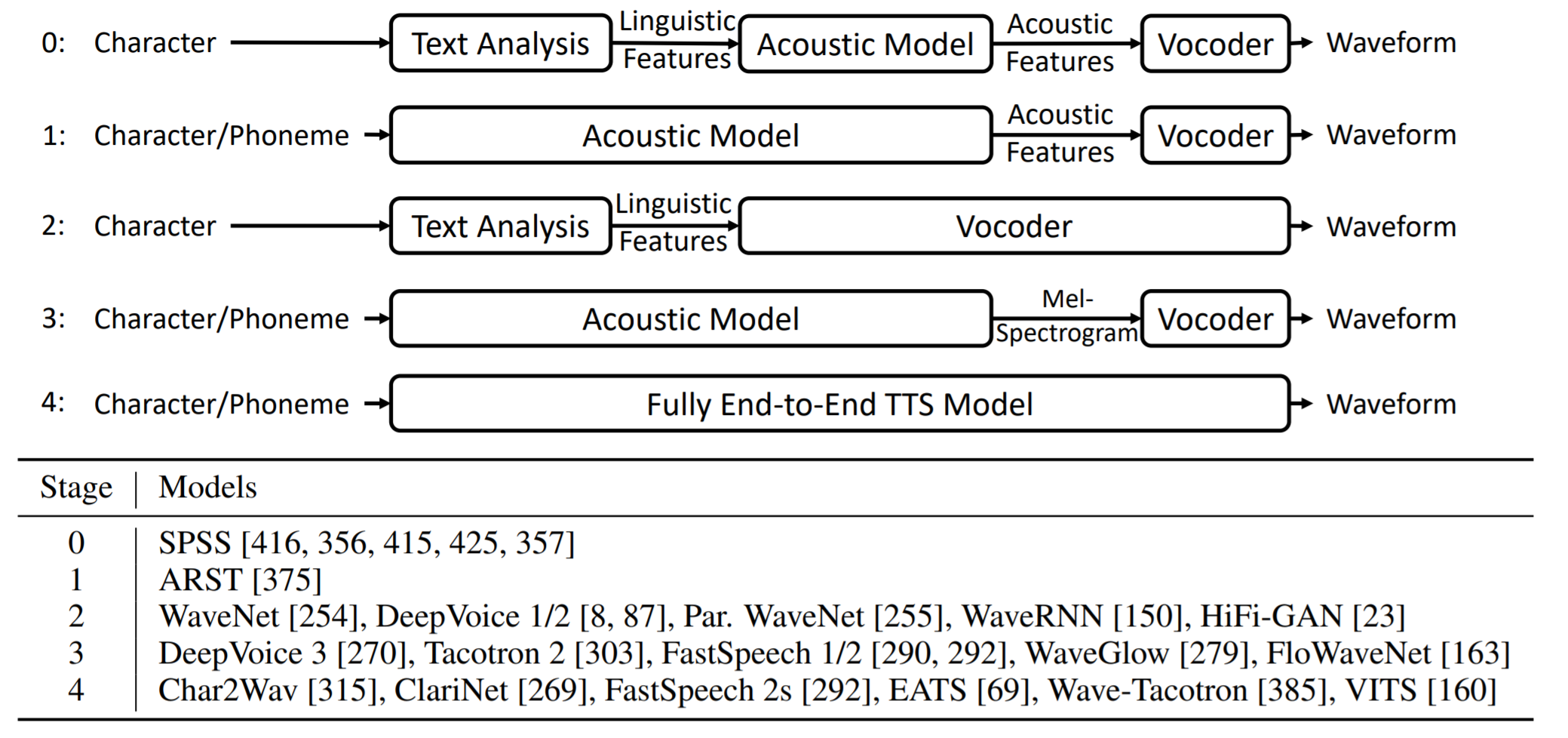
Here is the skeleton shared by almost every speech synthesis system, whatever its generation. Three stages, two conversions.
- The text, a string of characters. It gets analysed: where the words are, how they are pronounced, where sentences break. Historically this stage produced phonemes, a language's elementary sounds (the "sh" in "ship" is one phoneme).
- An intermediate representation, and this is the crux of the whole business. Nobody jumps straight from text to a sound signal. You go through a description of the sound to be produced, far more compact than the sound itself. That description is most often a mel spectrogram: a table saying, for each tiny slice of time, which pitches are sounding and how strongly. A score for the sound rather than the sound. In recent years this intermediate can also be a sequence of audio tokens, discrete symbols, the subject of the neural audio codecs and audio tokens lesson.
- The audio signal, the waveform, what the loudspeaker actually receives: tens of thousands of values per second. The module that builds sound from the intermediate representation is called a vocoder.
Why the intermediate? Because text and sound have wildly different densities. A ten-word sentence fits in sixty characters but lasts three seconds of audio, which at 24 kHz is roughly 75,000 numbers. Going straight from one to the other would ask a single model to decide what to say and what it physically sounds like at the same time. So the job is cut in two: one model decides the shape of the sound, another builds it.
The instinctive guess is that the hard part is pronouncing words correctly. It has not been for a long while: pronouncing "colonel" or "Beauchamp" is a largely solved problem, unfamiliar words included.
The real difficulty is prosody, that is, intonation (the melody of a sentence, where the voice rises and where it falls) and rhythm (how long each syllable lasts, where the pauses go and how long they are). It also covers emphasis: which word gets pushed forward.
Why is that hard? Because prosody is not in the text. The written line "You're sure." can be a calm statement, an incredulous question or a reproach, three prosodies for identical characters. So the model has to invent information its input does not contain, and invent it consistently across a whole sentence, sometimes a whole paragraph. That is what explains the signature failure of mediocre systems: every word correctly pronounced, and the whole thing still sounding wrong, every sentence on the same contour, pauses in the wrong places, a question that never rises at the end.
It is also why recent architectures handle rhythm and timbre separately: see the division of labour described for Voxtral TTS on the Voxtral page, where one part "holds the thread of the utterance" and the other "sculpts the timbre".
How Does Modern Speech Synthesis Work?
Human speech is a complex signal that simultaneously encodes word meaning, intonation, voice timbre, rhythm, and emotions. Modern models break this problem into simpler steps, and the history of the field is the history of those steps progressively merging.
Bark (Suno AI): The Progressive Layer Approach
Bark works like a sculptor progressively refining their work, in four successive passes:
- Semantic stage: the model reads your text and generates "semantic tokens", abstract representations of what each word should sound like, including meaning and intent
- Coarse stage: a second model translates these semantic tokens into approximate acoustic tokens, the basic sound structure is in place, but not yet the details
- Fine stage: a third model refines the acoustic tokens by adding clarity, precise timbre, subtle nuances
- Audio conversion: a vocoder (like EnCodec) transforms the final acoustic tokens into actual sound waves
What sets Bark apart: it also generates non-verbal elements, laughter, breathing, hesitations ("um..."), sighs. Which is to say, prosody rather than just words. This is what makes the voice sound alive, beyond simple monotone reading.
The limitations: quality is uneven depending on the text and language, and fine control over vocal style is limited. Sometimes brilliant, sometimes disappointing.
Licence: the weights published on Hugging Face are under the MIT licence, so commercially usable.
ElevenLabs: The Commercial Champion
ElevenLabs has established itself as the reference in production, for reasons of service as much as of model: cloning a voice from a short recording, broad language coverage, tone adjustment without changing voice, and latency low enough for live dialogue.
An earlier version of this page stated "29 languages" and "latency under 300 ms" as facts. Those values come from ElevenLabs' commercial documentation, shift from one model version to the next, and are backed by no published measurement protocol. Because the service is closed, no outsider can verify or reproduce them.
Treat them as announcements, not measurements: the language count depends on the exact model (multilingual, flash, turbo…) and the latency depends on the network as much as on the model. See how to read a benchmark score.
Licence: proprietary service, reachable only through the API. There are no weights to download, so the only legal question is the terms of the service contract, not a model licence.
For commercial applications that need consistent quality without running your own GPU infrastructure, ElevenLabs is the pragmatic choice: simple API, streaming generation for conversation, usage-based billing. The trade-off is depending on a third party for a service that may process recordings of identifiable voices, worth a hard look if the data is sensitive.
F5-TTS: The Flow Matching Approach
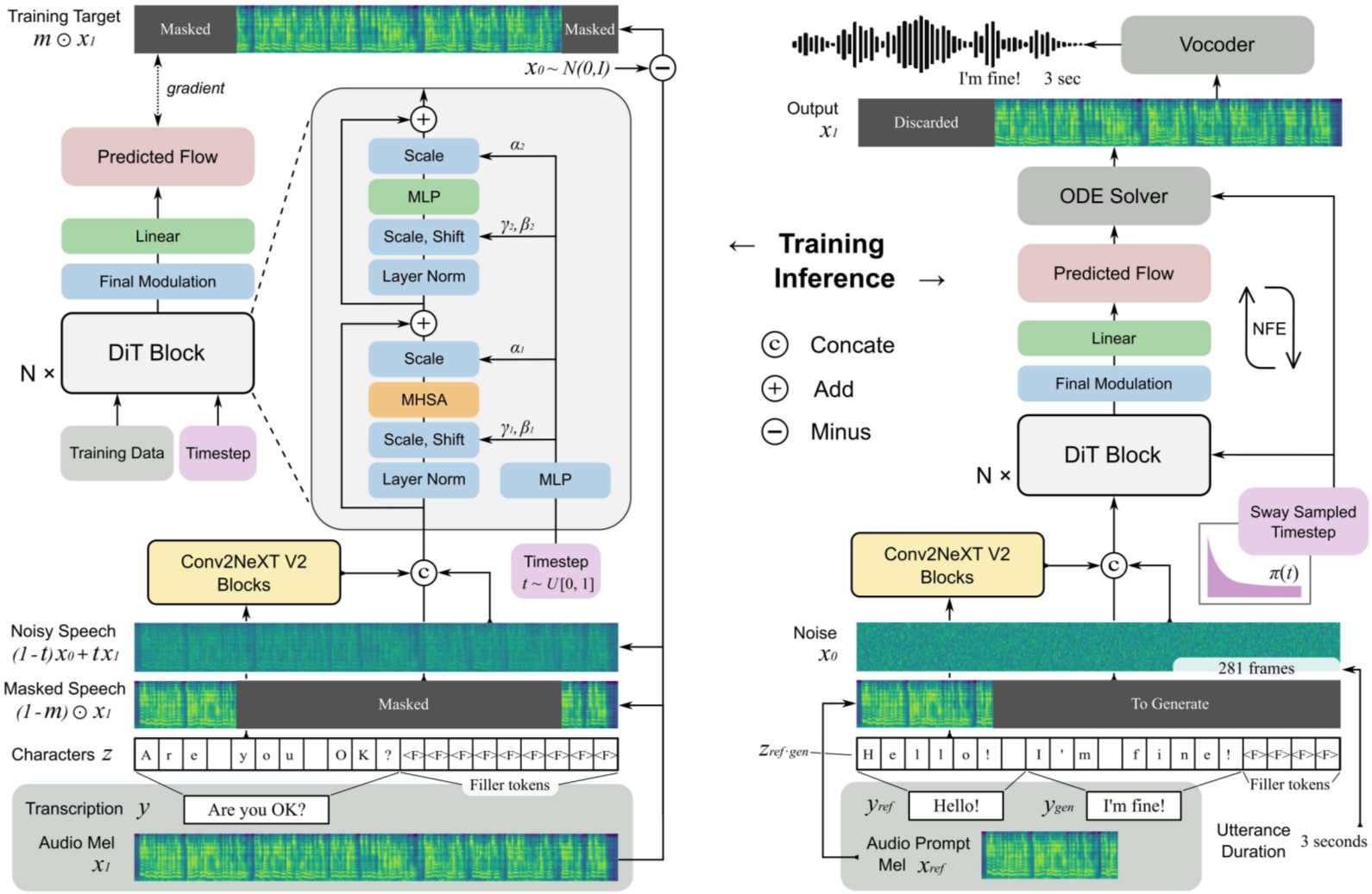
F5-TTS borrows a technique from the image generation world, flow matching: instead of Bark's stack of levels, it builds the complete spectrogram by progressively denoising it, in one continuous process, no semantic stage followed by an acoustic stage.
The analogy: Bark builds sound layer by layer, like a painter doing the sketch, then the base colours, then the details. F5-TTS makes the whole picture appear at once, like an image sharpening from blur. One confusion to avoid: "one process" does not mean "one computation". The denoising runs over several successive iterations on the same image; what disappeared are the stages of different kinds, not the repetitions. The mechanism is detailed in the score-based models and flow matching lesson.
F5-TTS (Chen et al., 2024)What the paper claims, in its own numbers: training on a public multilingual dataset of 100,000 hours, and an inference real-time factor of 0.15, about 0.15 seconds of compute per second of audio produced, so roughly seven times faster than real time. The authors also claim zero-shot cloning (no retraining on the target voice) and switching languages mid-sentence.
Concrete advantages:
- Simpler architecture, fewer failure points between stages
- No seam artifacts between levels, since there are no longer any levels
- Code released under the MIT licence, active community
The code of F5-TTS is released under the MIT licence, which is permissive. But the weights published on Hugging Face are under CC BY-NC 4.0, the NC standing for non-commercial.
These are two distinct legal objects, and it is the second that governs a deployment: holding the code under MIT does not permit commercial exploitation of a model whose weights are non-commercial. The shorthand "it's open source" flattens exactly that distinction.
Other Notable Players
VALL-E (Microsoft)
The pioneer of zero-shot voice cloning (nothing is retrained: you show the model a sample and it imitates). The paper's abstract reports pre-training on 60,000 hours of English speech and synthesis of a personalised voice from a 3-second enrolled recording. The authors also note that the model carries over the emotion and the acoustic environment of the reference clip, so considerably more than timbre alone. Historically decisive: this is the paper that established "treat audio like text" as the main road.
VALL-E (Wang et al., 2023)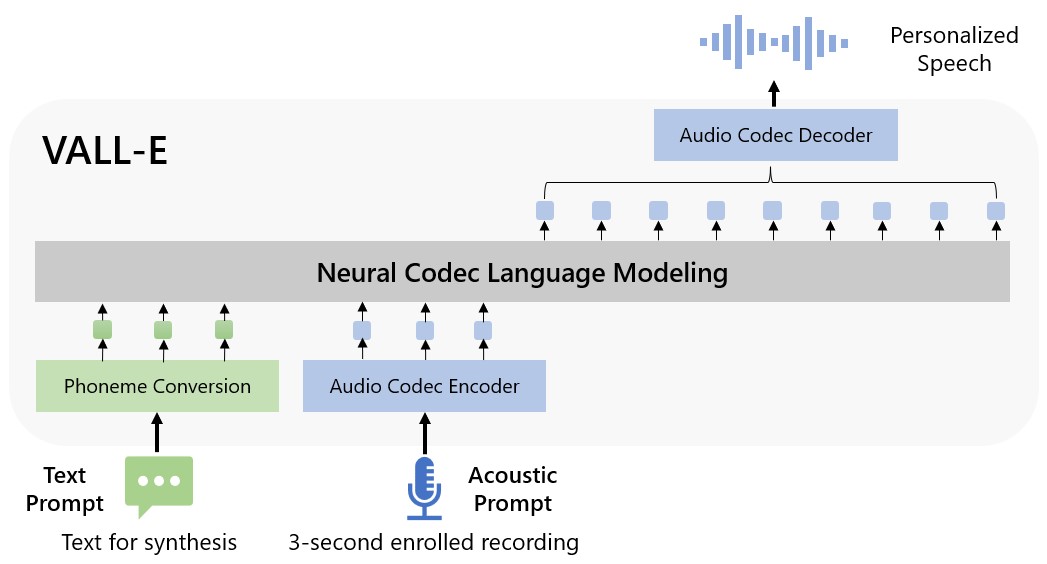
XTTS (Coqui)
The XTTS-v2 model card lists 17 languages (English, Spanish, French, German, Italian, Portuguese, Polish, Turkish, Russian, Dutch, Czech, Arabic, Chinese, Japanese, Hungarian, Korean, Hindi) and cloning from a 6-second clip. Its asset: it runs entirely locally, with no dependency on a remote service, valuable when the audio must not leave the building.
But mind the licence: the weights are not under a standard open-source licence. They are released under the Coqui Public Model License (CPML), a bespoke licence that restricts commercial use. As with F5-TTS, the Coqui toolkit itself is under MPL-2.0: software licence and model licence are not the same thing.
Parler-TTS (Hugging Face)
An original approach: instead of supplying a reference recording, you describe the voice you want in text ("warm and calm female voice, with a slight Southern accent") and the model produces it. Handy when you have no voice sample, and legally interesting, since you are then starting from nobody's voice. Weights released under the Apache 2.0 licence, so commercially usable.
OpenAI TTS
Simple and effective: a small set of preset voices and a minimalist API. No voice cloning, which also removes the consent question. Proprietary service; the number of available voices changes across versions, so check the current documentation.
Voxtral TTS (Mistral)
Covered in detail on the Voxtral page. Two things to carry away here. Technically, it is an autoregressive plus flow-matching hybrid that dispenses with the residual-quantization stack, cloning from a few seconds of reference. Legally, and this is the point that matters most for a legal reader: Voxtral TTS's weights are released under CC BY-NC 4.0, therefore non-commercial, while most of the Mistral range is Apache 2.0. Licensing is not uniform even within one model family; it has to be checked model by model, version by version.
Licence Before Demo
For this course, licensing is a first-order property, on a par with quality. Here is where the systems named on this page stand. Every value comes from the official model card or the corresponding code repository.
| System | Code licence | Weights licence | Commercial use of the weights |
|---|---|---|---|
| Bark (Suno) | MIT | MIT | yes |
| F5-TTS | MIT | CC BY-NC 4.0 | no |
| XTTS-v2 (Coqui) | MPL-2.0 (toolkit) | Coqui Public Model License | restricted |
| Parler-TTS | Apache 2.0 | Apache 2.0 | yes |
| Voxtral TTS (Mistral) | – | CC BY-NC 4.0 | no (API route or separate agreement) |
| ElevenLabs | proprietary | weights not released | service contract |
| OpenAI TTS | proprietary | weights not released | service contract |
Three habits this table should install:
- Code and weights carry separate licences. Three of the systems above pair permissive code with weights that are not. Saying "it's open source" answers no useful question.
- Voice cloning needs two permissions, not one. The model licence says what you may do with the model. It says nothing about the consent of the person whose voice is reproduced. An Apache 2.0 licence does not authorise cloning someone's voice.
- Licences change. Bark, for one, has not always been under MIT. Check the card as of the deployment date, not a blog post.
Technical Corner: How to Measure AI Voice Quality?
| Measure | What it does |
|---|---|
| MOS (Mean Opinion Score) | Human listeners rate the voice from 1 (bad) to 5 (excellent), and the ratings are averaged. Closest to what actually matters, and the most expensive. |
| WER (Word Error Rate) | You feed the synthetic voice to a speech recognition system and compare its transcript with the original text. Mind the direction: it is an error rate, so lower is better. The arithmetic is on the Whisper page. |
| Voice similarity | Distance between the voice print of the synthetic voice and that of the original, almost always a cosine similarity. It evaluates a clone, not a quality. |
| PESQ (Perceptual Evaluation of Speech Quality) | A score computed by a formula meant to imitate the ear's judgement. Automatic, therefore reproducible, but originally designed to grade a degraded telephone transmission, not a fully synthetic voice. |
An earlier version of this page claimed that a "MOS above 4.5" means listeners can no longer tell the voice from a human one. That threshold does not exist.
A MOS is not an absolute quantity: it is the mean rating of a given panel, on given clips, under given instructions. Change the panel, the language, the clip length or the wording of the scale, and the same voice gets a different number. This is why careful papers always have the system and its reference rated in the same campaign, and never compare a MOS against one published elsewhere. In many studies, genuine human speech does not itself reach 4.5.
The only defensible statement is a relative one: "in this test, the system scores a MOS not significantly different from that of the human reference recording." See how to read a benchmark score.
Ethics: When Your Voice Is No Longer Your Own
Cloning a voice from a few seconds of recording is an extraordinary capability. But also a dangerous one.
With this technology, someone can clone your voice and make it say anything in your name: phone fraud, a fake audio message sent to your family, misleading content for disinformation. Serious platforms require explicit consent from the person whose voice is reproduced and embed an inaudible watermark in the generated audio, meant to let anyone later recognise that it was machine-made.
Two caveats worth keeping. First, a watermark is only a safeguard if the tool used puts one there, downloaded weights of a freely licensed model will not necessarily do so. Second, how well such watermarks survive a simple re-encoding or compression is an open research question, not a settled fact.
Where Is Speech Synthesis Heading
- Cloning from ever shorter clips: recent papers are down to a few seconds of reference. No date or duration to announce here, the direction is clear, the next milestone's number is not.
- Precise control: emotion, pace, breathing, pauses, that is, prosody, driven by a written instruction rather than a voice clip.
- Multilingual with preserved identity: one voice changing language without losing its character. See on the Voxtral page the case of cross-lingual voice adaptation, which appeared without being explicitly trained for.
- Streaming generation: latency low enough for real dialogue, which pushes designers to cut the number of stages between text and sound.
- On the phone: local execution, no remote service, for privacy and responsiveness.
Speech synthesis has passed a tipping point: on consistency, multilingualism and availability, a machine beats a voice actor without argument. On getting the intonation right across a long, ambiguous text, the gap is still real. And the constraint that will decide what you may do with it is no longer technical: it is consent and licensing.
1. What is the real difficulty of speech synthesis today?
2. The code of F5-TTS is released under the MIT licence. Does that mean the model can be deployed commercially?
3. How does VALL-E clone a voice from only 3 seconds of recording?
4. A vendor announces that its voice reaches « a MOS of 4.6, above the 4.5 indistinguishability threshold ». What is that argument worth?
5. A project wants to clone a speaker's voice with a model under the Apache 2.0 licence. What else is needed?