Process Reward Models (PRM) vs Outcome Reward Models (ORM)
The Fundamental Problem: How Do You Judge Reasoning?
You're training a model via reinforcement learning (the basics are here) to solve math problems, or you're generating a hundred solutions and need to pick the best one. Either way, you need a judge. That's the role of the reward model (introduced in the RLHF lesson), and there are two radically opposed philosophies:
- Judge the outcome: is the final answer correct? Reward the entire reasoning as a block.
- Judge each step: is each reasoning step correct? Reward what's good, penalize what's off.
This is the distinction between ORM (Outcome Reward Model) and PRM (Process Reward Model). And this choice has profound consequences.
Let's Verify Step by Step (Lightman et al., 2023)An ORM is a teacher who only looks at the final answer on the paper. If it's 42, it's right. If it's 43, it's wrong. Regardless of the reasoning.
A PRM is a teacher who grades every line of the work, notes in the margin "good approach here," "sign error there." The student gets precise feedback on where they did well and where they went wrong.
Which of the two students improves faster?
ORM: Judging Only the Outcome
How It Works
You present the model with the question, the complete reasoning (treated as a black box), and the final answer. The ORM simply responds: "correct answer () or incorrect ()"?
That's it. No feedback on intermediate steps.
Advantages
- Simplicity: you just need to verify if the final answer is right or wrong
- Easy data: no need to annotate each step, just the answer
- Universality: works on any type of reasoning, even when steps are hard to delimit
The Major Problem: Reward Hacking
A model can arrive at the right answer by pure luck or through completely wrong reasoning, and the ORM rewards it anyway.
Problem: , find Reasoning: "Hmm... I'll guess... 5?" Answer: 5 ORM: "Correct!" (even though the model understood nothing)
The ORM rewarded luck, not skill. Over the long term, the model can learn misleading shortcuts rather than real reasoning.
The other problem is the sparse signal: a single bit of information (correct/incorrect) for a 10-step reasoning. The model knows "something went wrong," but not where in the reasoning chain.
PRM: Judging Each Step
How It Works
Each reasoning step is evaluated independently:
Problem: , find
- Step 1: ✓ (equation correctly stated)
- Step 2: ✓ (subtraction correct)
- Step 3: ✓ (division correct)
- Answer: ✓
It's a dense signal: the model knows exactly which step is good and which one is problematic.
The Cost of Annotation
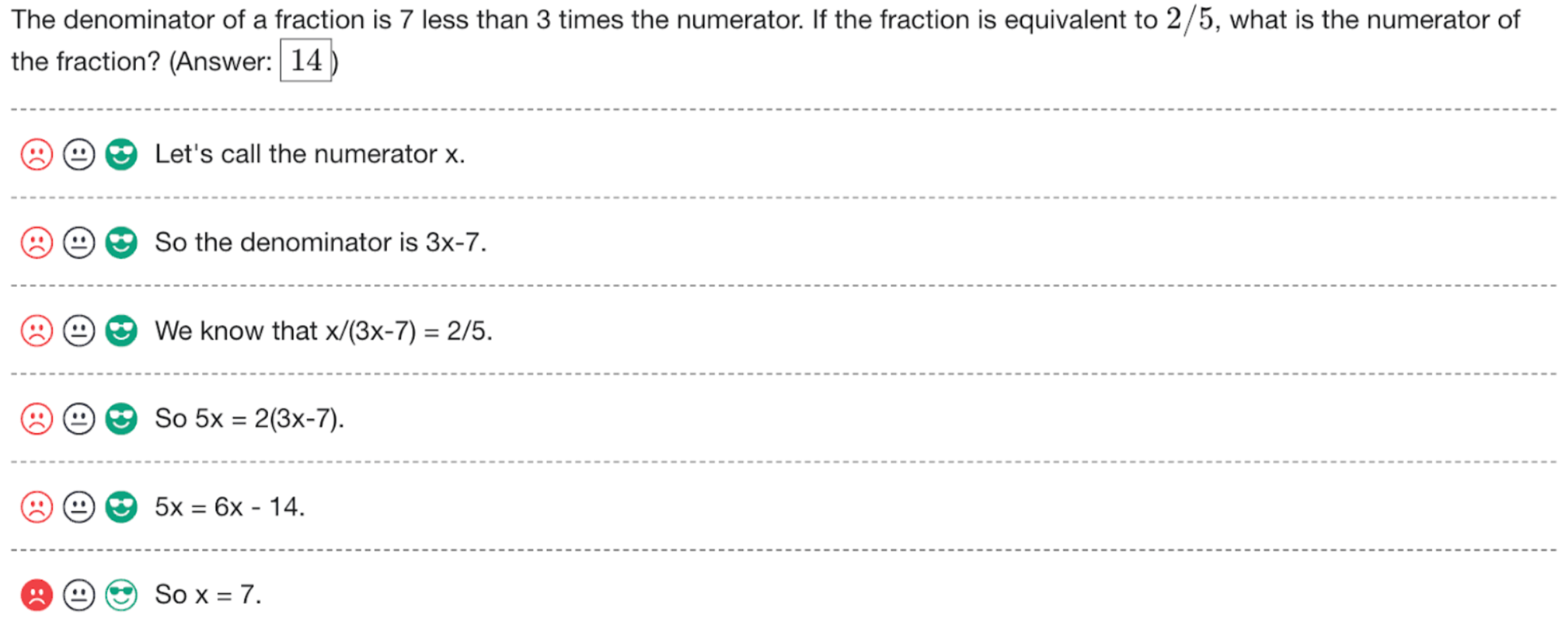
That's the price to pay: each step must be annotated by someone able to judge whether it's correct. For their foundational paper, OpenAI had human annotators produce the PRM800K dataset: 800,000 step-level labels (the figure is in the paper's abstract). This isn't the kind of work you outsource to annotators with no math skills.
The Decisive Advantage
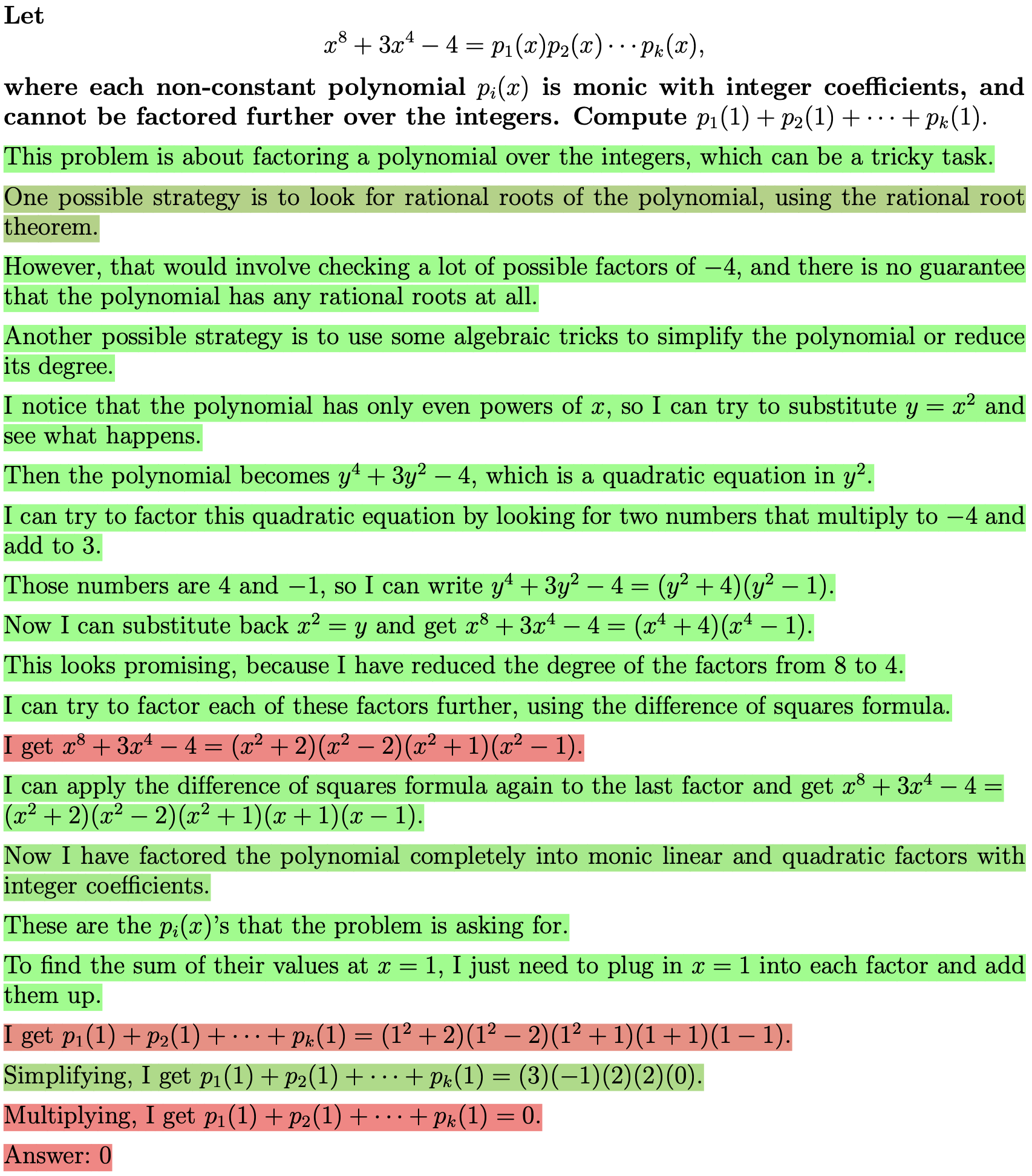
The PRM identifies and penalizes incorrect reasoning even when it arrives at the right answer by chance:
Problem: , find
- Wrong step: "I divide 15 by 4, which gives 3.75" ✗
- Correction: "Oh no, I divide 15 by 3, which gives 5" ✓
- Answer: 5 ✓
The ORM says "well done" for the final answer. The PRM says "careful, your first step was wrong" and penalizes that bad habit.
Empirical Results
Lightman et al.'s paper (OpenAI) on the MATH benchmark, in best-of-N selection: generate N = 1860 solutions per problem, and let the reward model pick the one it judges best.
| Method | Solved (best-of-1860) |
|---|---|
| ORM | 72.4% |
| PRM | 78.2% |
The PRM finds 5.8 extra points of solutions by eliminating false positives, those solutions that land on the right answer through wrong reasoning. (The paper's abstract announces "78% of problems from a representative subset of the MATH test set"; the figure below gives the exact values.)
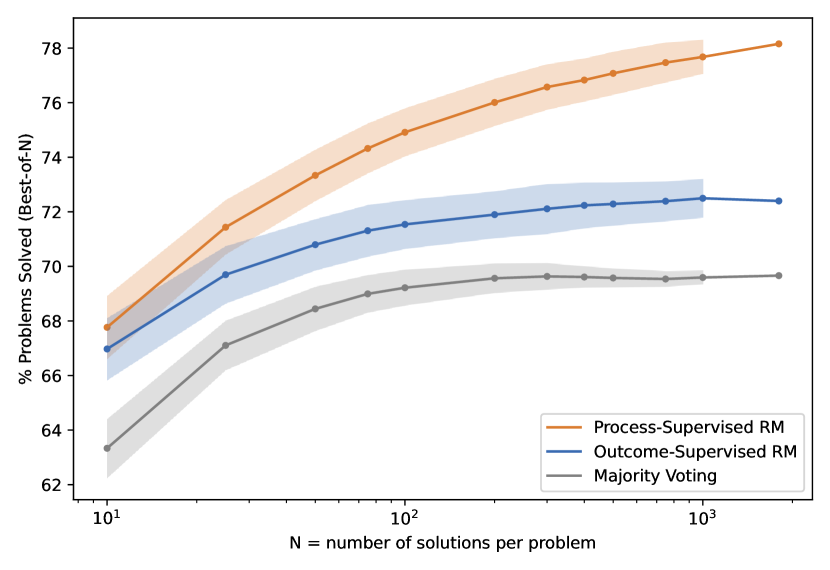
An important precision: Lightman et al. did not train a model by RL with their PRM. They compared the two kinds of reward models as selectors of solutions (best-of-N), and showed that step-level supervision produces a markedly more reliable judge than outcome-level supervision. The dense signal (feedback at each step) systematically outperforms the sparse signal (feedback only at the end). This result has oriented all subsequent research on reasoning.
Direct Comparison
| Aspect | ORM | PRM |
|---|---|---|
| Granularity | Final answer only | Each step |
| Training signal | Sparse (1 single signal) | Dense (multiple signals) |
| Data needed | Right/wrong answers | Step-by-step annotations |
| Annotation cost | Low | Very high |
| Selection quality | Good | Better |
| Error detection | Localization impossible | Precise localization |
| Vulnerable to reward hacking | Yes | Much less |
Practical Use Cases
Best-of-N Guided by PRM
solutions = [model.generate(problem) for _ in range(100)]
scores = [prm.score_steps(problem, sol) for sol in solutions]
best = solutions[argmax(min_step_score(scores))]
You generate 100 solutions, and the best one is the one where all steps are judged correct by the PRM. An ORM would simply choose the solution with the best overall score, potentially missing lucky reasoning.
MCTS Guided by PRM
In a tree search, each node represents a reasoning step. The PRM evaluates each node independently. Branches with well-scored steps are explored more deeply. This is the natural synergy between PRM and MCTS.
RL with PRM as Reward
Instead of giving a signal only at the end of reasoning, each step receives PRM feedback during RL training. The model learns where it does well and where it makes mistakes, not just whether the final answer is correct.
A caveat, though: this is the most fragile of the three use cases. A PRM is a learned model, hence hackable by the optimization, the DeepSeek-R1 paper reports trying PRMs for its large-scale RL and giving up on them, precisely because of reward hacking and re-annotation cost. The topic is developed in the RLVR lesson.
The PRM shines on domains where steps are clearly delimited and verifiable: math, code, formal proofs.
For fuzzy reasoning (literary analysis, philosophical argumentation), splitting into steps is ambiguous and annotation is subjective. In these cases, the ORM remains more pragmatic.
Hybrid Approaches and Automation
ORM + Light Verification
A pragmatic compromise: the ORM evaluates the overall score, and a lightweight verifier (code execution, symbolic computation) checks individual steps when possible. Less perfect than a true PRM, but much cheaper.
Automatic PRM (Without Human Annotators)
Human annotation doesn't scale. The alternative:
- Generate many solutions via CoT
- Verify the final answer automatically
- Use heuristics to estimate each step's quality (Monte Carlo estimation: a step is "good" if reasoning paths that pass through it often lead to the correct answer)
It's less precise than an expert-annotated PRM, but it's feasible at the scale of millions of examples.
A PRM is only as good as its annotations. Poorly trained annotators or vague criteria produce an unreliable PRM that can be worse than a simple ORM.
OpenAI invested in human annotators able to judge competition-level solutions to build PRM800K. The quality of the human expertise behind the annotations makes all the difference.
Why PRM Is Essential for Scaling
Want to do tree search (MCTS) on reasoning? The PRM is essential for guiding exploration efficiently.
The ORM only gives a signal at the tree's leaf (the final answer). To navigate the tree, you need to evaluate intermediate nodes, and only the PRM can do that. Without a signal on the branches, MCTS explores blindly.
This is why the PRM is a foundational building block of test-time compute scaling. As search methods become more sophisticated, the need for a fine and precise reward signal becomes critical.
Perspective
The PRM embodies a shift in philosophy: instead of rewarding only the destination (the right answer), you reward the path (the right reasoning). It's a better learning signal, and it produces models that truly reason rather than guess.
As automatic verifiers improve (formal proofs, code execution, symbolic tools), the PRM's scope of application expands beyond math into science, engineering, and planning.
1. A reasoning chain starts with a wrong step, corrects itself along the way, and lands on the right answer. How do the ORM and the PRM react?
2. What did Lightman et al. actually demonstrate in the paper « Let's Verify Step by Step »?
3. The DeepSeek-R1 paper reports trying PRMs for its large-scale RL, then giving up on them. Why?
4. You need to rank philosophical essay arguments generated by a model. PRM or ORM?