Mistral Enters the Reasoning Game
OpenAI's o1 launched the reasoning model race. DeepSeek-R1 democratized it in open-source. Now Mistral, Europe's AI champion, enters the arena with Magistral.
And true to its transparency philosophy, Mistral offers something that neither OpenAI nor DeepSeek provide as clearly: a fully visible chain of thought. You don't just receive the answer, you see exactly how the model arrived at it.
Unlike o1 (whose thinking remains hidden), Magistral shows you its complete reasoning. The reasoning tokens are visible in the response. You can read the step-by-step thinking process, identify exactly where an error crept in, and judge for yourself whether the reasoning is sound.
Architecture and Training
Two Recipes for Two Models
The Magistral paper (June 2025) describes one starting point and two paths, and the first is the more interesting:
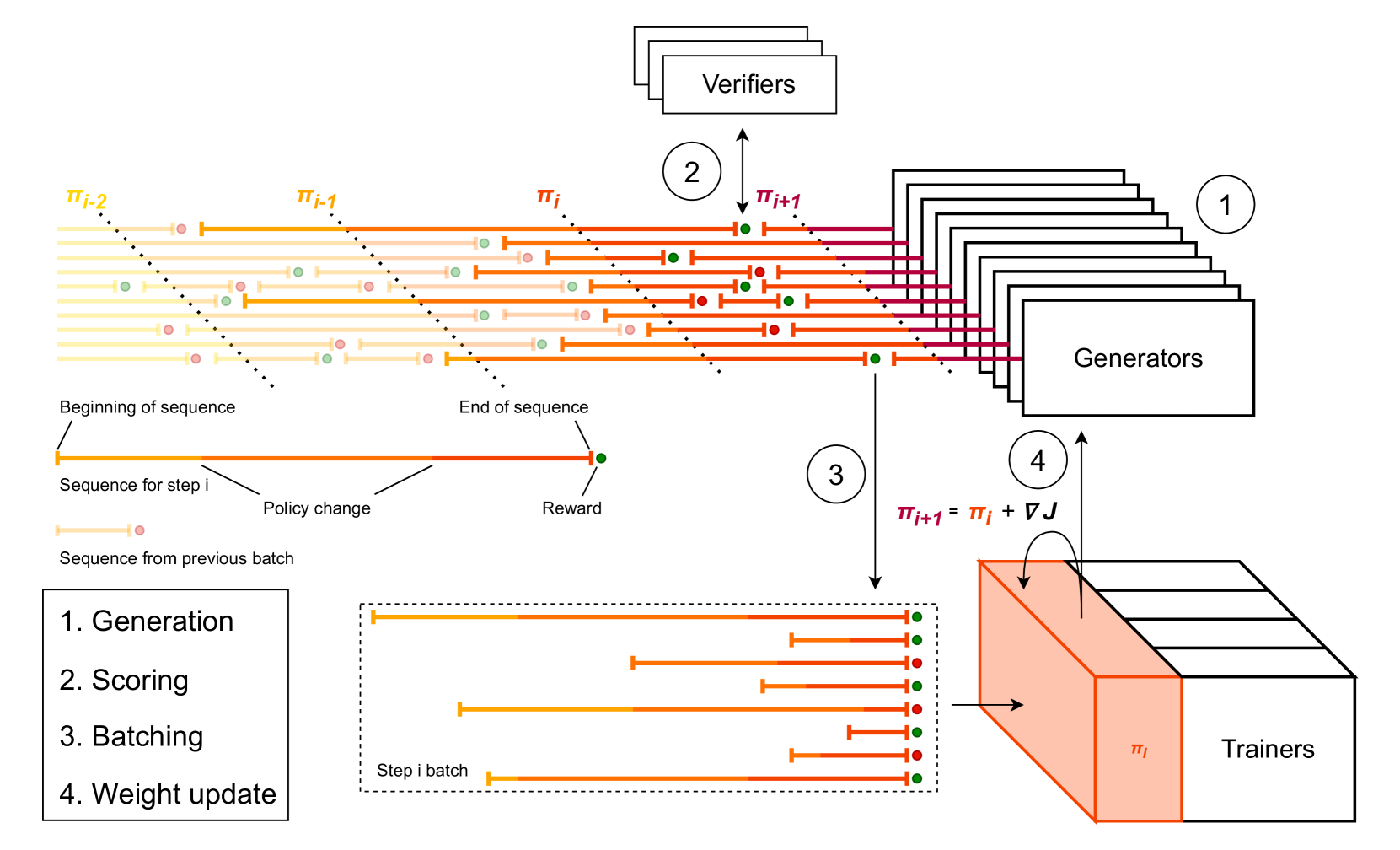
- Magistral Medium starts from Mistral Medium 3, an already trained and aligned model, and is obtained through reinforcement learning alone (RL, the basics are here), with verifiable rewards on math and code problems: no imitation phase on chains of thought. Mistral stresses that everything is done in-house, without distilling the reasoning traces of an existing model such as R1.
- Magistral Small starts from Mistral Small and combines both ingredients: a cold-start SFT on the reasoning traces produced by Magistral Medium, then RL on top.
In other words: the large model learns to reason through pure reinforcement, and the small one first learns by copying the large one, distillation within a single house.
The Structured Chain of Thought
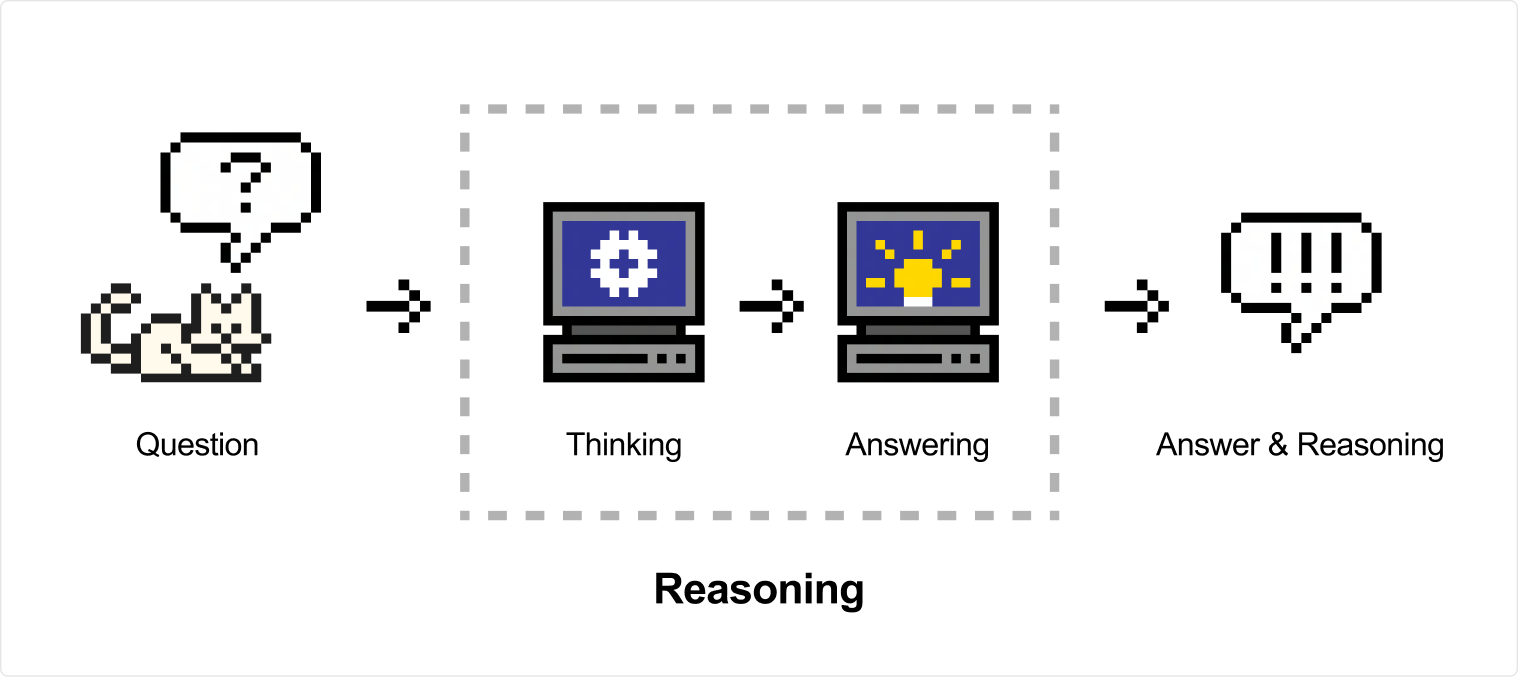
What distinguishes Magistral is the readability of its reasoning. The format is structured and explicit:
<thinking>
The problem asks to find...

Step 1: Identify the variables
  x = unknown
  3x + 15 = 42

Step 2: Set up the equation
  3x + 15 = 42

Step 3: Solve
  3x = 42 - 15 = 27
  x = 27 / 3 = 9

Verification: 3(9) + 15 = 27 + 15 = 42 ✓
</thinking>

The answer is x = 9.
It's clear, structured, and most importantly verifiable. You can follow each step and immediately spot if something is off. It's the difference between a student who shows you their scratch work and one who just gives you the final answer.
The Two Variants
Magistral Small
The open model, 24 billion parameters, released as open weights under the Apache 2.0 license:
- Deployable locally on common hardware
- Low latency, suitable for interactive applications and prototyping
- The community can study it, adapt it, redistribute it
Magistral Medium
The proprietary model, available through the API and Le Chat:
- Noticeably deeper reasoning than Small
- Handles more complex problems reliably
- The choice for production when every performance point counts
Small = local deployment, full sovereignty over the weights, prototyping. Medium = production, best performance, via the API.
Concrete Performance
The numbers Mistral published, on AIME 2024 (math competition), under both protocols (pass@1 vs majority voting, refresher here):
| Model | AIME 2024 (pass@1) | AIME 2024 (maj@64) |
|---|---|---|
| Magistral Medium | 73.6% | 90.0% |
| Magistral Small | 70.7% | 83.3% |
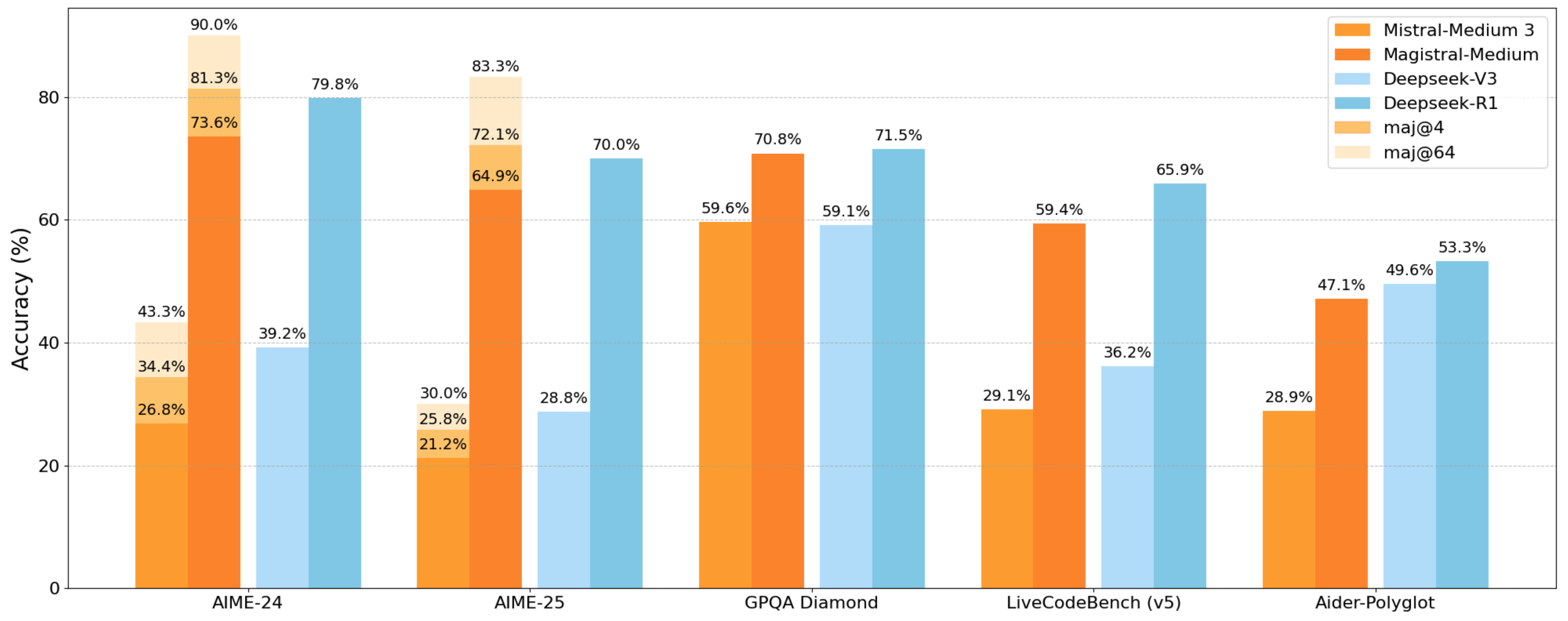
The gain delivered by reasoning can be read off the figure below: the same base model goes from 26.8% to 73.6% on AIME-24 once trained to reason. That's exactly what the chain of thought delivers, and here, you can read it in full.
Technical Corner: Why Transparency Changes Everything
Concrete Advantages of Visible Reasoning
Unlike hidden-reasoning models (like o1), Magistral's transparency opens up practical possibilities:
- Debugging: when the answer is wrong, you see exactly which step the reasoning went off track. No need to guess
- Trust: you can read the reasoning and decide for yourself whether the logic holds up, instead of blindly trusting
- Education: in pedagogical contexts, showing the solving process is as important as giving the answer
- Regulatory audit: for applications in regulated sectors (finance, healthcare), reasoning traceability isn't a bonus, it's a requirement
Granular Control via the API
The Mistral API allows fine-grained configuration of Magistral's behavior:
- Limit the number of thinking tokens to control costs
- Force or disable reasoning mode per request
- Access thinking tokens separately in the API response
This level of control is valuable for production integration.
Integration into the Mistral Ecosystem
Magistral doesn't live in isolation, it integrates into Mistral's complete lineup:
- Le Chat: conversational interface with integrated reasoning
- La Plateforme: unified API for all Mistral models
- Agents: Magistral as the reasoning engine for autonomous agents
- Pixtral + Magistral: reasoning on visual content
The Vision + Reasoning Combo
The combination of Pixtral (vision) and Magistral (reasoning) is particularly powerful for tasks that require visual analysis followed by reasoning: interpreting complex graphs, solving geometry problems from a figure, or analyzing technical diagrams.
Problems that require first understanding an image, then reasoning about it, are exactly the niche for the Pixtral + Magistral combination. Diagram analysis, visual data interpretation, geometry, that's where this synergy truly shines.
The Global Positioning
| Model | Visible thinking | Open-source | Multimodal | European |
|---|---|---|---|---|
| o1/o3 | No | No | Yes (o3) | No |
| DeepSeek-R1 | Yes | Yes | No | No |
| Magistral | Yes | Partial | Via Pixtral | Yes |
| Gemini Thinking | Partially | No | Yes | No |
| QwQ (Alibaba) | Yes | Yes | No | No |
Magistral occupies a unique position: transparency + quality + European sovereignty. For European companies and institutions concerned about digital sovereignty, that's a strong argument.
The reasoning model landscape changes every month. The scores and positioning presented here are a snapshot at a given moment. Check recent benchmarks and most importantly test on your own use cases before making a decision.
Mistral's Complete Strategy
Magistral illustrates how Mistral is building a complete ecosystem:
- Text: Mistral Large (the generalist)
- Code: Codestral (the development specialist)
- Vision: Pixtral (multimodal)
- Reasoning: Magistral (deep thinking)
All with a resolutely European approach: transparency, data sovereignty, accessibility. It's a coherent vision of what an AI company should offer in a world that's asking more and more questions about the governance of artificial intelligence.
1. What does Magistral offer that o1 does not, and why is it decisive in a regulated industry?
2. How was Magistral Medium trained to reason, according to the June 2025 paper?
3. On AIME-24, the score jumps from 26.8% to 73.6% between the first two orange bars of the figure. What exactly is being compared?
4. Your team wants to prototype locally, with full sovereignty over the model weights. Which Magistral variant should you pick?