SAI: Superhuman Adaptable Intelligence (Goldfeder, LeCun et al., 2026)
SAI: Superhuman Adaptable Intelligence, LeCun's Post-AGI Vision
In February 2026, Yann LeCun co-signs (with Judah Goldfeder, Philippe Wyder and Ravid Shwartz-Ziv) a paper that doesn't propose a new model, not a new architecture, but a conceptual framework shift for all AI research. His thesis: the concept of AGI (Artificial General Intelligence) is a scientifically flawed objective, and it needs to be replaced with something measurable and actionable.
AI Must Embrace Specialization via Superhuman Adaptable Intelligence (Goldfeder, Wyder, LeCun, Shwartz-Ziv, 2026)Why AGI Is a Bad Objective
LeCun begins with a devastating assessment of the term "AGI" itself.
An Overloaded and Ill-Defined Term
The term AGI is used inconsistently by practically everyone. For some researchers, AGI means a system capable of passing any human cognitive test. For others, it's an autonomous agent capable of replacing a human worker in any job. For still others, it's an artificial consciousness. Three radically different definitions, a single acronym.
The result: no stable operational definition. This is a fundamental scientific problem. An objective you can't precisely define is an objective you can't measure, and an objective you can't measure is an objective you can't verifiably achieve.
The Illusion of Human Generality
LeCun's most powerful argument is the following: humans are "general" only from the inside looking out. We evaluate intelligence relative to our own distribution of tasks. We judge a system as "general" if it can do what we can do. But that's a massive anthropocentric bias.
A human is incapable of perceiving ultrasound, navigating by echolocation, processing a million documents in parallel, or solving a system of equations with 10,000 variables mentally. Our "generality" is actually a biological specialization on a very narrow subset of all possible problems.
The No Free Lunch Theorem
LeCun draws on the No Free Lunch theorem of Wolpert and Macready: no single algorithm can be optimal on all problems. It's a mathematical result, not an opinion. Any performance gain on one class of problems necessarily comes at a loss on other classes.
Seeking a "general" system that excels at everything is therefore not just difficult, it's theoretically impossible. AGI, as fantasized, is a mathematical mirage.
The term AGI has three fatal flaws:
- No stable definition, everyone puts whatever they want into it.
- Based on anthropocentric bias, we measure "generality" relative to human capabilities.
- Theoretically impossible, the No Free Lunch theorem forbids a universally optimal algorithm.
LeCun's conclusion: AGI is not a scientific objective, it's a marketing slogan.
What SAI Proposes Instead
A Change of Question
Instead of asking "can the system match humans on all tasks?", LeCun proposes a different and far more productive question: "how fast can the system learn something new?"
It's a complete reversal of perspective. You no longer measure coverage (how many tasks), but adaptation speed (how long to master a new task).
The Key Metric: Adaptation Time
LeCun introduces a formal metric: , the time needed for a system to reach superhuman performance on a new task. It's measurable, comparable, and allows you to plot progress curves.
A system with a low is a system that learns fast. An ideal SAI system would have tending toward zero across a wide range of important tasks.
Definition of SAI
SAI = Superhuman Adaptable Intelligence: a system capable of learning to surpass humans on any important task, and capable of filling gaps where humans are fundamentally incapable.
The keywords are crucial:
- Superhuman, not "as good as," but "better than."
- Adaptable, the capacity for rapid learning, not static coverage.
- Intelligence, real cognitive skills, not pattern matching.
Embracing Specialization
Unlike the fantasy of a single universal model, SAI explicitly embraces specialization. A SAI system is a collection of specialized modules, each excellent in its domain, that collaborate to cover a broad spectrum of skills. It's more biologically realistic (the human brain is modular) and theoretically sounder (consistent with the No Free Lunch theorem).
| AGI | SAI | |
|---|---|---|
| Question | "Can it do everything?" | "How fast can it learn?" |
| Metric | Task coverage | Adaptation time |
| Architecture | One universal model | Collaborative specialized modules |
| Reference | Human performance | Superhuman performance |
| Theoretical basis | Vague | Compatible with No Free Lunch |
The Technical Roadmap
LeCun doesn't just criticize AGI. He proposes a concrete roadmap for building a SAI system, articulated around three pillars.
1. Self-Supervised Learning: Learning Without Annotations
The first pillar is self-supervised learning, and more specifically JEPA (Joint-Embedding Predictive Architectures). The fundamental idea: an intelligent system must be able to learn the structure of the world without human supervision, simply by observing.
JEPAs work by learning to predict latent representations rather than raw pixels or tokens. This is a crucial distinction from classic generative models: instead of predicting every detail of the next input (which is expensive and useless), the system learns to predict the essentials, the abstract structure.
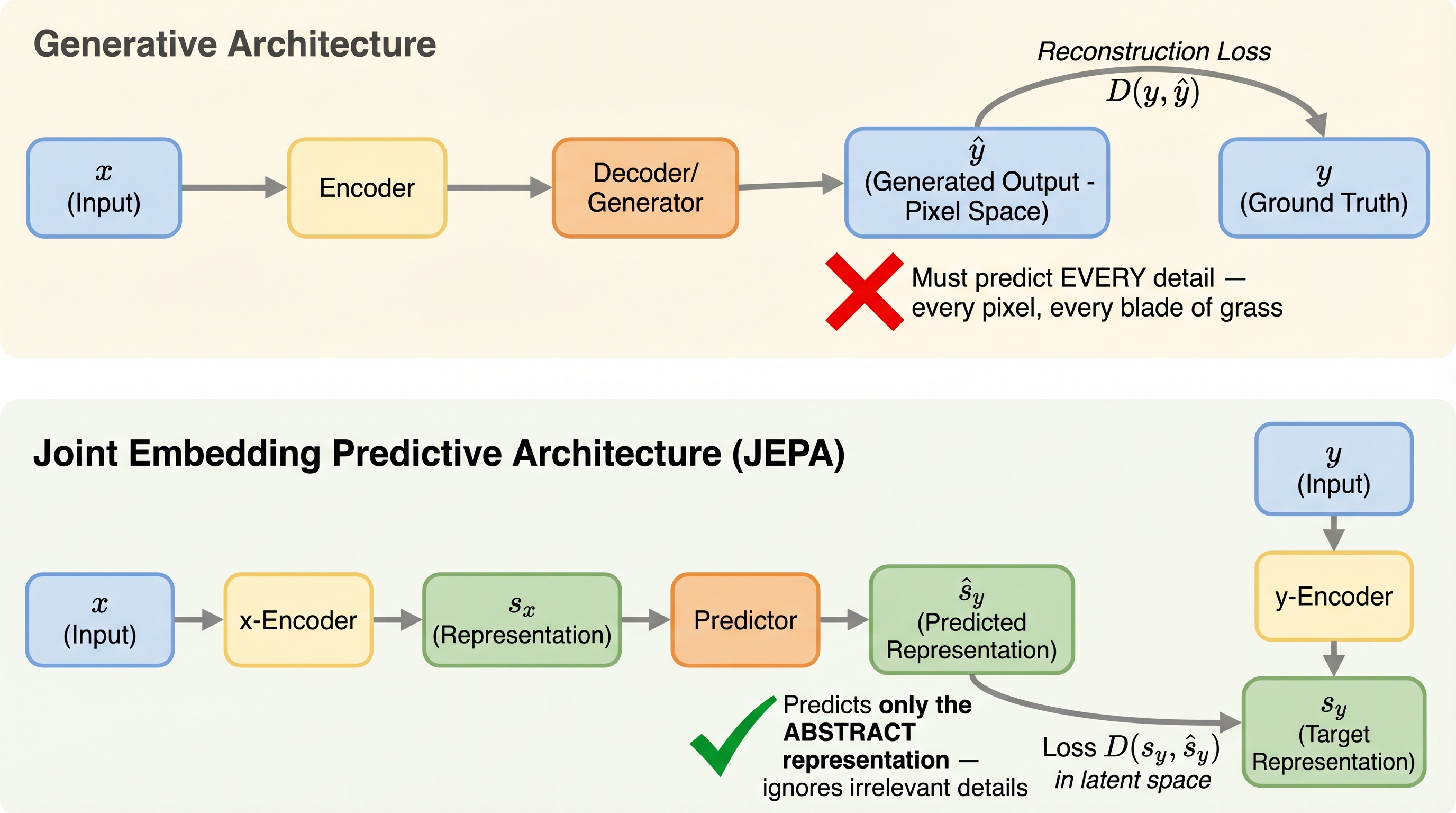
According to LeCun, this is exactly what the human brain does: we don't predict every photon that will hit our retina, we predict the causal structure of what will happen.
2. World Models: Simulating the World to Plan
The second pillar is building world models, internal simulators that allow the system to:
- Predict the future: "if I do X, what will happen?"
- Plan: "what sequence of actions leads me to the desired result?"
- Simulate consequences: mentally test actions before executing them in the real world.
This is the foundation of what LeCun calls "System 2" intelligence (referencing Kahneman): slow, deliberate reasoning based on internal simulation rather than reflexive responses.
World models are at the heart of the LeWorldModel project and, more broadly, of world-model research.
3. Modular Architecture: Against the Single Model
The third pillar is a head-on opposition to the dominant autoregressive paradigm (the next-token prediction of LLMs). For LeCun, predicting the next token is an architectural dead end for achieving true intelligence.
His proposal: a modular architecture where multiple specialized systems collaborate:
- A perception module (vision, audio, text)
- A world model for simulation and planning
- A short-term and long-term memory module
- An action and decision-making module
- A "configurator" that orchestrates everything based on the task
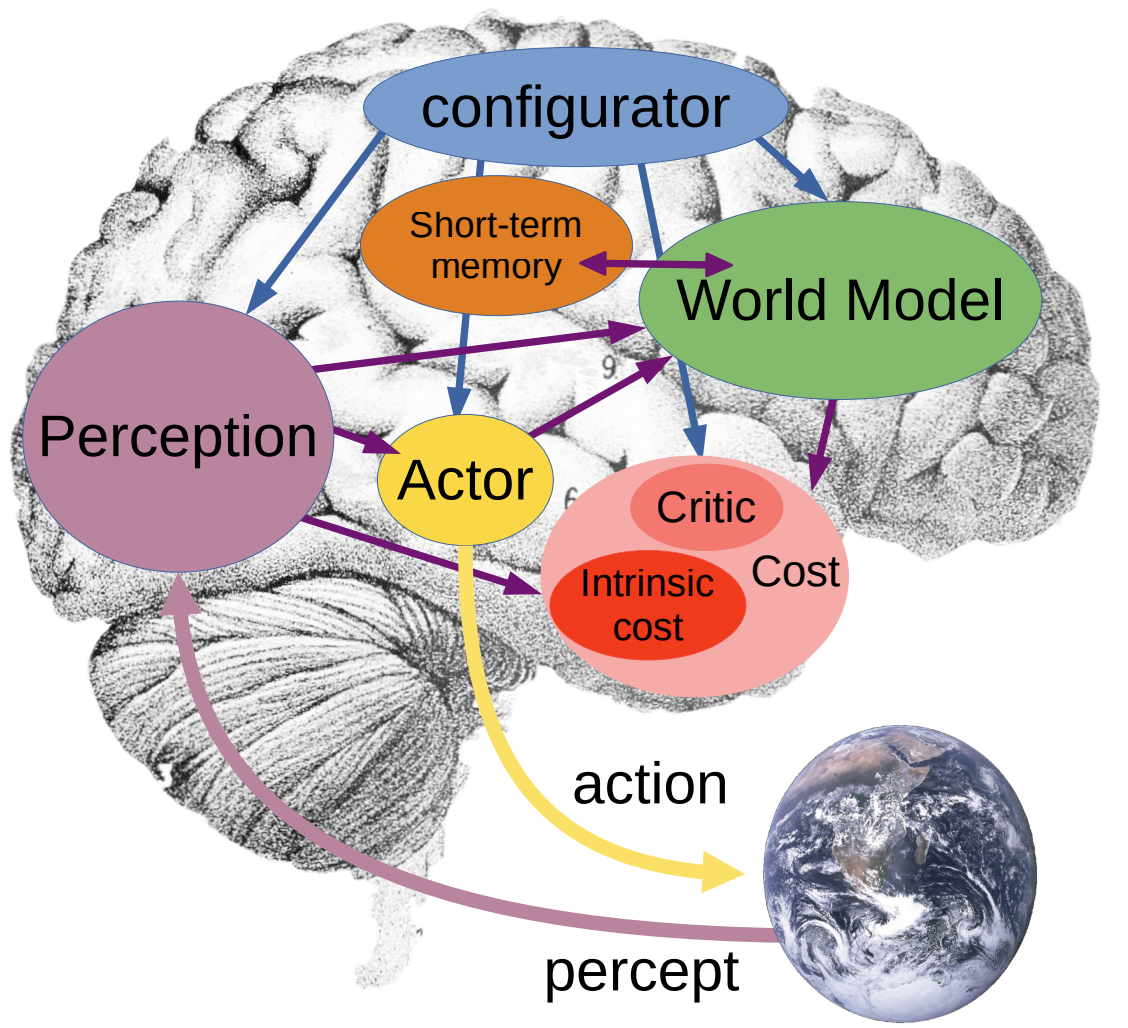
Each module can be optimized independently, and new modules can be added without retraining everything, hence the rapid adaptability.
- JEPA / Self-Supervised Learning, learn the structure of the world without annotations, by predicting abstract representations.
- World Models, an internal simulator to predict, plan, and reason before acting.
- Modular Architecture, specialized modules that collaborate, rather than a single autoregressive model.
LeCun vs LLMs
LeCun's position on LLMs is unambiguous: autoregressive language models are a wrong path toward achieving true intelligence.
The Fundamental Limitations According to LeCun
His main arguments:
- LLMs don't understand the world, they model the statistical distribution of text. That's not the same thing.
- Next-token prediction is a training objective that wastes enormous capacity on irrelevant details (predicting every word, every comma).
- LLMs don't have an internal world model usable for planning.
- Scaling up won't solve these structural problems. "Scale is not enough", structure and the right learning paradigm matter more than model size.
AMI Labs: Betting Against LLMs
LeCun has put his money where his mouth is by founding AMI Labs (Advanced Machine Intelligence), which raised $1.03 billion. The company's mission is explicitly to build intelligence systems based on world models, not language models.
It's a massive and deliberate industrial bet against the dominant paradigm. While virtually the entire industry invests in ever-larger LLMs, LeCun is going all-in on a fundamentally different approach.
The Critiques
LeCun's paper didn't achieve unanimity, and several critiques deserve examination.
Goertzel: "This isn't new"
Ben Goertzel, a historic figure in AGI research, responded that SAI is merely a particular parameterization of his own EPGI framework (Efficient Pursuit of General Intelligence). According to him, the ideas of specialization and rapid adaptation are already contained in existing theoretical frameworks. LeCun is rebranding known concepts under a new acronym without a fundamentally new contribution.
The Question of Utility
SAI proposes measuring adaptation on "important tasks," but the notion of utility remains vague. Who decides which tasks are "important"? By what criteria? This residual subjectivity weakens SAI's claim to be a more rigorous framework than AGI.
AGI with Additional Constraints?
Some critics argue that SAI is simply AGI with additional constraints (adaptation speed, specialization), not a replacement of the concept. It's a refinement, not a conceptual revolution. The debate remains open on whether this reframing provides real scientific value or is primarily a rebranding exercise.
Why This Matters for the Course
This paper is relevant beyond the terminological debate, for several reasons.
It reframes how we think about AI progress. Instead of asking "when will we reach AGI?", the question becomes "how fast can our systems adapt to new tasks?" That's a measurable and scientifically productive question.
It connects several course concepts:
- JEPAs, detailed in the LeWorldModel lesson, are the learning engine proposed by LeCun.
- World models (dedicated lesson) are the central pillar of the SAI architecture.
- Self-supervised learning is the theoretical foundation of the entire approach.
It structures a debate that shapes the future of the field. The AGI vs SAI debate isn't academic: it influences funding priorities, research directions at major labs, and public discourse about AI. Understanding the terms of this debate is essential for anyone working in the field.
1. According to LeCun's paper, why is AGI a bad scientific objective, beyond being difficult?
2. What does the paper say about the « generality » of human intelligence?
3. What question does SAI substitute for « can the system do everything? », and with what metric?
4. What distinguishes a JEPA from a classic generative model, according to the page?
5. Among the criticisms of SAI the page reports, which one targets the very rigor of the new framework?