The Model That Judges Itself
The starting intuition is simple: if a model can generate an incorrect answer, can it also recognize it as incorrect when asked to verify? The answer is often yes, and it's less paradoxical than it seems.
Generating a good answer and verifying an answer are two tasks of different difficulty. Coming up with a mathematical proof is hard. Checking that a proof is correct is generally easier. Writing a bug-free program is hard. Reading a program and spotting the bug is often more accessible.
Self-verification exploits this asymmetry: the model becomes its own quality controller.
Generating a good answer = hard. Verifying if an answer is good = easier. A model that fails to generate correctly on the first try can still detect the error when shown its own answer. It's like proofreading your exam paper: you see mistakes that you wouldn't have avoided while writing.
Self-Verification Techniques
1. Self-Refine: Iterative Improvement
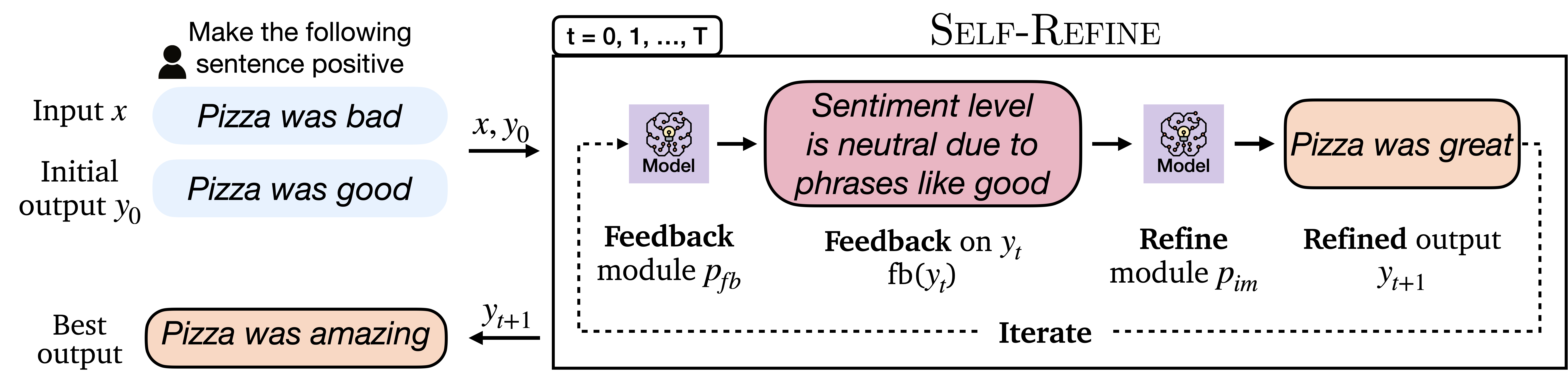
The principle is a dialogue of the model with itself:
- Generate an initial answer
- Ask: "Critique this answer. What are the potential errors?"
- Ask: "Improve the answer taking this critique into account"
- Repeat steps 2-3 until the critique finds no more issues
It's like an author who rereads and revises their manuscript in multiple passes. Each pass catches errors that the previous one missed.
2. Self-Debugging: The Special Case of Code
For code, self-verification has a huge advantage: you can execute the code and get objective feedback.
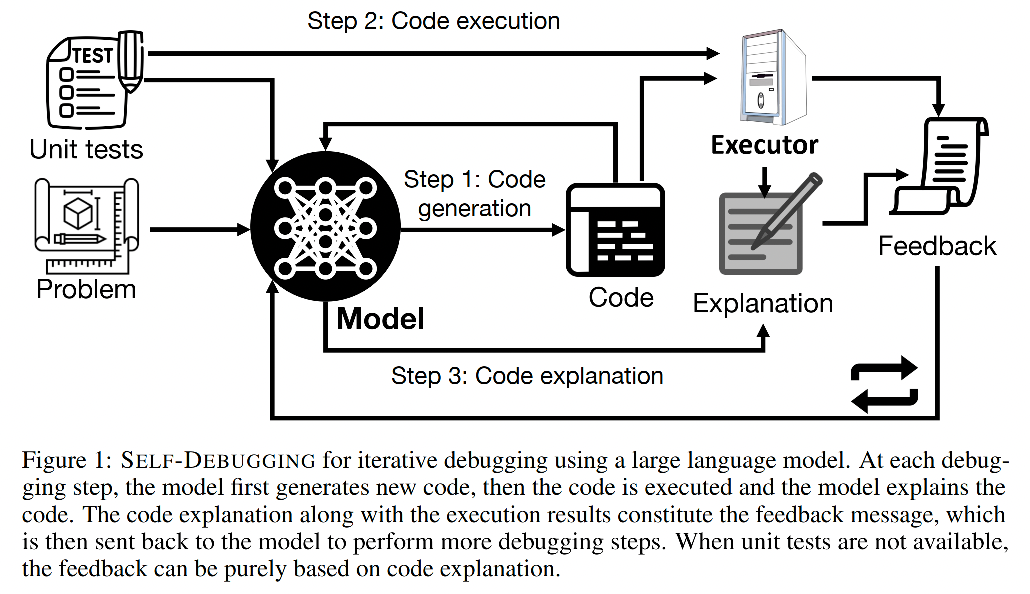
- The model generates the code
- You execute it against tests
- If error: you show the error message to the model
- The model analyzes the error and proposes a fix
- You re-test
The feedback isn't subjective here: the test passes or it doesn't. That's what makes self-debugging so effective compared to other forms of self-verification.
3. Verification by Inversion
An elegant technique: instead of directly verifying whether the answer is correct, you solve the problem in reverse:
Problem: , find Proposed answer: Verification: ✓
Instead of re-deriving the solution, you substitute and verify that it checks out. This pattern is generalizable well beyond math.
4. Constitutional AI (Self-Critique)
The model evaluates its own answer against explicit principles:
- "Is this answer helpful?"
- "Is this answer honest and factual?"
- "Is this answer safe and harmless?"
The model judges itself according to a "constitution" of principles. This is the foundation of alignment at Anthropic.
For math: substitute the answer into the original equation. For translations: translate back into the source language and compare. For summaries: verify that each key point in the summary can be found in the original text.
This inversion pattern is generalizable and remarkably effective. The cost is minimal (one additional call) and reliability increases significantly.
Reflexion: Learning from Mistakes with Memory
The Reflexion framework (Shinn et al., 2023) pushes self-verification further by adding a failure memory:
Reflexion: Language Agents with Verbal Reinforcement Learning (Shinn et al., 2023)- The model attempts to solve the task
- On failure: it generates a reflection ("I failed because I confused X and Y")
- This reflection is stored in memory
- On the next attempt: previous reflections are included in the prompt
- The model avoids previously made errors
The results are spectacular. On HumanEval (code generation), the paper's abstract announces 91% pass@1, versus 80% for the GPT-4 of the time, then state of the art. On AlfWorld (agent tasks in a simulated environment), the paper reports 130 out of 134 tasks solved.
Error memory transforms each failure into learning. Instead of making the same mistakes, the model accumulates experience, like a developer who keeps a bug journal.
The Real Limitations: Don't Overestimate
Can the Model Really Self-Correct?
The honest answer: sometimes yes, often no.
Rigorous studies show that self-correction without external feedback is limited:
| Error Type | Detection by Self-Verification |
|---|---|
| Obvious factual errors | Often detected |
| Subtle logic errors | Frequently missed |
| Hallucinations on unknown topics | Not detected |
| Systematic biases | Reinforced instead of corrected |
Huang et al. (2023) showed that without objective external feedback (code execution, symbolic computation, factual verification), LLMs do not significantly improve through self-correction. The model tends to maintain its initial answer, or worse, degrade it on second thought. Self-verification works mostly when there's an objective anchor.
Large Language Models Cannot Self-Correct Reasoning Yet (Huang et al., 2023)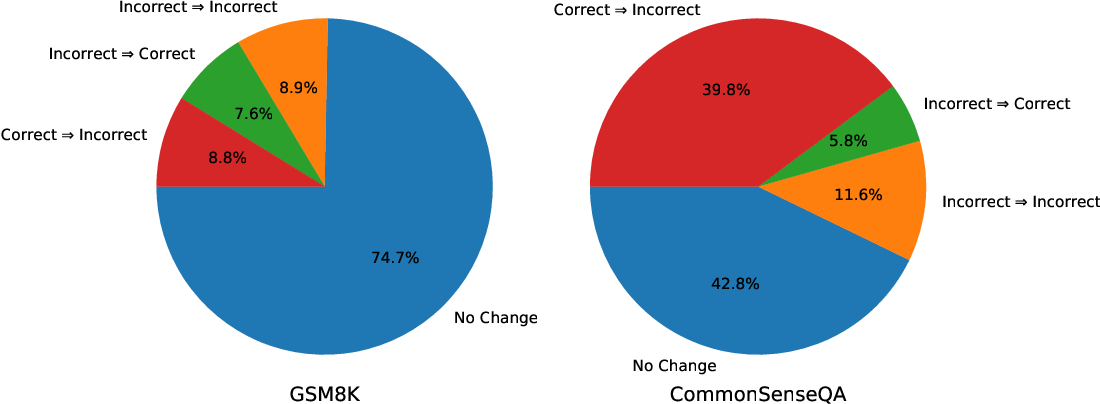
Confirmation Bias
Like a human who defends their opinion rather than looking for their own errors, the LLM has a confirmation bias. "My answer is correct" is more probable in token space than "I was wrong." The model tends to justify its initial answer rather than genuinely questioning it.
Cumulative Cost
Three iterations of critique-improvement consume 4 to 5 times more tokens than the initial answer. It's a significant investment that is only justified if the quality gain is real.
Best Practices for Effective Self-Verification
1. Combine with External Feedback
Self-verification works much better with an objective anchor:
- Code: unit test execution
- Math: verification by substitution or symbolic computation
- Facts: web search verification
- Format: automatic JSON/XML validation
response = model.generate(prompt)
critique = model.generate(f"Critique: {response}")
if execution_test(response) == PASS:
    return response  # No need to improve
else:
    improved = model.generate(f"Fix based on: {critique}")
    return improved
2. Limit Iterations
2 to 3 iterations maximum. Beyond that, the model goes in circles, "fixes" things that didn't need fixing, or degrades the original answer. More is not always better.
3. Use a Different "Judge"
For critique, use a radically different prompt, or better yet, a different model. This reduces confirmation bias: the "judge" doesn't have the same blind spots as the "generator."
Self-verification corrects errors that the model is capable of "recognizing": obvious calculation errors, glaring logical inconsistencies. But it doesn't correct deep hallucinations or biases the model isn't aware of.
It's a reliability multiplier on "dumb" errors, not a universal correctness guarantee.
The Evolution: Internalized Self-Verification
Modern reasoning models (o1, R1) have internalized self-verification into their chain of thought. Instead of explicitly asking the model to "verify your answer," the model verifies itself spontaneously while thinking. It goes back over its steps, tests alternatives, detects its own inconsistencies, all during the generation process.
Self-correction is no longer just a prompting trick. It's a capability that can be trained and integrated directly into the model, a sign of the field's maturation.
1. You simply ask a model to reread its answer and correct it if necessary, with no external feedback. What do the studies cited on this page observe?
2. Why does self-debugging on code work markedly better than other forms of self-verification?
3. The model answered x = 4 to the problem 2x + 3 = 11. According to the inversion principle, what is the most reliable way to have it check its answer?
4. What does the Reflexion framework add on top of the plain critique-and-improve loop?