After o1: Iterating on Reasoning
o1 demonstrated that LLMs could truly reason. The logical next step? Push this capability further and make it more accessible. OpenAI launched o3 and o4-mini to address both of these axes.
A quick note on naming: o2 was skipped to avoid confusion with the British telecom operator O2. But the technical progression is very real and significant at each version.
The pace of evolution of reasoning models is remarkable. o1 (September 2024), o3 announced in December 2024, then o3 and o4-mini released on the same day in April 2025. In less than a year, several generations with tangible gains at each iteration. Since then, OpenAI has unified this entire lineage into GPT-5 (2025), then GPT-5.4 (March 5, 2026) and GPT-5.5 (April 23, 2026): reasoning is now natively integrated, without a separate model. Seven weeks between 5.4 and 5.5, the pace is accelerating.
o3: Deeper, More Versatile Reasoning
o3 retains the fundamental principle of o1 (the invisible chain of thought) but considerably extends its capabilities.
Key Improvements
- Deeper reasoning: longer, better-sustained chains of thought on problems that require many steps, where o1 started to lose the thread
- Tool use during thinking: o3 can use tools (web search, code execution) while it's thinking, not just before or after. It's like a researcher consulting a reference mid-reasoning
- Multimodal reasoning: o3 natively integrates images into its thinking. It can look at a graph, diagram, or photo and reason about it
- Better calibration: o3 is better at evaluating its own certainty, which reduces confident but wrong answers
The Landmark Result: ARC-AGI
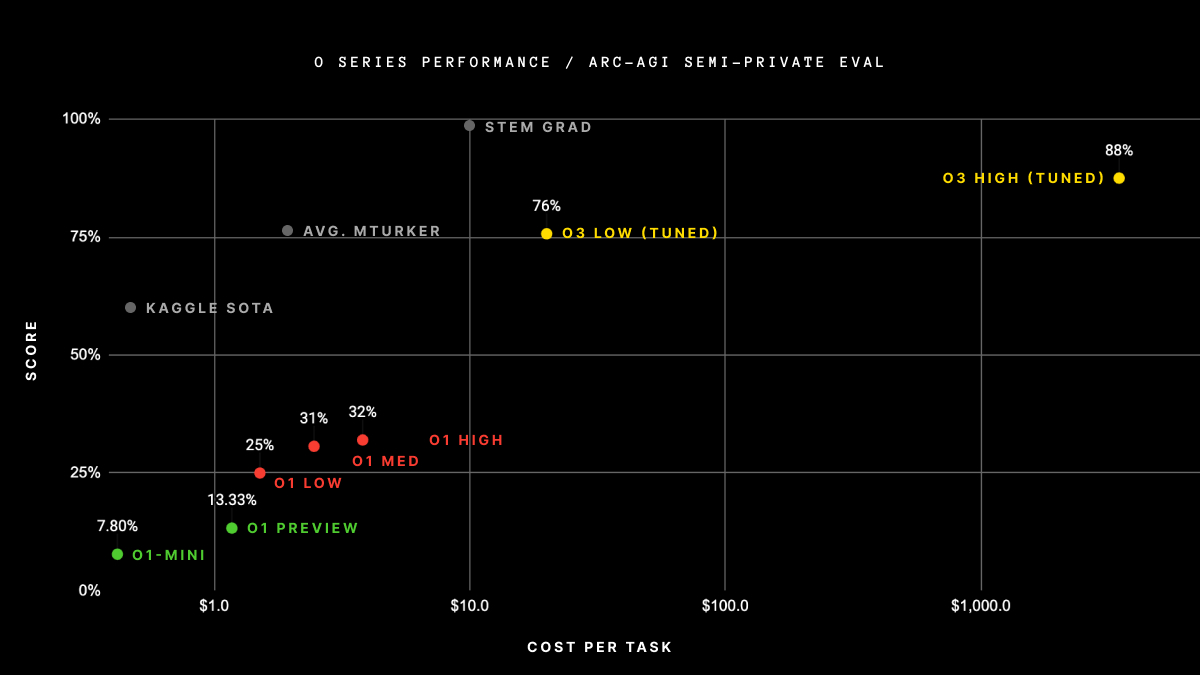
ARC-AGI is a benchmark specifically designed to test abstract reasoning, the type of reasoning that humans do naturally but that resisted AI. Finding patterns in grids, extrapolating rules from a few examples.
o3 with a high compute budget achieves scores close to human level on this benchmark. This is a result the AI community didn't think was achievable this quickly.
Adjustable Compute Levels: Choose Your Investment
o3 introduces an important practical innovation: you can dose the amount of thinking based on the problem:
- Low: quick thinking, few reasoning tokens. For moderate problems
- Medium: the standard balance between quality and cost
- High: deep thinking, many tokens. For the toughest problems
This is a huge efficiency gain: no more paying top dollar for a simple question.
Instead of forcing a uniform thinking level on all problems, being able to choose Low/Medium/High allows easy questions to not waste compute, and hard problems to receive enough. It's a step toward truly adaptive intelligence that doses its effort based on difficulty.
o4-mini: Democratized Reasoning
While o3 pushes the depth of reasoning, o4-mini explores another direction: making reasoning fast and affordable.
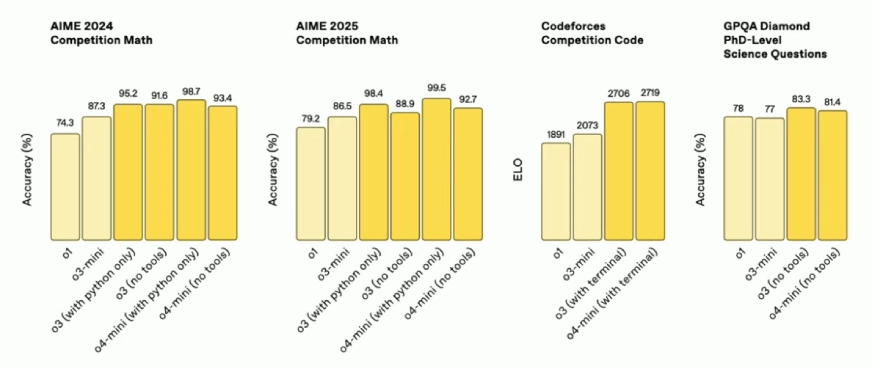
o4-mini is specifically optimized for STEM problems (Science, Technology, Engineering, Math), with a focus on the performance/cost ratio.
Positioning in the Lineup
- Much cheaper than o3, making reasoning accessible for high-volume applications
- Significantly reduced latency: faster responses, suitable for interactive applications
- Competitive performance on math and code: not far from o3 for a fraction of the price
- Same API as GPT-4o: easy migration from a standard model
Strengths and Limitations
o4-mini shines on math and code, its home turf. But its general knowledge is less extensive than o3's, and it's not designed for creative or conversational tasks. It's a STEM specialist, not a generalist.
Comparison: Choosing the Right Model
Prices are OpenAI API prices at each model's launch, per million tokens (input / output), the striking fact being that o4-mini cost less than GPT-4o while reasoning:
| Model | Input / output price | Math | Code | Knowledge | Latency |
|---|---|---|---|---|---|
| GPT-4o | $2.50 / $10 | Good | Good | Excellent | Fast |
| o1 | $15 / $60 | Excellent | Excellent | Good | Slow |
| o4-mini | $1.10 / $4.40 | Excellent | Excellent | Good | Medium |
| o3 | $10 / $40 (cut to $2 / $8 in June 2025) | Excellent | Excellent | Very good | Slow |
Context, spring 2026: o1, o3, and o4-mini have been retired from ChatGPT and unified into GPT-5. The flagship is GPT-5.5 (April 23, 2026), which natively integrates reasoning and targets long agentic tasks: code, data analysis, operating software, multi-tool workflows. Smaller variants offer a better quality-to-cost ratio for everyday use.
The Reasoning Model Ecosystem
OpenAI started the trend, but reasoning has become an intense competitive battleground.
Competing Proprietary Models
- Gemini 3.1 (Google): natively multimodal (text + image + audio + video), very long contexts. Gemini 3.1 Pro reached 94.3% on GPQA Diamond, among the very best scores published in spring 2026
- Claude Opus 4.7 (Anthropic): released April 16, 2026, oriented toward long agentic tasks in production
- Grok 4.20 (xAI): available March 2026, focused on reasoning plugged into real-time X and web data
Open-Source Alternatives
- DeepSeek V4-Pro / V4-Flash: released April 2026, MoE with 1.6T parameters of which 49B active (Pro) or 284B / 13B (Flash), 1M-token context, thinking/non-thinking mode. Among the cheapest frontier models ever published ($0.14 / M input tokens for Flash)
- DeepSeek-R1: the historic lineage, free, MIT license, competitive performance with o1. Proof that reasoning isn't reserved for giant labs
- Qwen-QwQ (Alibaba): open-source reasoning, strong on Asian languages
- Magistral (Mistral): transparent reasoning, developed in Europe
Reasoning is no longer a monopoly. It has become a standard capability that every serious model must offer.
Technical Corner: The "Reasoning as a Service" Paradigm
Reasoning models fundamentally change how AI is billed:
Before: you pay for input tokens + output tokens. That's it.
Now: you also pay for "thinking", the tokens the model uses to think internally.
The cost is dynamic: an easy problem consumes few reasoning tokens, a doctoral-level problem consumes many. Your bill depends on the difficulty of the questions you ask.
The Automatic Router Pattern
An increasingly common architecture pattern: a router that analyzes the difficulty of each request and sends it to the appropriate model.
- Simple request → a small, fast, cheap model (a light GPT-5.5 variant, DeepSeek V4-Flash)
- Complex request → GPT-5.5, Claude Opus 4.7 or DeepSeek V4-Pro (integrated reasoning)
This optimizes overall cost without sacrificing quality on difficult cases.
The o3 vs GPT-4o debate is now obsolete with GPT-5.5 integrating both capabilities. But the principle remains valid: extended reasoning tends to "overthink" simple problems. GPT-5.5 automatically doses reasoning effort based on query complexity.
The Question That Changed
Before reasoning models, the question was simple: "what's the best model?"
Now, it's become a multi-criteria optimization problem: "which model, for this type of problem, with this budget, within this response time, gives the best result?"
OpenAI's reasoning models have transformed model selection into a true engineering problem.
The rest of the story at OpenAI runs through GPT-5, which folds reasoning into a single family then Astra (GPT-6), which reverses o1's promise: more and more of the thinking done silently, in a single pass, and a written chain of thought that says less (see the OpenAI profile).
1. o3 scores 88% on ARC-AGI, close to human level. What important caveat comes with that number?
2. Which o3 novelty, compared with o1, changes the very nature of its thinking?
3. Which launch fact best sums up o4-mini's positioning in the lineup?
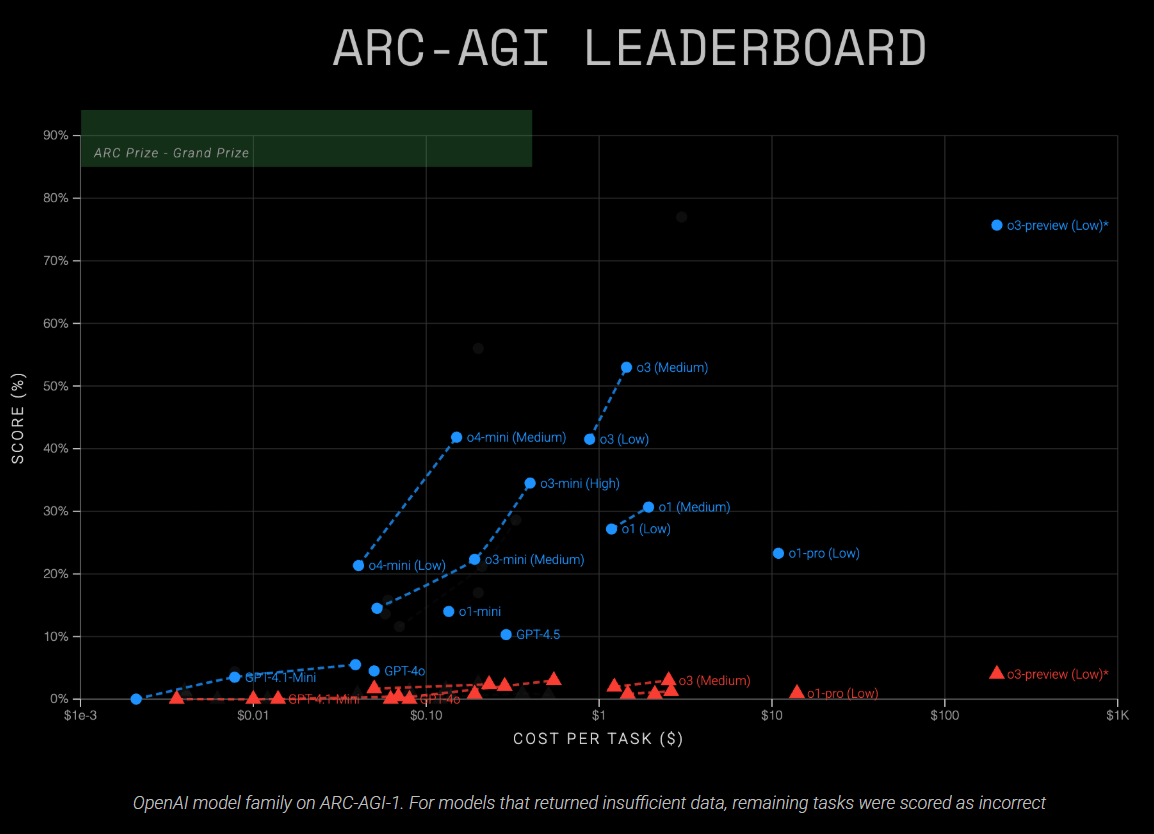
4. On the ARC-AGI cost/score leaderboard, what do the red triangles (GPT-4o and GPT-4.1, the non-reasoning models) teach us?