Neither Pixtral model can still be called on Mistral's Application Programming Interface (API), but not for the same reason, and the distinction is the one that matters when reasoning about a portfolio.
Pixtral 12B was replaced: deprecated on 2 December 2025, removed from the API on 31 December 2025, with the documentation pointing to Ministral 3 14B, another small multimodal model under Apache 2.0. Its weights remain published under Apache 2.0 on Hugging Face: the removal covers the hosted service, not the files. An open licence already granted cannot be taken back.
Pixtral Large was absorbed: its vision capability folded into Mistral Medium 3.5 during the April 2026 consolidation, and the model itself was retired on 31 May 2026.
Replaced is not absorbed. See Pixtral 12B for the detail of the case and the 2026 line consolidation for the broader move. This page describes the architecture, which is still worth knowing: its technical choices carried over into the models that followed.
The problem: the off-the-shelf image encoder
Most vision-language models (VLM) take a perfectly reasonable shortcut: pick up an already-trained image encoder (CLIP, SigLIP) bolt it onto their language model through a small projection module, and train only that module. The full mechanism is described in Vision-Language Models.
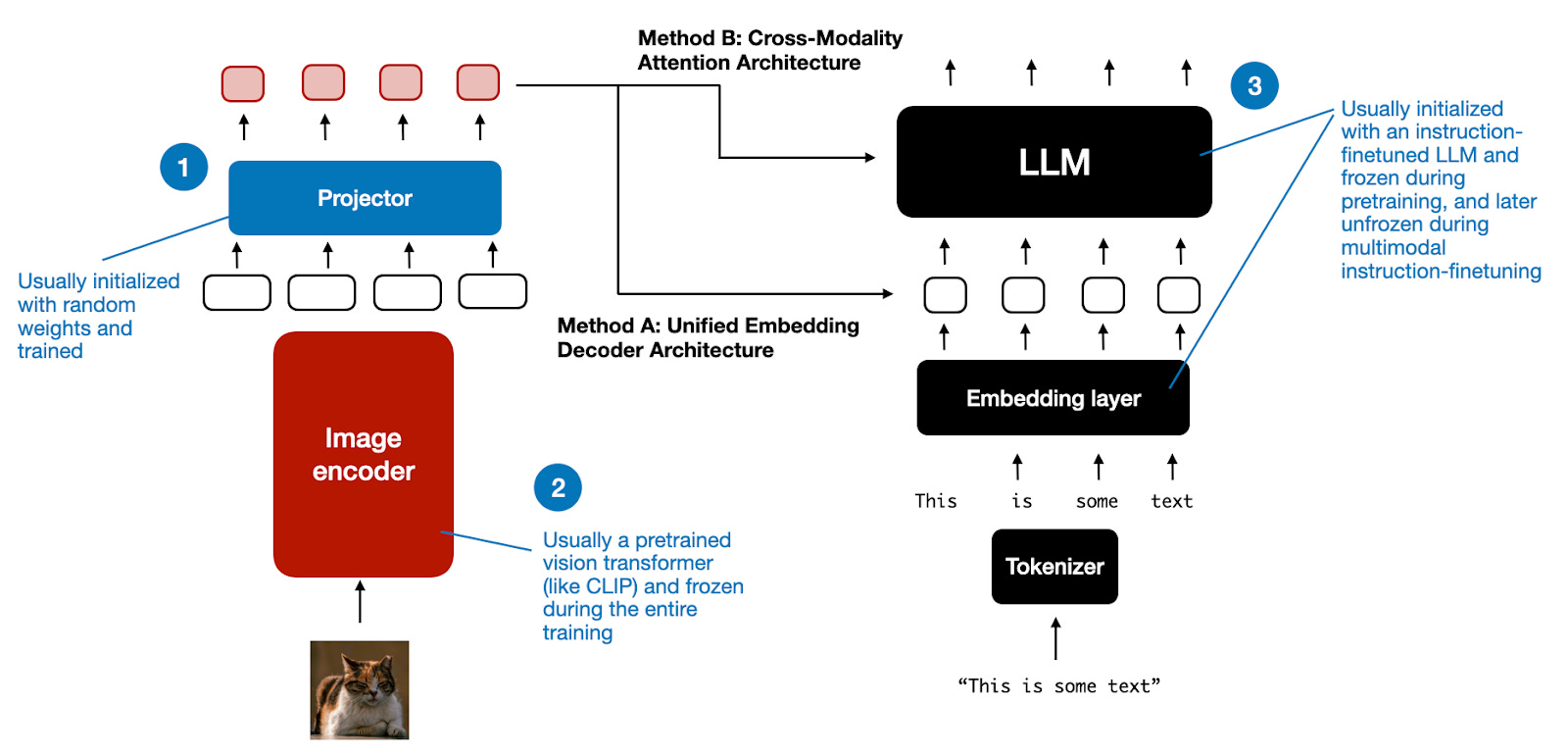
That shortcut carries a precise cost, and it is not a vague matter of "shallow integration." It is that you inherit the constraints of the encoder you borrow. CLIP was trained on square images of fixed size: bolting CLIP on means agreeing to force-resize every input image into that square. For a photograph, fine. For an A4 portrait document whose small print you want to read, that is information lost at the very first step.
So Mistral took the more expensive route: train its own visual encoder from scratch, with a specification requiring it to accept images at their original resolution and aspect ratio.
Pixtral 12B (Mistral AI, 2024)Architecture
Pixtral 12B
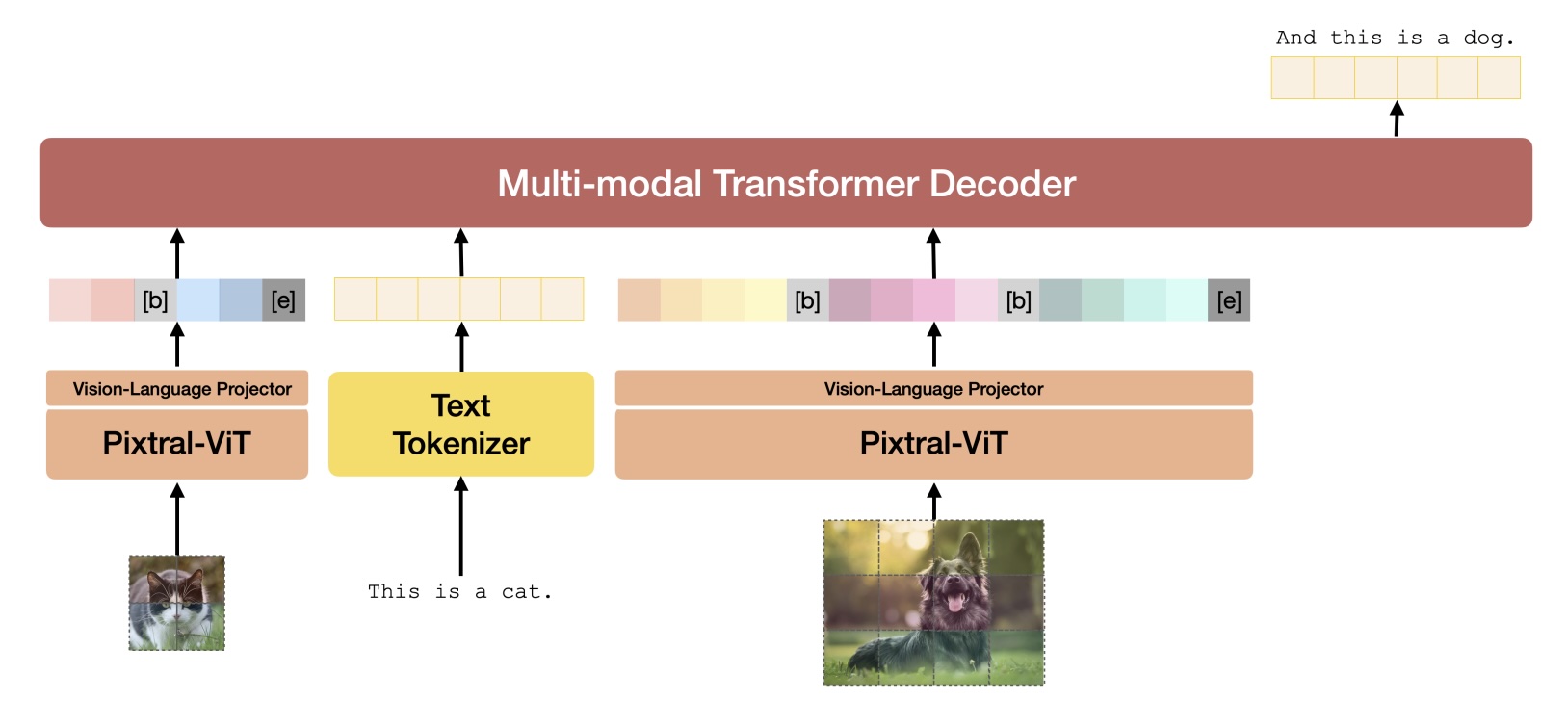
- Visual encoder: a Vision Transformer (ViT) of 400 million parameters, trained from scratch, with a patch size of 16 × 16 pixels.
- Language decoder: Mistral NeMo 12B, a 12-billion-parameter language model.
- Resolution: variable, with no imposed input size.
- Context: 128,000 tokens, visual tokens included.
- Licence: Apache 2.0.
Patch size is the number that governs everything else. With 16 × 16 squares, a 1024 × 1024 image gives:
that is, 4,096 tokens spent in the context window on a single full-resolution image, roughly 3% of the 128,000 available. This calculation, not any aesthetic preference, is why providers offer to reduce resolution: halving the width divides the token count by four.
Pixtral Large
Per Mistral's official announcement, Pixtral Large (November 2024) totals 124 billion parameters, breaking down into a 123-billion-parameter multimodal decoder (Mistral Large 2) and a 1-billion-parameter visual encoder. Context window: 128,000 tokens, which the announcement says fits at least thirty high-resolution images.
Note what that breakdown says: the visual encoder, even in the top-end version, is under 1% of the total. Seeing an image costs few parameters; reasoning about what you see is what costs.
The real contribution: original resolution and aspect ratio
This is the technical difference that set Pixtral apart from many VLMs of its time. The model accepts images of any size and any proportions, without distorting them:
- the image is cut into 16 × 16 pixel patches, as in any ViT;
- the number of patches therefore varies naturally with image size, instead of being fixed in advance;
- special tokens restore the geometry that flattening destroys: the paper names them
[IMAGE BREAK], inserted between two rows of patches, and[IMAGE END], placed at the end of an image's sequence; - no forced resizing, no wasteful padding.
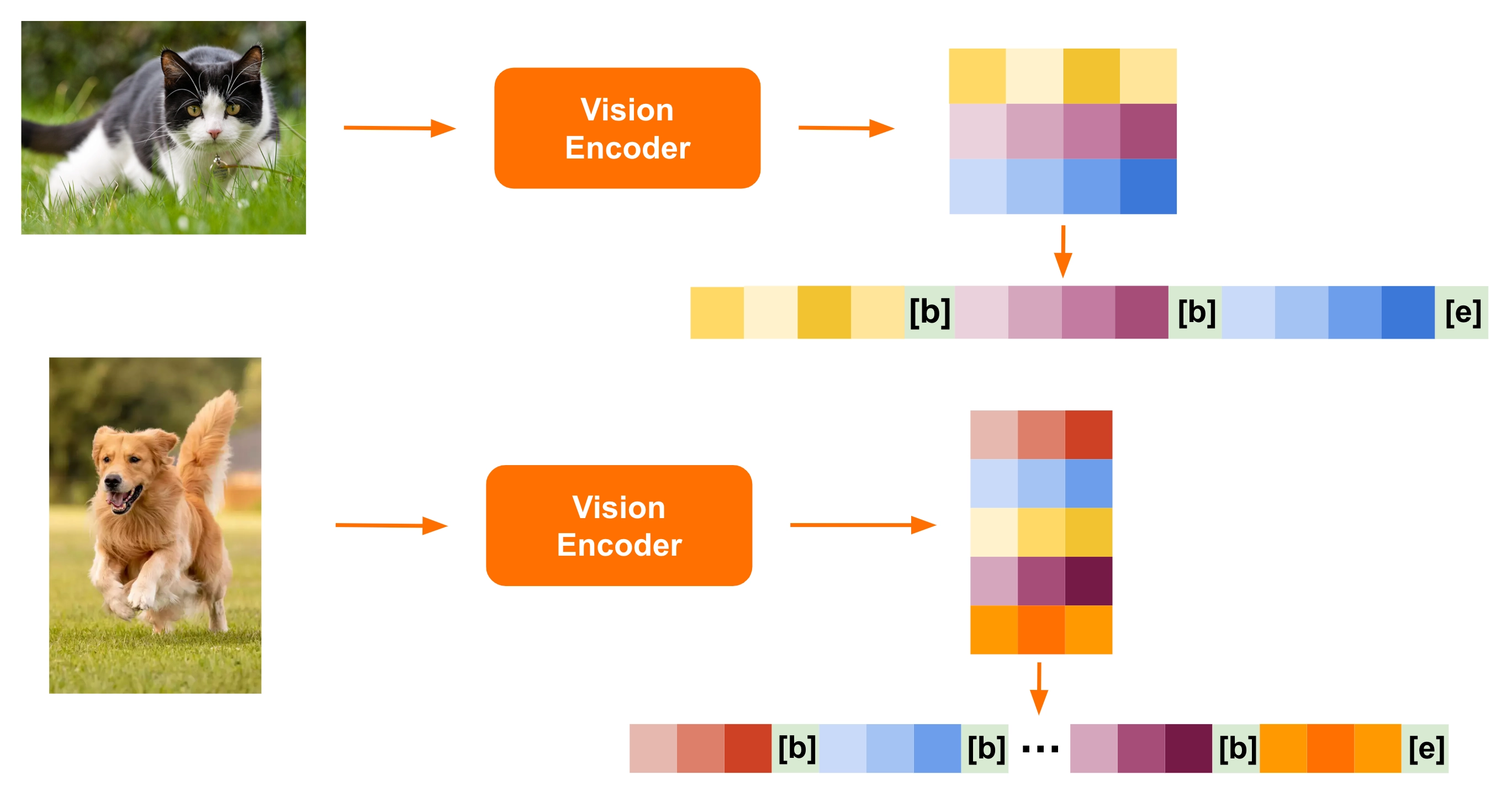
Why do those two small tokens matter? Because a language model receives a queue of vectors, not a grid. Laying 4,096 patches end to end with no marker is like reading a table with the line breaks stripped out: you have every word, you have lost the columns. [IMAGE BREAK] restores the line break, [IMAGE END] closes the image before the text resumes.
For reading text in a document (Optical Character Recognition, OCR), keeping the original aspect ratio is decisive. An A4 portrait keeps its proportions, small print keeps its pixels, the layout stays legible. The link is direct: the number of patches devoted to a line of text is proportional to that line's real size in the image, so squashing the image into a square literally takes patches away from the text.
What the published numbers say
Pixtral 12B, in its own paper
The results table in the Pixtral 12B paper compares the model to GPT-4o in its 13 May 2024 version:
| Benchmark | Pixtral 12B | GPT-4o (version 0513) |
|---|---|---|
| MMMU | 52.0% | 68.6% |
| MathVista | 58.3% | 64.6% |
| ChartQA | 81.8% | 85.1% |
| DocVQA | 90.7% | 88.9% |
Three readings, and the third is the most useful.
First, the order of magnitude: on MMMU (university-level questions requiring you to read a figure) a 12-billion-parameter model is far behind a frontier model. No surprise there, since MMMU tests general knowledge as much as vision.
Second, the only line where Pixtral 12B comes out ahead is DocVQA, reading scanned documents. That is exactly where original resolution was expected to pay off, and it is the line that vindicates the architectural choice.
Third: these figures come from a comparison published by Mistral, against a GPT-4o version dated May 2024, with protocols of Mistral's choosing. They were accurate and checkable on their date; they say nothing about the state of the art today. See how to read a benchmark score.
The paper's abstract adds two checkable comparisons: Pixtral 12B beats open models of similar size (Llama-3.2 11B, Qwen-2-VL 7B), and it beats Llama-3.2 90B while being about seven times smaller, 90 divided by 12 is 7.5. The authors also release an open benchmark, MM-MT-Bench, for evaluating VLMs on realistic scenarios.
Pixtral Large
The official Pixtral Large announcement publishes exactly one numeric score: 69.4% on MathVista. For ChartQA and DocVQA it claims to surpass GPT-4o and Gemini 1.5 Pro without giving values, and it declares itself the best open-weights model on the LMSys vision leaderboard, with a stated lead of about 50 Elo points over the next model.
We do not fill in the missing cells. A comparison table where three cells out of four are reconstructed "approximately" is worse than a table with three empty cells: it conveys a false sense of precision, and that is precisely the fault to learn to spot in a technical document.
What Pixtral could do
Understanding documents
This was its strength, and the only one backed by a number:
- reading text in complex layouts;
- tables and forms: not merely reading the words but reproducing the structure;
- charts and diagrams: interpreting a bar chart, a technical drawing;
- structured extraction: reading an invoice and pulling out the address, the total and the line items in a usable format.
See document understanding and OCR for the full family of techniques.
Several images in one request
Pixtral handles multiple images in a single call, which lets you compare two documents or reason over a multi-page file. The cost shows up in the window: thirty high-resolution images are enough to occupy all 128,000 tokens.
Interleaved text and images
The model accepts requests where text and images alternate: "here is page 1 [image], here is page 2 [image], summarize what changed." That is the natural format of document work, and it presupposes training on interleaved documents rather than isolated image-caption pairs.
Practical use
On the Mistral API
The identifiers pixtral-large-latest and pixtral-12b-2409 no longer resolve on the API. The catalogue's multimodal model is now the unified flagship, Mistral Medium 3.5; check its exact identifier in the documentation before writing code, since names change with every consolidation.
from mistralai import Mistral

client = Mistral(api_key="...")

response = client.chat.complete(
    model="mistral-medium-latest",
    messages=[{
        "role": "user",
        "content": [
            {"type": "text", "text": "Describe this image in detail."},
            {"type": "image_url", "image_url": {"url": "https://...image.jpg"}}
        ]
    }]
)

print(response.choices[0].message.content)
The multimodal message format is the same as OpenAI's: a list of typed blocks, text or image_url. An existing integration ports from one provider to another by swapping the client and the model name.
Locally, from the open weights
This is the route that outlives deprecation. Pixtral 12B's weights remain downloadable under Apache 2.0, and can be served with vLLM:
vllm serve mistralai/Pixtral-12B-2409 \
  --tokenizer_mode mistral \
  --limit_mm_per_prompt 'image=4' \
  --max_model_len 16384
Two options deserve a word. --limit_mm_per_prompt 'image=4' caps the number of images per request; --max_model_len 16384 caps total sequence length, and therefore reserved memory. Both exist for the reason seen above: each image consumes thousands of tokens, and without a cap a single request can demand far more memory than the machine has. Check the exact option syntax against the documentation for the vLLM version you install, it has changed more than once.
You then get a local API compatible with the OpenAI format. This is the answer when the documents being processed must not leave your own machines: medical records, litigation files, client data.
Where Pixtral sat in Mistral's line-up
The line-up Pixtral belonged to (one model per job) no longer exists. Since 28 April 2026, Mistral Medium 3.5 has been a single multimodal model covering what top-end text, top-end vision, reasoning and agentic coding used to do separately. Vision is no longer a model of its own: it is a capability every current model has, down to the 3-billion-parameter Ministral 3.
The full story, including which specialized model survived the consolidation and why, is in the 2026 line consolidation.
Perspective
Two things to take away from Pixtral, and neither is a number.
The first is technical: when the constraint you need to lift sits upstream (here, a borrowed encoder that imposes fixed-size square images) reusing an off-the-shelf component is not enough, and the component has to be rebuilt. The reasoning transfers: the choice between borrowing and rebuilding turns on whether the constraint that hurts lives inside the borrowed component.
Do not turn that into a general rule, though. Training your own encoder is not automatically better: several of the strongest open VLMs of 2026 still rely on an off-the-shelf SigLIP-style encoder and do very well. What justified the expense at Mistral was one specific requirement (documents) not a superiority in principle.
The second is legal, and it reaches well beyond Mistral: what let Pixtral 12B survive its removal from the catalogue is the Apache 2.0 licence its weights were published under. An open licence already granted on a released version cannot be revoked. For an organization that built a product on a model, that is the whole difference between an inconvenient deprecation and a blocking one.
1. A company built its product on Pixtral 12B's open weights. The model is pulled from Mistral's API at the end of 2025. Where does that leave the company?
2. Why does Pixtral insert a special [IMAGE BREAK] token between two rows of patches?
3. How does accepting images at their native format concretely help with reading an A4 document?
4. In the results table of the Pixtral 12B paper, what is the most useful reading?