The Distinction to Hold Throughout
"Multimodal" can mean two very different things, and conflating them is the main source of confusion in this area.
Understanding several modalities: you hand the model an image, a sound or a video, and it talks about it. This is the easy case, and it is broadly demonstrated. All it takes is one encoder per modality, converting the input into tokens that the model's trunk handles as if they were text. The output is still only text.
Generating several modalities: the model must itself produce an image, a sound or a video. That is a problem of a different nature, and far less well solved. You have to decide how the output gets made: through discrete tokens that a decoder turns back into pixels, or by handing the job to a separate generation module.
When a publisher announces a "unified" model that generates images, only one question matters: does a single network produce the output, or does the model write a prompt and send it to a separate image-generation model?
In the second case there is no unified model, there is a chain of tools. That is perfectly legitimate as a product, and often better in quality. But it is not the same thing under the hood, and for understanding what a system can really do, the difference is decisive.
This point is rarely explicit in press releases. When it is not, treat the question as open.
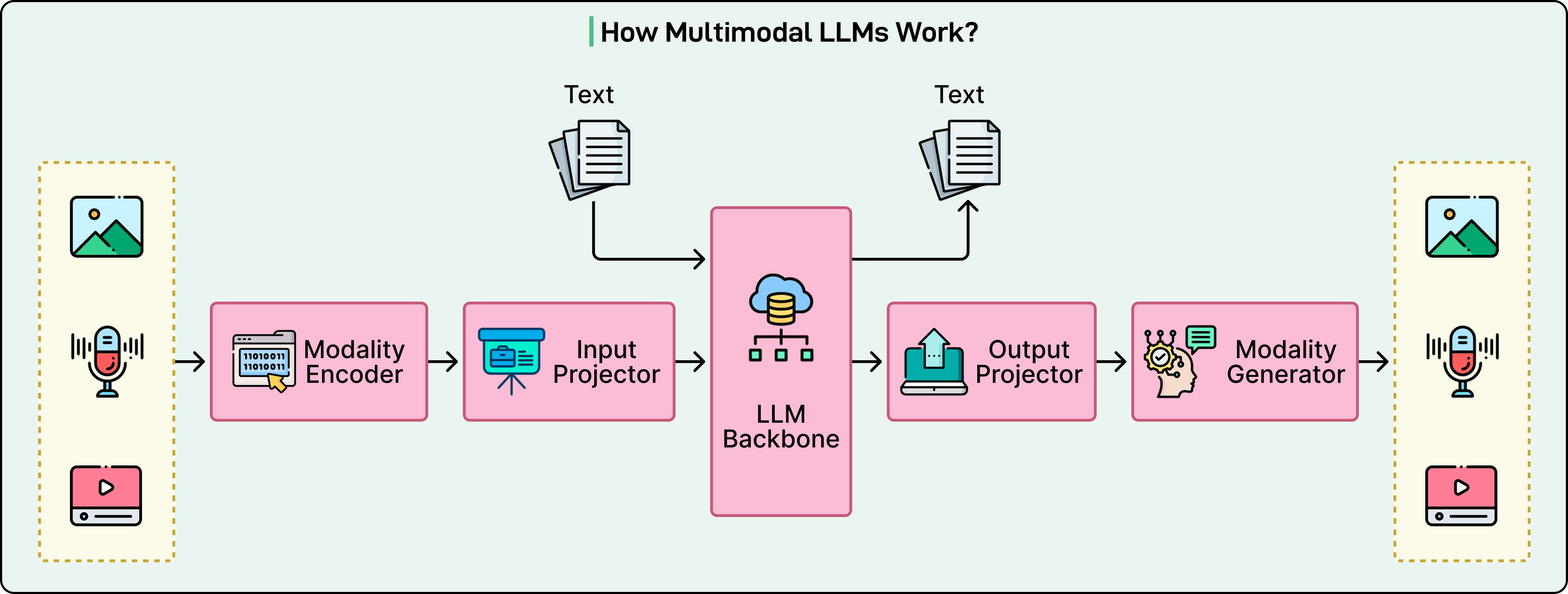
The diagram is useful because it shows the asymmetry. On the left, the modality encoders: one component per input type, whose output is projected into the trunk's space. On the right, the modality generators: one component per output type. The left side is well mastered today and present in many open models. The right side is where architectures still diverge.
The Easy Side: Understanding
One Single Principle: Everything Becomes Tokens
A language model can only handle a sequence of vectors. Text gets in by being cut into tokens, each token then replaced by a vector. To let an image or a sound in, you therefore only need to convert them into a sequence of vectors too. Nothing else is asked of the trunk.
Images
An image is cut into patches, small squares of pixels, and each patch becomes a token. That is the Vision Transformer procedure, covered in Vision-Language Models. Let us do the arithmetic with numbers that divide cleanly:
A 1024 × 1024 pixel image, cut into 16 × 16 pixel squares, gives:
Why squares and not pixels? A lone pixel carries almost no information, and a one-megapixel image would give a million tokens, which is impractical. A 16-pixel square is the usual compromise: small enough to keep detail, large enough for the count to stay reasonable.
In practice each provider also applies its own resizing and its own tiling, so the real token cost of an image is specific to each service and stated in its pricing documentation. That is where to look it up, rather than memorising an order of magnitude.
Audio
Sound is first turned into a mel spectrogram: an image whose horizontal axis is time, vertical axis frequency, and colour intensity. The word "mel" refers to the scale of pitch as the human ear perceives it, which distinguishes low frequencies finely and high ones coarsely; the spectrogram is therefore stretched to reflect that perception rather than the physics. That spectrogram is then cut up, exactly like an image.
The number of tokens per second of audio depends entirely on the codec used and differs from one provider to the next. It cannot be guessed: here again, the service's pricing documentation is the only source. The mechanism of neural audio codecs is covered in Neural Audio Codecs and Audio Tokens, and Mistral's audio family in Voxtral.
Video
Video combines the two: frames sampled at a regular interval, converted into visual tokens, and the soundtrack converted into audio tokens. The sampling rate is a setting of the service, not a property of the video, sampling one frame per second from a ten-minute clip gives 600 frames to encode, whatever the file's actual frame count.
Each modality consumes tokens from the same context window as the text. The reasoning always runs the same way: take the token cost of an input, as published by the provider, and divide the window by that cost.
With a 100,000-token window and an image charged at 1,000 tokens, you fit 100 images, and nothing else. Video is the fastest-burning item, since it stacks frames and sound. An order of magnitude learned by heart will be wrong at the next price update; the calculation stays right.
The Hard Side: Generating
Three Ways to Get an Image Out
By discrete tokens. You give the model an image vocabulary: an image tokeniser converts a picture into a sequence of symbols drawn from a finite dictionary, exactly like a text tokeniser. The model can then predict the next token without knowing whether it will be a piece of text or a piece of image, and a detokeniser rebuilds the pixels at the end. This is the approach of Chameleon and Emu3.
By a dedicated generation module. The trunk produces a representation, which a separate module (often a diffusion model) turns into an image. The two are trained to work together, but they are two networks.
By a hybrid trunk. A single Transformer does both jobs: it predicts text tokens one by one, and it denoises image patches, the way a diffusion model does, within the same sequence. This is the idea behind Transfusion (Meta, 2024), taken up in 2025 by BAGEL and Show-o2, covered below.
By tool call. The model writes a text prompt and passes it to an independent image generator. This is not unified generation, as noted above.
Transfusion: Predict the Next Token and Diffuse Images with One Multi-Modal Model (Zhou et al., Meta, 2024)A model generating an image token by token, left to right, commits irrevocably at each token: what is written is not revised.
A diffusion model does the opposite: it revises the whole image at each step and nothing is fixed until the end, see Diffusion Models.
These are two distinct mechanisms, and that is precisely the tension in unification: the shared trunk is built on the first, while the best visual results come from the second. The hybrid trunk is the attempt to reconcile the two inside one network.
Early Fusion: Chameleon
Chameleon: Mixed-Modal Early-Fusion Foundation Models (Chameleon Team, Meta, 2024)Early fusion: text and image are mixed from the input onward, in a shared vocabulary and a single sequence. There is no image branch and text branch, there is only a sequence of tokens of two kinds.
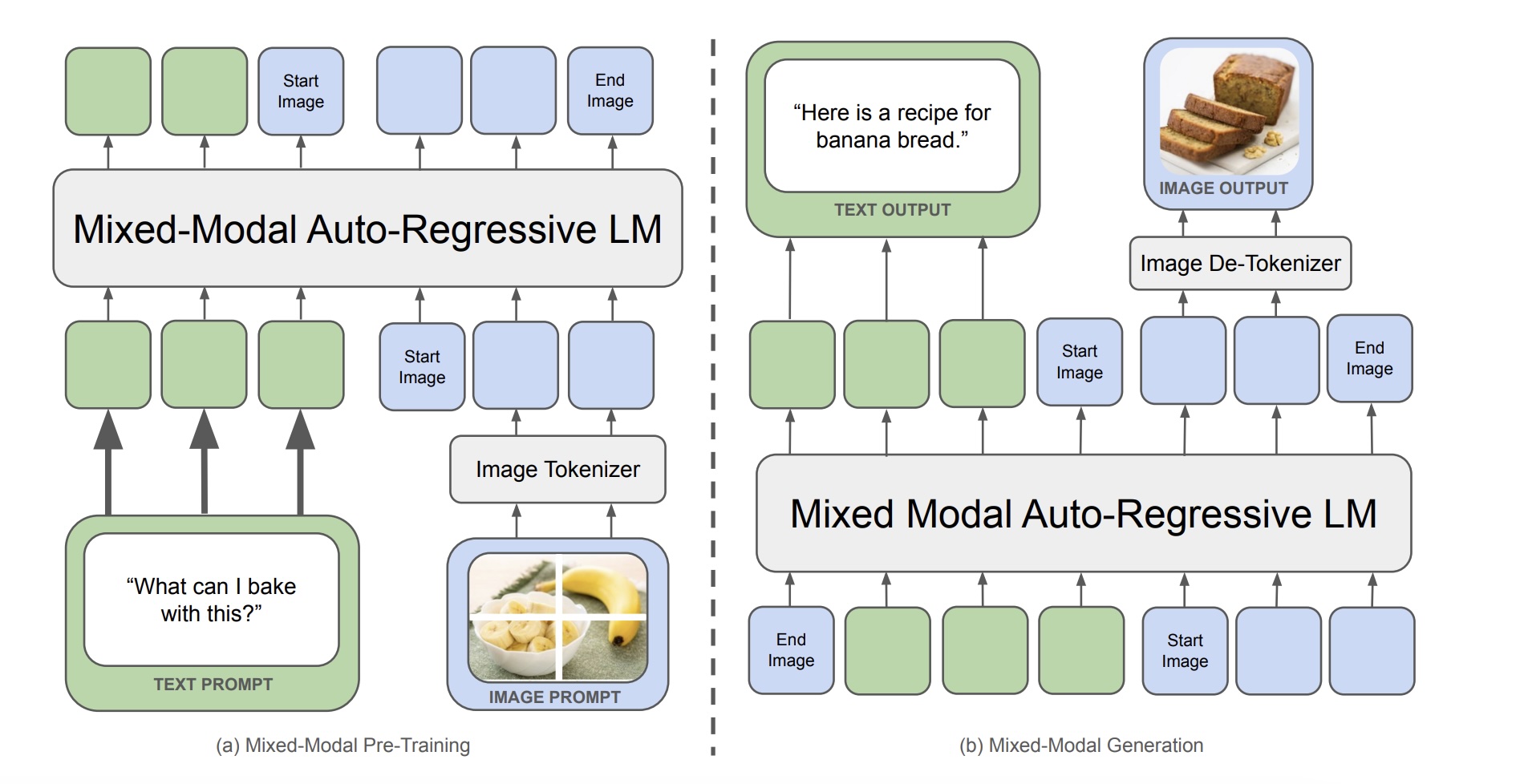
The advantage is real and easy to state: the model can produce a document where text and images alternate naturally, since they are made of the same stuff. So is the drawback: the paper documents training difficulties specific to this mixture, which have to be addressed by architectural adjustments, a sign that unification is not free.
Emu3 and LLaVA-OneVision
Emu3: Next-Token Prediction is All You Need (BAAI, 2024)Emu3 pushes the same idea as far as video: text, images and video are all converted into a shared discrete token space, and a single training objective (predict the next token) serves for everything. It is the clearest case of a model that both understands and generates with one mechanism.
LLaVA-OneVision: Easy Visual Task Transfer (Li et al., 2024)LLaVA-OneVision sits squarely on the easy side, and owns it: it handles single images, image sequences and video, but its output is text. It is an excellent example of what can be done cleanly in multimodal understanding with open weights.
2025: Open Models That Understand and Generate
2025 brought a run of open models that do both jobs. Each answers, in its own way, the same difficulty, which needs explaining first.
The representation conflict. To understand an image, you want tokens that carry meaning ("a dog, lying down, on a sofa") and can forget the pixel detail. To generate an image, you want the opposite: tokens that keep the detail (the texture of the fur, the exact light), or the output comes out blurry. One encoder serves both badly.
- Janus-Pro (DeepSeek, January 2025) settles it by decoupling: two separate image encoders, a semantic one for understanding and a discrete-token one for generation, plugged into a single trunk of at most 7 billion parameters. Simple, and effective for its size.
- BAGEL (ByteDance Seed, May 2025) adopts the hybrid trunk: two "experts", one for understanding and one for generation by denoising, sharing the same attention, about 7 billion active parameters out of 14 in total, under the Apache 2.0 licence. Its paper reports that abilities it was not explicitly trained for, such as free-form image editing, emerge when it is trained on large amounts of interleaved data (text, images, video clips).
- Show-o2 (June 2025) combines token prediction for text with denoising for images and video in a single model.
- Emu3.5 (BAAI, October 2025) stays with discrete tokens, at 34 billion parameters trained on sequences drawn from web videos, plus a trick that produces an image about twenty times faster than token by token.
- HunyuanImage 3.0 (Tencent, September 2025) applies the unified approach to an image model with 80 billion parameters in total (13 active, through a mixture of experts), released with open weights.
| Model | Date | How the image comes out | Weights |
|---|---|---|---|
| Chameleon | 2024 | Discrete tokens, one vocabulary | Open (research) |
| Transfusion | 2024 | Hybrid trunk: tokens for text, denoising for images | Paper only |
| Janus-Pro | Jan 2025 | Two decoupled encoders, discrete tokens out | Open |
| BAGEL | May 2025 | Hybrid trunk with two experts | Open (Apache 2.0) |
| Emu3.5 | Oct 2025 | Discrete tokens, accelerated decoding | Open |
| GPT-4o / GPT Image | 2025-2026 | Autoregressive per OpenAI, details unpublished | Closed |
| Nano Banana (Gemini) | 2025-2026 | Unpublished | Closed |
One last remark, which matters if you want to judge these models: on image quality alone, the best open unified models of 2025 compare with the good specialised diffusion models of a year or two earlier, not with the best of the moment. Their value lies elsewhere: editing, reasoning about an image, alternating text and pictures.
What the Closed Models Have Shown
Three very different statuses circulate under the single word "capability":
- Measured: a published number, with the protocol needed to reproduce it. Rare.
- Shown: a filmed demonstration or a set of examples chosen by the publisher. Common, and informative about what is possible, not about what is typical.
- Announced: a promise of a feature to come.
The reading grids for numbers of the first kind are in How to Read a Benchmark Score. The other two categories cannot be corrected, only flagged.
GPT-4o: Voice Without the Cascade
The "o" in GPT-4o stands for omni. What this model brought is easy to describe, because it is enough to compare it with what it replaces.
Before, a voice assistant was a cascade of three models:
Audio → speech recognition → text → language model → text → speech synthesis → audio
That cascade has two structural flaws, independent of the quality of each brick. First, the delays add up: three models in a row, three waits. Second, and more seriously, passing through text destroys everything that is not in the words, intonation, hesitation, laughter, the identity of the voice. The language model cannot take them into account, since it never receives them.
An audio-to-audio model removes both problems at once, because there is no longer an intermediate stage where the information is lost.
On latency, OpenAI's GPT-4o announcement states a response to audio input in 232 milliseconds at best and 320 milliseconds on average, and compares that order of magnitude to human reaction time in conversation. Both numbers are the publisher's own; they have not been independently measured, and a latency in any case depends on the network and the load.
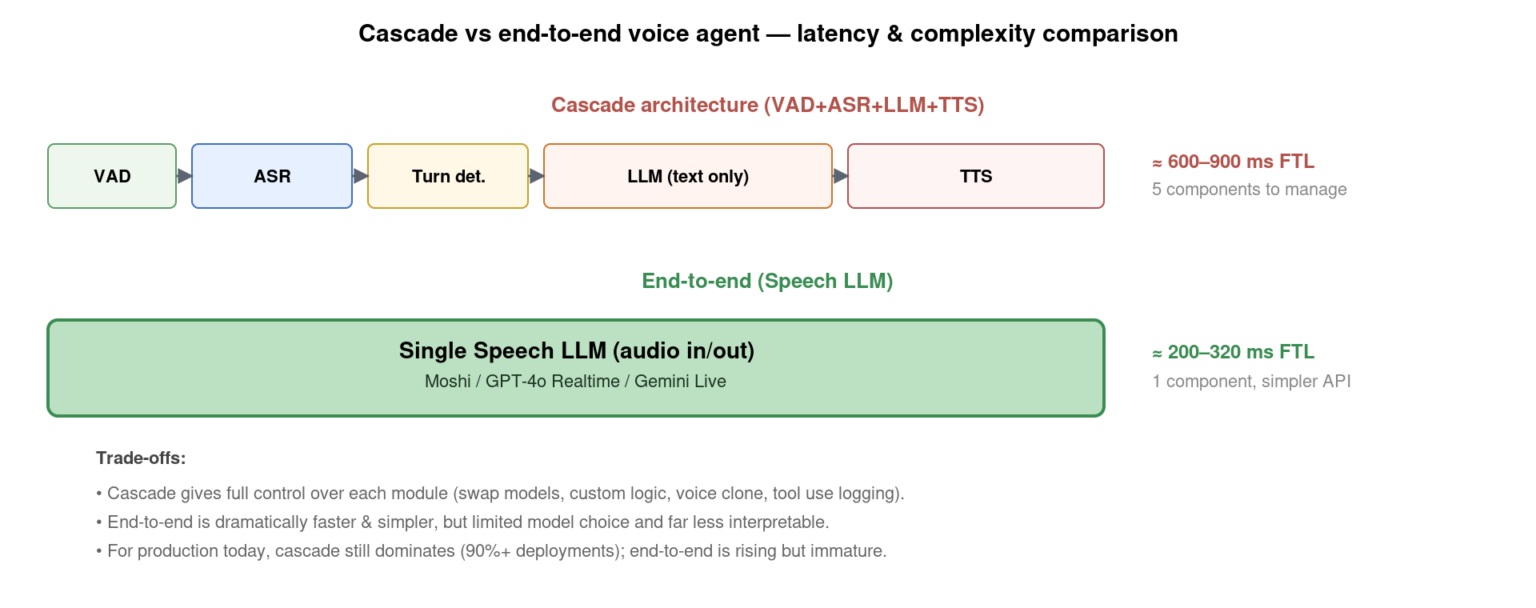
Note that this example belongs to both sides at once: the model understands audio and generates it. This is the case where unification has the clearest benefit, because the output modality is the same as the input one. Voice without the cascade has since become standard at the big publishers, and open models offer it too, such as Alibaba's Qwen3-Omni (September 2025), which takes text, images, sound and video and answers in text or speech.
Qwen3-Omni Technical Report (Qwen Team, 2025)GPT-4o and Gemini: Images Move Into the Trunk (2025-2026)
On 25 March 2025, ChatGPT's image generation stopped going through DALL-E 3: GPT-4o itself produces the image, autoregressively according to OpenAI. Apply the test from the top of the page: OpenAI states that a single model produces the output, without publishing the full architecture. In particular, nobody outside knows whether a diffusion decoder steps in at the very end. The status is therefore "shown" and "asserted", not "measured".
Google followed the same path: native image output in Gemini 2.0 Flash in March 2025, then Nano Banana (Gemini 2.5 Flash Image) in August 2025 and its successors, detailed in Text-to-Image. In May 2026 Google unveiled Gemini Omni, a family meant to generate "from any input", starting with video. According to Demis Hassabis's presentation, it combines Gemini with the company's generation models (Veo, Nano Banana, Genie). "Combines" is exactly the word that should trigger the test question: one network, or several modules trained together? The answer is not public.
Gemini: The Long Context Window
Gemini's headline argument is not generation but the size of the context window, that is, how much material the model can examine at once.
Gemini 1.5: Unlocking multimodal understanding across millions of tokens of context (Google, 2024)The Gemini 1.5 technical report (2024) announces windows on the order of a million tokens in production, and reports an ability to retrieve a specific piece of information that holds up to at least 10 million tokens in research conditions. The point matters for multimodality: since everything is tokens, a long window fills up just as readily with text as with hours of video or audio. That is what the report's title sums up. The following generations, up to the Gemini 3 range of 2026, have kept that order of magnitude of a million tokens (see Google DeepMind).
The practical consequence is a different way of working. You can load a long recording and ask where a topic is discussed, instead of chopping it up in advance and indexing the summaries. But do not conclude that a long window replaces document retrieval: the trade-off between the two is covered in Long Context or Retrieval.
The Limits, Bluntly
A Generalist Is Not the Best at Everything
This is the only general statement one can make without a number: on a single, well-defined task, a model built for that task stands a good chance of beating a generalist, because it does not have to spread its capacity.
But be wary of the over-precise claims that circulate on this theme. Two shortcuts not to repeat:
- "For OCR, LayoutLM is still better." The claim conflates two things. OCR stands for optical character recognition: turning an image of a page into text. LayoutLM is not an OCR engine: it is a document-understanding model, which consumes the output of an OCR while taking into account where the words sit on the page. These are two different stages of the same chain. The subject is covered in Document Understanding and OCR, and Mistral's offering in Mistral OCR.
- "For speech synthesis, service X is better." That is plausible, and it is also what its vendor says. Speech synthesis is assessed by comparative listening, with human judges and a protocol; without that protocol, the claim is a preference. See Text-to-Speech.
Balancing the Modalities Is a Real Problem
Training on text, image and audio at once produces a simple, awkward phenomenon: improving the model on one modality can degrade it on another, since they share the same capacity and the same training budget.
The known answers are tuning the data proportions and weighting the loss functions per modality. No general recipe is published, and neither are the proportions chosen by closed models. This is a point where the open literature is thin.
What "Unified" Does Not Guarantee
A shared trunk guarantees that the modalities are handled by the same weights. It guarantees neither that the model actually reasons across modalities, nor that its quality is uniform from one modality to the next, nor that the generation is produced by the trunk rather than delegated. Those three things are verified separately, and rarely in a press release.
Where the Field Is Going
The direction announced by every player is the same: a model that takes text, image, sound and video indifferently, and produces text, image and sound indifferently.
The actual state, in November 2026, is more nuanced, and worth stating without enthusiasm. Multimodal understanding is settled: it is present in every publisher's leading models, and in many open-weight ones. Image generation by the assistant itself has become an everyday product since 2025 at OpenAI and Google, and these systems now lead the image leaderboards, but their architecture is unpublished. On the open side, unified models exist (Janus-Pro, BAGEL, Emu3.5, HunyuanImage 3.0) and the trend is towards hybrid trunks that predict text and denoise images; they still trail the best specialised generators on raw quality. Video, finally, is only at the start of this unification, with Gemini Omni.
The question that will decide what comes next is not whether one model can do everything, but whether unification delivers a gain in cross-modal reasoning (understanding a chart and commenting on it, hearing a hesitation and answering it) greater than what each modality loses by sharing its capacity. That question is not settled.
1. What is the difference between « understanding » and « generating » several modalities, and where does each stand?
2. A publisher announces a « unified » model that generates images. What question should you ask first to find out what is really under the hood?
3. Beyond speed, why does an audio-to-audio model like GPT-4o change the nature of a voice assistant?
4. How many images fit in a multimodal model's context window?
5. A publisher's filmed demonstration shows its model commenting on a live video. What status should you give that capability?
6. Why does Janus-Pro use two different image encoders, one for understanding and one for generating?