Video generation is the field where announcements come fastest. Model names, version numbers, advertised durations and resolutions change within weeks. Every figure of that kind here is dated and attributed to whoever announced it; for the current state of play there is no substitute for the publisher's own page.
Two difficulties, by contrast, are structural and will hold whatever this month's model is:
- Temporal coherence: it is not enough for each frame to be good, each must be compatible with the one before it.
- Cost: you are not making one image, you are making dozens per second of video, and the cost does not grow merely in proportion.
Those are the two subjects of this page.
First Problem: Temporal Coherence
What "Coherent" Means Here
Let us count first. A 10-second video at 24 frames per second:
Suppose we generate those 240 frames independently, with an excellent image model, from the same prompt. Each frame, taken on its own, will be beautiful. Played in sequence, it is unusable: the character's face changes every frame, his shirt changes colour, background objects appear and vanish. The result is not a video, it is a slideshow of 240 different photographs of the same subject.
So the problem is not the quality of each frame. It is that nothing in an image model ties frame 57 to frame 58.
Generating 240 good images is a solved problem, 240 times over. Generating a video is a different problem: motion has to be plausible, object identity has to survive time, and elementary physics must not be insulted too badly.
The analogy: drawing a portrait is one skill; making an animated film is another, which presupposes the first without reducing to it.
The Mechanism That Answers It: Temporal Attention
The answer fits in a sentence: add layers that make the frames talk to each other.
In an image model, attention is spatial: each region of the image looks at other regions of the same image. In a video model, a second pass of attention is added, temporal: a given point of the frame looks at the same point in the other frames of the sequence. It is that second pass, absent from an image model, that keeps the face from changing.
Make-A-Video: Text-to-Video Generation without Text-Video Data (Singer et al., 2022)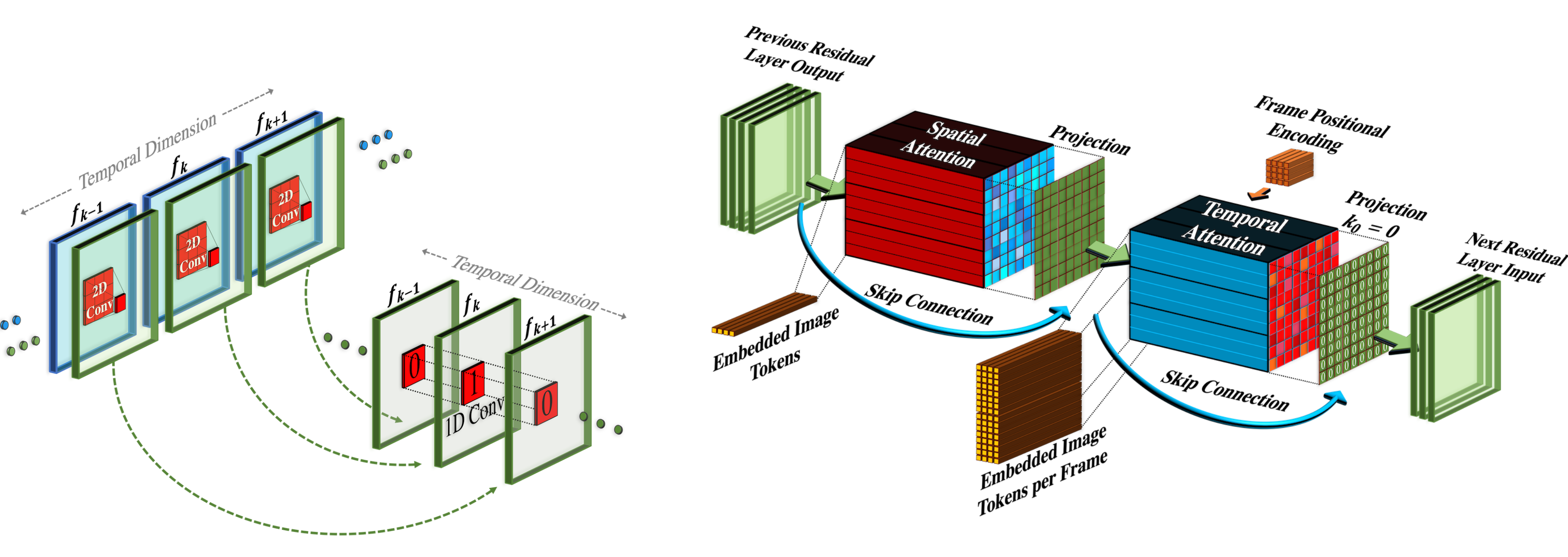
The term pseudo-3D in that figure is worth unpacking, because it names exactly this compromise: instead of processing the space-time volume in one go, which would be "true" 3D, it is processed in two separate passes, space, then time. That is far cheaper, and largely sufficient. The frame positional encoding, the orange box, is what tells the model the order of the frames; without it the network would not know which comes before which.
Cutting the Video Into Space-Time Cubes
Recent models push the idea further. Rather than reasoning frame by frame, they compress the whole video into a three-dimensional volume (width, height, time) then cut that volume into small cubes. Each cube becomes a token, and the cubes together form a sequence handed to a Transformer, exactly like a sentence.

Two consequences of this cutting, often misunderstood:
- Clip duration only changes the length of the sequence. A model that accepts any sequence length therefore accepts, in principle, any duration and any aspect ratio. That is the flexibility claimed by Sora's technical report.
- Coherence is no longer a bolted-on layer, it is in the mechanism. Since attention spans the whole sequence of cubes, a cube from the end of the clip can look at a cube from the beginning. That is what gives coherence across the whole clip, not just from one frame to the next.
Second Problem: Cost, and Why It Explodes
This is where most write-ups throw out a multiplier without justifying it. Let us build one.
First factor: the number of frames. One second of video at 24 frames per second is 24 times the content of one image. For 10 seconds, 240 times. A video model does, however, also compress time in its latent space (the video encoder groups several neighbouring frames into a single latent slice) which cuts that factor down accordingly. The exact factor depends on the model and is not always published.
Second factor, the one that really hurts: the cost of attention. The cost of the attention mechanism grows as the square of the number of tokens. If moving from image to video multiplies sequence length by , then attention spanning the whole of space-time costs times more, not times.
Avoiding that square is exactly why architectures separate spatial from temporal attention, as in the figure above: two passes costing each are far cheaper than one costing .
Third factor: the number of denoising steps. It is the same as for an image (a few dozen) but it multiplies everything above.
The honest conclusion: video's overhead relative to an image runs to two or three orders of magnitude, and you can see where those orders of magnitude come from. A precise figure such as "100 to 1,000 times" cannot be attributed, though: it depends on duration, resolution, the temporal compression ratio and the attention structure chosen, none of which is published for closed models.
What 2025 and 2026 Added
The two underlying problems have not gone away. But three capabilities that 2024's models lacked became standard among the leading ones between May 2025 and autumn 2026.
Sound, Made Together With the Picture
Until 2024, generated videos were silent. To give them a soundtrack, you ran a second model that watched the finished clip and invented noises on top. The flaw showed mostly on faces: lips moving out of step with the words, like a badly dubbed film.
Veo 3, unveiled by Google in May 2025, was the first major commercial model to produce the picture, the dialogue, the sound effects and the ambience in one generation. Within a year it had become the norm at the top end: Sora 2, Kling from late 2025, Seedance 2.0, and open-weight models such as LTX-2.
The mechanism, as described by the few models that publish it, extends exactly what we saw above. Sound is compressed and cut into tokens too. The network then denoises two sequences at once, one for the picture and one for the sound, and a two-way cross-attention makes them look at each other at every step: the audio stream "sees" the mouth opening, the video stream "hears" the syllable being spoken. The LTX-2 technical report (Lightricks, January 2026) describes two streams of unequal size, roughly 14 billion parameters for the picture and 5 billion for the sound. Google has not published Veo 3's architecture.
LTX-2: Efficient Joint Audio-Visual Foundation Model (HaCohen et al., 2026)Why a smaller audio stream? A second of compressed audio carries far less information than a second of video. The total cost is therefore still dominated by the picture, for the reasons given in the previous section.
The Same Character From One Shot to the Next
Temporal attention holds a face steady within one clip. It says nothing about the next clip: rerun the same prompt and you get a different actor. For telling a story across several shots, that is a deal-breaker.
Two answers have taken hold:
- Reference images. You supply one or more pictures of a character, an object or a setting; the model receives them as extra tokens it has to respect. Runway Gen-4 (March 2025) made this its headline feature; Veo 3.1 (October 2025), Kling and Seedance offer it too.
- Multi-shot generation. The model produces a short sequence cut into several shots in one go (Kling 3.0 advertises up to six), which amounts to stretching attention across the cuts: the character in shot 4 can "look at" the one in shot 1.
Either way, it is the principle of image-to-video, covered below: anchor the appearance on something fixed rather than leaving it to the luck of each generation.
Longer Clips, Still Short
Advertised durations have climbed: from 5 to 10 seconds for most models in 2024, to 15 seconds (Kling 3.0, February 2026), then to 30 seconds in a single pass announced in the summer and autumn of 2026 (Alibaba's Wan 3.0, Kling 4.0). The ceiling follows from the cost section: doubling the duration doubles the sequence length, and attention spanning the whole sequence would cost up to four times as much. A film is still made shot by shot, then edited together.
The Models, and As of When
What follows is a dated snapshot, and the figures quoted are those announced by the publishers in their own communications, not independent measurements. An advertised duration or resolution is a marketing argument before it is a result: it describes the best case obtained, not what you get on every attempt. No ranking is offered here, for want of any public, reproducible evaluation of the field, see How to Read a Benchmark Score for what these announcements would need in order to be scores.
Sora (OpenAI)
Announced in February 2024 with a technical report titled Video generation models as world simulators. The architectural elements it describes are the ones set out above: compression by a video autoencoder, cutting into space-time cubes, a diffusion transformer, variable duration and aspect ratio.
OpenAI announced clips up to one minute long at the time. The report explicitly acknowledges limits, and those are the part worth keeping, because they are general: physics is understood only by correlation, causal interactions are poorly maintained, and fine detail remains hard.
Sora 2, launched on 30 September 2025, added synchronised sound and came with a mobile app of the same name: a feed of short, fully generated videos, into which anyone could insert their own face (or that of friends who allowed it) through a feature called "cameos". The app passed a million downloads in under a week, according to OpenAI.
Six months later, on 24 March 2026, OpenAI announced it was shutting down the Sora app and API: the app closed in April, and API access was due to end in late summer 2026. The company said little about why; the press linked the decision to a refocus on other products, to compute costs and to a steep drop in usage once the novelty wore off. Disney, which had announced in December 2025 a one-billion-dollar investment and a licence for its characters on Sora, withdrew from the deal. As of 4 November 2026, then, the model that started the race is no longer an available product.
Veo (Google DeepMind)
Google announced Veo 2 in late 2024, with generation up to 4K according to its own release. Veo 3 (May 2025) brought the native sound described above; Veo 3.1 (October 2025) enriched the audio and added reference images plus control over the clip's first and last frames. Base clips remain short (around 8 seconds) and can be lengthened through successive extensions.
As of 4 November 2026, Veo 3.1 is still the latest public version of the line. In May 2026 Google unveiled Gemini Omni, a family of models meant to generate "from any input", starting with video, with edits requested in conversation. It is a step towards the unified models covered in Unified Multimodal Models.
Kling (Kuaishou)
A model from the Chinese group Kuaishou, announced in 2024, noted for the quality of its human motion and available through a consumer app. The 2.x versions followed one another through 2025, native sound arrived at the end of the year, then Kling 3.0 (February 2026) advertised multilingual sound, clips up to 15 seconds and six-shot sequences. Kuaishou announced the availability of Kling 4.0 in mid-October 2026, with generations of up to 30 seconds according to its release. Kling sits, with Veo and Seedance, at the top of 2026's blind-vote leaderboards, arenas where web users pick the better of two videos without knowing which model made them. Those are aggregated preferences, not quality measurements in the strict sense.
Runway
One of the field's longest-standing commercial players, progressing by generations:
- Gen-1 (2023): transforming an existing video, so-called video-to-video.
- Gen-2 (2023): generation from a text prompt or an image.
- Gen-3 Alpha (2024): announced gains in temporal coherence and resolution.
- Gen-4 (March 2025): consistent characters and settings from reference images.
- Gen-4.5 (December 2025): announced gains in realism and prompt adherence.
Runway's appeal is less the model than the tool: a web interface, camera-motion control, and an image-to-video mode that is practical because it anchors the result on an image the user chose.
Seedance (ByteDance) and Hailuo (MiniMax)
ByteDance, TikTok's parent company, released Seedance 1.0 in June 2025 with a technical report, then Seedance 2.0 in February 2026, which generates picture and sound together from several references. Viral clips featuring well-known actors and film characters immediately drew protests from the US studios' association (MPA) and the actors' union SAG-AFTRA, plus cease-and-desist letters from Disney and Paramount. ByteDance promised stronger safeguards and delayed, then staggered, the international launch.
Seedance 1.0: Exploring the Boundaries of Video Generation Models (ByteDance Seed, 2025)Hailuo, from the Chinese company MiniMax, stood out in 2025 for believable physical motion at a low price.
| Family | Publisher | Recent version (date) | What sets it apart | Weights |
|---|---|---|---|---|
| Veo | Google DeepMind | Veo 3.1 (Oct 2025) | Native sound since Veo 3, reference images | Closed |
| Sora | OpenAI | Sora 2 (Sept 2025), shut down in 2026 | Social app, cameos | Closed |
| Kling | Kuaishou | 3.0 (Feb 2026), 4.0 announced (Oct 2026) | Multi-shot, multilingual sound, long clips | Closed |
| Seedance | ByteDance | 2.0 (Feb 2026) | Multiple references, picture and sound | Closed |
| Runway | Runway | Gen-4.5 (Dec 2025) | Creative tooling, references | Closed |
| Wan | Alibaba | 2.2 (Jul 2025) open; 3.0 (Aug 2026) | Apache 2.0 up to 2.2 | Open, then closed |
| LTX-2 | Lightricks | Jan 2026 | Joint picture and sound | Open |
Every leading family describes the same skeleton: an autoencoder that compresses the video in space and time, a cut into space-time cubes, a diffusion transformer, and text conditioning. Since 2025, a second token stream for sound, denoised alongside the picture, is often added.
What distinguishes the models is therefore no longer the architecture, but scale, training data (whose provenance is almost always kept secret) and the control mechanisms offered to the user. This is also what makes the field hard to evaluate: the differences are not in what gets published.
The Other Difficulties
Physics Is Not Simulated
None of these models contains any equations of mechanics. They have seen a great many videos in which objects fall, so they produce objects that fall. That is a learned statistical regularity, not an applied law.
The difference shows as soon as you leave familiar situations: a glass unshattering, a liquid climbing, an object passing through another. These models are sometimes called "world simulators"; it is more accurate to say they reproduce the appearance of the situations they have seen. Models that try to go further, by reacting to a user's actions, such as Google DeepMind's Genie 3, are covered in World Models.
Where the Data Comes From
Training cost and the composition of video datasets are not published by closed publishers. All one can note is that high-quality annotated video is scarce, expensive and often of uncertain legal status, which probably explains part of the silence.
The question became very concrete in 2025-2026: models able to reproduce film characters or real actors on request, such as Sora 2 at launch or Seedance 2.0 in February 2026, drew protests from studios and actors' unions. For what judges have said so far about model training, see What the Courts Have Said About Training; for tracing data, Dataset Provenance and Licences.
Variants of the Problem
Image to Video
Rather than starting from text alone, you start from a still image supplied by the user, which the model sets in motion. This is easier for the model, because the starting image fixes the appearance of the characters and the setting, a good part of the coherence problem is settled in advance. And it is more controllable for the user, who can approve the image before paying for the video.
- Stable Video Diffusion (Stability AI): open weights, derived from Stable Diffusion.
- Wan 2.2 (Alibaba): open weights, with an image-to-video mode.
- Luma Dream Machine, Runway, Kling, Veo: commercial services, all of which offer this mode.
Video to Video
You transform an existing video: change of style, setting, season. The coherence problem is largely solved by the source, since the motion is already given; what remains is keeping the style from flickering between frames.
Open-Weight Models
- Stable Video Diffusion (Stability AI): image to video.
- CogVideo (Tsinghua University): text to video, with a public paper.
- Open-Sora: a community effort to reproduce Sora's approach.
- Mochi (Genmo): open-weight model.
- HunyuanVideo (Tencent, late 2024): a large open-weight model.
- Wan 2.1 and 2.2 (Alibaba, February and July 2025): under the Apache 2.0 licence, so commercially usable, the open reference of 2025. Wan 2.2 splits denoising between two "experts", one for the early, very noisy steps and one for the finishing touches. Later versions, Wan 3.0 (August 2026) included, are only offered through an API.
- LTX-2 (Lightricks, January 2026): open weights, picture and sound generated together.
The gap with closed models is wider in video than in images. It narrowed in 2025 with Wan, then partly reopened: native sound reached closed models first, and Alibaba stopped publishing the weights of its newest versions. Three reasons hold up without needing a figure: quality video data is scarce and dearly paid for; training compute is far above that of an image model, for the reasons set out above; and the technical difficulty of temporal coherence lends itself less well to scattered contributions.
Realistic generated video moves a threshold: a faked photograph was already possible before deep learning, a convincing faked video much less so. The feared uses are deceptive video of real people, the fabrication of false evidence of events, and impersonation, including in video calls.
The technical answers put forward are invisible watermarking of the output, such as Google's SynthID, and signed provenance metadata standardised by the C2PA coalition, Coalition for Content Provenance and Authenticity. Neither survives a simple screen recapture in all cases, and after-the-fact detection remains an endless race. There is no established solution.
The Sora app showed the problem at scale in autumn 2025: despite a visible watermark and C2PA metadata, realistic videos of public figures, including dead ones, circulated, and OpenAI had to tighten its rules within weeks of launch. Native sound makes the risk worse, since it adds a believable voice to a believable face.
Where the Field Stands (November 2026)
A useful comparison: video generation is roughly where image generation was before it became dependable, impressive in flashes, uneven from one attempt to the next.
The comparison still holds, but the bar has moved. Synchronised sound, clips of 10 to 30 seconds and recurring characters have become catalogue features, and the top of the leaderboards changes hands from month to month between Kling, Veo and Seedance. What remains uneven: physics in unusual situations, hands and on-screen text, sustaining an action over time, and the share of failed attempts that have to be thrown away.
Sora's shutdown is also a reminder that the question is not only technical. A consumer video service is expensive to run, for the reasons in the cost section, and a spectacular product is not necessarily a lasting one.
The lines of work announced by the players are the same everywhere: lengthen the coherent duration, raise resolution, give fine control over motion and shot cuts, cut cost. No credible date can be put on any of that, and the "one or two years away" predictions that have circulated in this field for years have done no better than chance.
1. Why can you not produce a video by generating its 240 frames one by one with an excellent image model?
2. What does temporal attention add to an image model?
3. Why do video architectures separate spatial attention from temporal attention, rather than processing the space-time volume in one go?
4. A vendor announces clips « up to one minute » at high resolution. How should you read that figure?
5. These models are sometimes called « world simulators ». What physics do they actually contain?
6. Before 2025, a generated video's soundtrack was added afterwards by a second model. What did Veo 3 and its successors change?