The Story: Why Leave OpenAI
In 2021, a group of researchers from OpenAI (among the most important ones) left the company. Dario Amodei (VP of Research), Daniela Amodei (VP of Operations), Tom Brown (first author of the GPT-3 paper), and others. The reason? A fundamental disagreement on strategy.
Their conviction: you can't build truly safe AI by just slapping a "safety" layer on after the fact, like sticking an airbag on an already-built car. Safety must be in the DNA of the model, in its very design, in its training architecture.
Anthropic was founded on this conviction: develop models as powerful as possible, while placing AI safety research at the center, not on the sidelines. This isn't a brake on performance. It's a competitive advantage.
Unlike competitors who see safety as a cost or a constraint, Anthropic turns it into a commercial positioning. Large companies (banks, insurance companies, law firms, government agencies) pay a premium for AI they can deploy with confidence. "We build more reliable AI" isn't a slogan. It's a value proposition that justifies higher prices.
Claude: The Assistant That Acknowledges Its Limits
Claude has evolved through several generations, each marking notable progress:
- Claude 1 (March 2023): 100,000 tokens of context. Anthropic's first real public test. Already noted for its ability to follow complex instructions.
- Claude 2 (July 2023): better at reasoning and code. Extended context window.
- Claude 3 (March 2024): three versions for different needs. Haiku (fast and economical), Sonnet (the balanced option), Opus (maximum power).
- Claude 3.5 Sonnet (June 2024): surpasses GPT-4o on most benchmarks. Becomes the favorite of developers.
- Claude 4 / Sonnet 4 (2025): new agentic capabilities. The model can act on systems, not just answer questions.
- Claude Opus 4.6 / Sonnet 4.6 (February 2026): current models, 1M token context. Claude Sonnet 4.6 reaches 80.8% on SWE-Bench and becomes the default free model on claude.ai.
What Sets Claude Apart
Massive context: 1 million tokens (since Sonnet 4.6). You can put an entire book, a complete legal file, or a medium-sized codebase into a single conversation. The model maintains coherence across the whole thing.
Nuanced instruction following: Claude actually reads what you ask. Complex instructions with conditions, exceptions, and priorities? It follows them. This is a strength that professional users notice immediately.
Excellence in code: Claude has become the favorite of many developers. The quality of generated code, the ability to understand complex codebases, and precise spec-following make the difference.
Calibrated honesty: Claude tends to say "I'm not sure" rather than making up a plausible but false answer. Hallucinations are reduced compared to competitors, though not eliminated.
Anthropic offers Haiku, Sonnet, and Opus. Not a single model, but three. Haiku for fast and economical tasks (classification, customer support, triage). Sonnet for daily balance (productivity, writing, code). Opus when you need the absolute best (complex analysis, advanced reasoning). Each use case has its optimized tool. Customers don't pay for power they don't need.
Constitutional AI: Aligning an AI Without an Army of Annotators
The classic problem with RLHF (Reinforcement Learning from Human Feedback): you need thousands of human annotators to rate the model's responses. It's slow, expensive, and annotators have contradictory biases (one finds a response too cautious, another too permissive).
Anthropic invented Constitutional AI (CAI). The idea is elegant:
-
Write a constitution: an explicit set of principles (e.g., "be honest", "refuse harmful content", "respect privacy", "acknowledge uncertainty").
-
The model critiques itself: you generate a response, then the model examines it in light of the constitution. "Does this response respect the principle of honesty?"
-
The model revises itself: based on its own critique, it improves its response. It's an iterative self-improvement process.
-
AI trains AI: instead of human annotators, another instance of the model rates whether the revised response follows the constitution. These ratings are used for reinforcement learning.
Result: a process that's scalable (no need for thousands of humans), transparent (the principles are written and readable), and consistent (a single framework of principles, not contradictory annotator opinions).
DeepSeek R1 showed that pure RL with just a simple reward can make reasoning emerge. Anthropic showed that RL with a "constitution" can make alignment with values emerge. These two discoveries converge: many sophisticated behaviors can emerge without detailed process supervision. You define the objective, and the model finds the path.
Safety Research: Understanding the Neurons
Anthropic conducts frontier research in mechanistic interpretability: understanding how neural networks actually think, neuron by neuron, feature by feature.
Key discoveries:
Superposition: neurons don't each encode a single concept. They encode multiple concepts simultaneously, in a compressed manner. It's as if each instrument in an orchestra played multiple melodies at the same time. It's efficient for the model, but makes interpretation very difficult.
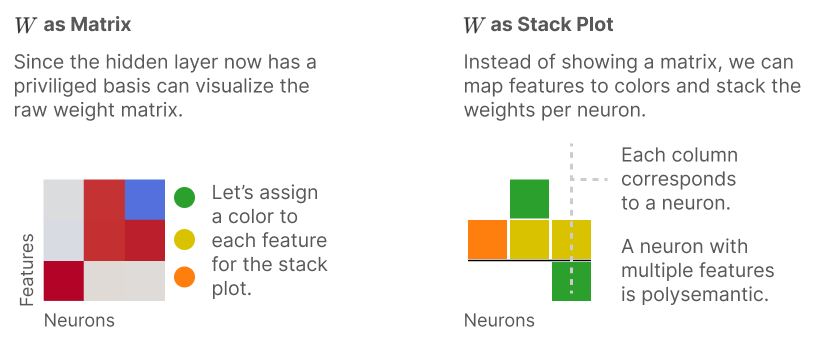
Sparse autoencoders: a technique for extracting interpretable "features" from the model's internal representations. Each feature corresponds to an identifiable concept: "the Eiffel Tower", "Python code", "sarcasm", "organic molecules". You can read and understand what the model "knows".
Scaling monosemanticity: Anthropic found millions of these interpretable features in Claude 3 Sonnet. It's a huge step toward understanding internal workings. If you can identify the features responsible for undesirable behavior, you can potentially modify or remove them.
This research isn't just academic. If you can understand how a model makes its decisions, you can detect problems before they manifest in production. That's the promise of interpretability.
The Products: From Research to Market
- Claude.ai: the web interface (free and paid tiers). The direct equivalent of ChatGPT.
- Claude Code: a CLI (command-line) agent for programming. The model understands your codebase, navigates files, writes and modifies code.
- Claude API: for developers. Integration into applications, pipelines, and systems.
- Amazon Bedrock: Claude via AWS (Amazon invested $4 billion in Anthropic). The enterprise distribution par excellence.
- Computer Use: Claude can interact with graphical interfaces (click, type, navigate). The foundations for truly autonomous agents.
Anthropic preaches caution in the face of advanced AI. But it also builds the most powerful models possible. It argues that it's by being at the frontier that you can see and mitigate risks. If you don't build the most advanced models, you don't know what safety problems they pose. Critics ask: is this a "responsible race" or a rationalization of the race for profits? The answer depends on whether Anthropic truly maintains its safety investments when commercial pressure intensifies.
2026 update
The Opus family went through several closely spaced iterations across 2025-2026. The common thread: steady gains in coding and agentic tasks, paired with greater efficiency and a sustained focus on reliability.
-
Claude Opus 4.5 (November 2025): at release, state of the art in coding on the SWE-bench benchmark (solving real programming tasks drawn from GitHub repositories). Beyond the score, two practical changes stood out: a strong reduction in the number of output tokens for comparable answer quality (the model is more concise, hence cheaper to run), and a marked price drop, on the order of $5 / $25 per million tokens for input / output. The model also introduced an "effort" parameter (to tune how much compute the model spends on a request) and more explicit context management.
-
Claude Opus 4.6 (February 2026) and Claude Opus 4.7 (April 2026): two iterations that consolidated the trajectory. Further gains in coding, in vision (understanding images and visual documents), and on multi-step agentic tasks, the chains where the model must plan, use tools, and keep a coherent state across several turns.
-
Claude Opus 4.8 (May 2026): the last iteration of the 4.x generation. The emphasis is on honesty and reliability, fewer hallucinations and more predictable behavior. It's the concrete, product-level expression of Anthropic's long-standing positioning: a model you can rely on with confidence matters as much as one that scores points on a benchmark.
-
Claude Fable 5 and Claude Mythos 5 (June 9, 2026): not one more iteration but a new tier. The "Mythos" class sits above Opus in the hierarchy; Fable 5 is presented as the most capable model Anthropic has ever made generally available ($10 / $50 per million input / output tokens). Mythos 5 is the same model with certain safeguards removed, restricted to approved partners and research programs.
-
Claude Opus 5 (July 24, 2026): the economical version of that new tier. Anthropic claims performance close to Fable 5 on many tasks at half the price ($5 / $25).
-
Claude Fable 5.1 and Mythos 5.1 (September 1, 2026): same price as Fable 5 ($10 / $50), but cache reads cut fourfold (from $1 to $0.25 per million tokens), which mostly changes the bill of agents running for a long time on the same context. The announced gains are on terminal agent tasks (Terminal-Bench 4.0: 55.8% against 42.0% for Fable 5; AutomationBench: 31.4% against 17.1%). Safeguards were retuned: around 60% fewer interventions per Claude Code session, and in cybersecurity, vulnerability discovery is allowed for defensive purposes while exploit generation stays blocked. Mythos 5.1 remains the same model with lighter safeguards, restricted to vetted organizations in cybersecurity and life sciences. Available on the API and at AWS, Google Cloud and Azure.
-
Claude Opus 5.5 (September 22, 2026): the first model of the 5.5 generation, and a rare case where the lower tier overtakes the one above it. On Anthropic's table, Opus 5.5 beats Fable 5.1 on every published benchmark (Terminal-Bench 4.0: 66.4% against 55.8%; OSWorld 2.0: 81.8% against 80.7%), at $4 / $20 per million tokens, 60% less per token than Fable 5.1 and 20% less than Opus 5. Adaptive thinking is always on, set by five effort levels (medium by default). The most interesting technical change is discreet: each thinking block is now bound by signature to the conversation that produced it (system prompt, tools, earlier messages), and replaying it after editing that prefix returns an error. That is precisely the defence against reusing blocks across sessions described in encrypted reasoning. Sonnet 5.5 and Haiku 5.5 are announced for the following weeks.
The lineup now reads as four tiers: the Mythos class (with Fable 5) on top, then Opus, Sonnet, and Haiku. A single release ships a whole scale of models, the same logic as Sol/Terra/Luna at OpenAI. It is not neutral from a security standpoint (see encrypted reasoning: the guard asymmetry between members of one family is exactly what extraction attacks exploit).
The price drop and the reduction in output tokens aren't just numbers: they lower the real cost of deploying at scale. The "effort" parameter lets you trade speed/cost against depth of reasoning depending on the task. And the focus on honesty speaks directly to the needs of regulated users (legal, finance, healthcare): a model that acknowledges its uncertainty is easier to fold into a process where mistakes carry consequences.