How a Gaming Company Controls Global AI
15 years ago, NVIDIA made graphics cards for playing video games. Machine learning researchers then discovered that these GPUs (Graphics Processing Units), designed to compute millions of pixels in parallel, were perfect for multiplying neural network matrices.
Today, NVIDIA is worth over $3 trillion. It's one of the most valuable companies in the world. Why? Because it controls the infrastructure on which all of global AI relies. Not the models. Not the data. The physical computing infrastructure.
The historical analogy: NVIDIA is to LLMs what oil companies were to the automobile. You can build the best car in the world, but if you can't buy gas, it doesn't move.
NVIDIA controls 80 to 90% of the GPU market for AI training. And it's not just hardware: it's the CUDA software ecosystem that creates total lock-in. Migrate to AMD? It breaks all the code. The technical inertia is immense. It's a competitive advantage that's almost impossible to overcome.
The Hardware: The Generation That Changes Everything
The H Series: The Current Standard
H100 (2023) is the chip that defined the era of modern LLMs. It's on clusters of H100s that OpenAI trained GPT-4, Meta trained LLaMA 2 and 3, and virtually all major models of 2023-2024 came to life.
The numbers are staggering: 80 billion transistors, 80 GB of HBM3 memory with 3.35 TB/s bandwidth, and a price tag of $30,000 to $40,000 per GPU. A typical training cluster uses thousands of H100s, do the math. Demand was so strong that delivery times reached 6 to 12 months in 2023-2024, creating a genuine global shortage.
H200 is an evolutionary improvement: same architecture, but with 141 GB of HBM3e memory (nearly double the H100). It's the solution for models that don't fit in memory on an H100.
Blackwell: The New Generation
B100/B200 (2024-2025) represent a true generational leap, not just an evolution. The B200 is 2 to 4x faster than the H100 for training, thanks to several combined innovations:
The second-generation Transformer Engine now supports FP4 (4 bits) for inference, twice as compact as the H100's FP8. Concretely, a model that ran on 4 GPUs in FP8 can now fit on 2 GPUs in FP4, with almost no quality loss.
5th-generation NVLink doubles bandwidth to 1.8 TB/s between GPUs, reducing the main bottleneck of distributed training: the time spent synchronizing gradients between GPUs.
To put this in perspective: a cluster of 1,000 B200s does the work of 2,000 to 4,000 H100s. That cuts the hardware budget in half, or doubles training speed at constant budget.
Cluster Infrastructure: Connecting Thousands of GPUs
A single GPU isn't enough to train a modern LLM. You need thousands, and the real challenge isn't the power of each GPU, it's how fast they talk to each other. A GPU waiting for data from another GPU is a GPU that's not computing. And at $40,000 per chip, every second of waiting costs money.
NVIDIA understood this and provides the entire networking stack, from the most local to the most global:
NVLink connects GPUs within the same server. It's a direct cable between GPUs, at 900 GB/s, 14 times faster than the classic PCIe bus. When two GPUs in the same server need to exchange gradients, it goes through NVLink. Without it, distributed training would be 10x slower.
NVSwitch is the switch that organizes these connections. In a server with 8 GPUs, every pair of GPUs might need to communicate. NVSwitch allows any GPU to talk to any other at full speed, without bottlenecks. It's like a telephone switchboard that connects any extension to any other without a queue.
InfiniBand handles communication between servers. When you have 1,000 GPUs spread across 100 servers, you need a network connecting these machines. Standard Ethernet (the kind in your home router) is far too slow and generates too much latency. InfiniBand is a network specialized for high-performance datacenters: 400 then 800 Gb/s per link, with a technology called RDMA (Remote Direct Memory Access) that allows a GPU to read directly from the memory of another remote GPU, without going through the CPU. It's the difference between sending a letter through the mail and reading directly from the other person's screen.
DGX SuperPOD is the turnkey solution: NVIDIA sells you the complete rack with servers, GPUs, InfiniBand networking, liquid cooling, and management software. You plug in, power on, and train. The price? Tens of millions of dollars.
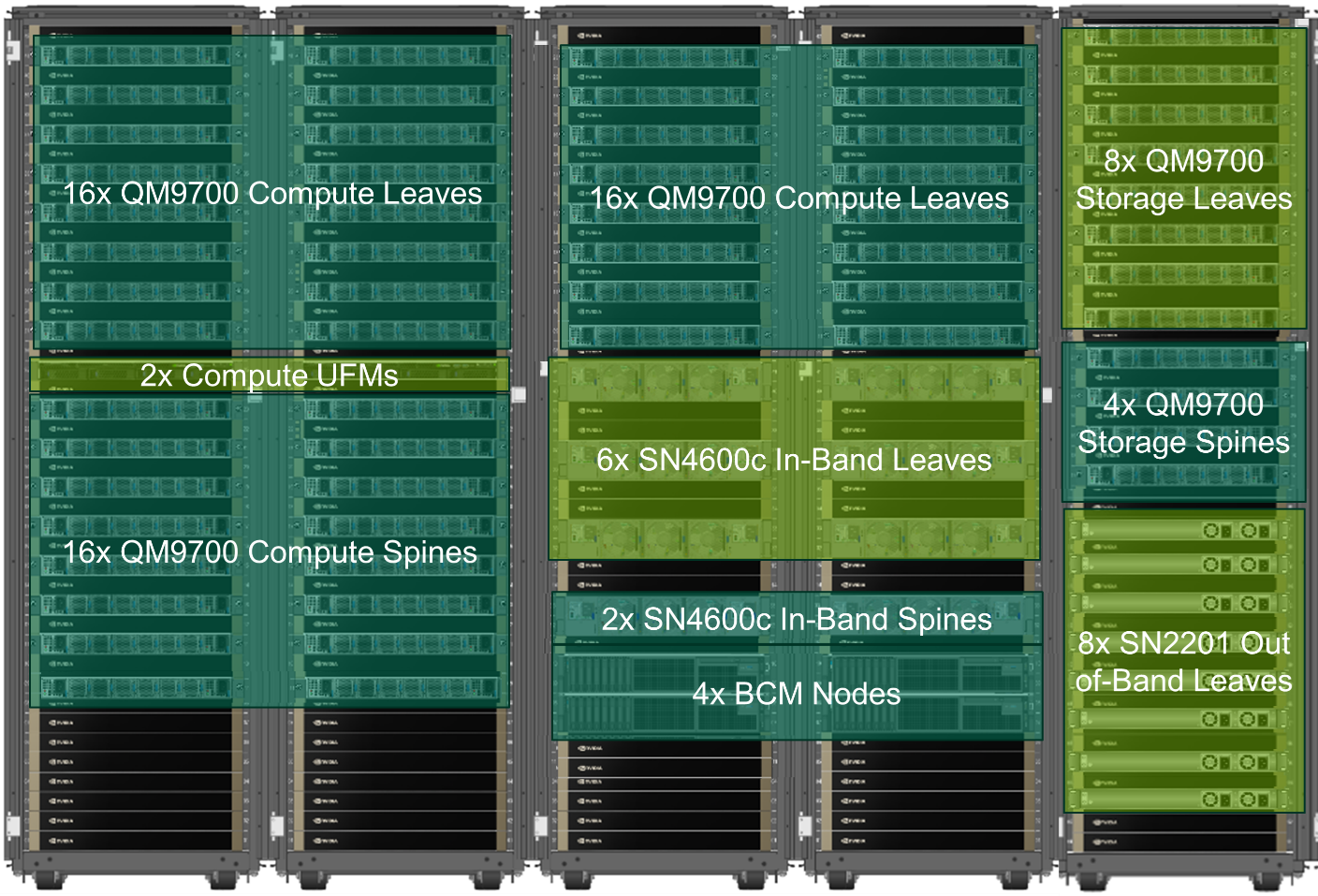
NVIDIA doesn't just sell the engine. It sells the engine, the transmission, the chassis, the road, and the toll booth.
Demand for AI GPUs massively exceeds supply. Companies order years in advance. Secondary market prices can be 2 to 3x the list price. Google, Microsoft, and Meta each spend billions of dollars per year on NVIDIA GPUs. It's an arms race where the currency is silicon.
The Software Ecosystem: The Real Lock-In
CUDA: The Secret Weapon
CUDA (Compute Unified Device Architecture), launched in 2006, is the real source of NVIDIA's power. It's the language and programming environment for writing code for NVIDIA GPUs.
All of AI runs on it. PyTorch, TensorFlow, JAX: all use CUDA under the hood. Millions of developers are trained on CUDA. Years of optimized libraries are built on CUDA.
Migrating to AMD (ROCm) or Intel? That means rewriting or adapting all the code, libraries, tools, and workflows. It's an enormous transition cost that few organizations are willing to pay. It's the most powerful vendor lock-in in the current tech industry.
Key Libraries
On top of CUDA, NVIDIA has built layers of libraries that all frameworks use without you knowing:
- cuDNN accelerates neural network operations (convolutions, attention, normalization). When PyTorch executes an attention layer, it's cuDNN doing the work behind the scenes.
- cuBLAS optimizes matrix multiplications, the fundamental operation of every neural network. Without cuBLAS, training would take weeks instead of days.
- TensorRT optimizes models for production: it fuses operations, quantizes weights, and eliminates unnecessary computations. Result: a model that runs 3 to 5x faster in inference.
- TensorRT-LLM is the specialized version for LLMs, with continuous batching (processing multiple requests in parallel) and paged attention (managing memory intelligently).
- Triton is a high-level GPU programming language, created by OpenAI and adopted by NVIDIA. More accessible than raw CUDA, it lets you write GPU kernels in near-Python.
Frameworks
- NeMo: NVIDIA's in-house fine-tuning and pre-training framework for LLMs. Used by many companies to adapt models to their needs.
- RAPIDS: the GPU equivalent of pandas and scikit-learn. You take your data science code, replace
import pandaswithimport cudf, and your processing goes from minutes to seconds. - Isaac: robotics and physics simulation platform. Lets you train robots in virtual worlds before releasing them into the real world.
NVIDIA Also Builds Its Own Models
NVIDIA is no longer content being just a hardware supplier. The company develops its own AI models, which worries its customers (who are also its competitors):
- Nemotron is a family of LLMs ranging from 8B to 340B parameters. NVIDIA trains them on its own clusters and offers them as open-source, in direct competition with Meta (LLaMA) and other open models.
- GR00T is a foundation model for humanoid robots, capable of understanding language and translating it into physical actions.
- VILA is a collection of vision-language models that understand both images and text.
- DGX Cloud provides access to pre-configured NVIDIA GPU clusters via the cloud, without buying the hardware. You pay per hour of compute.
It's a strategy of vertical integration: NVIDIA wants to be present at every layer, from silicon to model. This gives them a unique advantage, they can optimize each layer of the stack to work perfectly with the others.
NVIDIA also contributes significantly to research. Flash Attention was optimized on their GPUs. Megatron-LM is their framework for training large-scale LLMs (used by many labs). Their researchers regularly publish in top conferences.
The Competition: Alternatives Are Emerging
AMD: the most serious challenger. The MI300X rivals the H100 on paper (192 GB of HBM3). But ROCm (the CUDA alternative) remains immature. Adoption is slow. The problem isn't the hardware, it's the software.
Intel: with Gaudi 3, Intel is attempting a comeback after years of falling behind in AI. The hardware is decent, but the software ecosystem isn't up to par. Intel is betting on price (cheaper than NVIDIA) to convince, but few major labs have made the switch.
Google: TPUs (Tensor Processing Units). Excellent for Google's internal needs. Not really available elsewhere (except via Google Cloud). A competitive advantage for Google, not for the ecosystem.
Amazon: Trainium/Inferentia. Custom chips for AWS customers. Economical, but limited software ecosystem.
Startups: Cerebras (wafer-scale chip, a single integrated circuit the size of an entire silicon wafer), Groq (ultra-fast inference with a deterministic architecture), SambaNova. Technologically interesting, but none has reached the critical mass to threaten NVIDIA.
NVIDIA remains dominant. The software gap (CUDA) is larger than the hardware gap.
NVIDIA is caught in the US-China geopolitical competition. American export restrictions ban the sale of H100/H200 to China. NVIDIA created downgraded versions (H800, A800) to work around the restrictions, but even those are now limited. DeepSeek trained its models on H800s. These restrictions could expand and have a lasting impact on the market.
2026 update
NVIDIA's "build our own models" strategy reached a new milestone with the Nemotron 3 family, rolled out in stages: the Nano version shipped in late 2025, and the lineup scales up gradually to the Ultra version expected around mid-2026. These aren't just more LLMs: they are open-weight models (weights freely downloadable) that mark a genuine architectural shift.
Where Nemotron 1 and 2 stayed conventional Transformers, Nemotron 3 adopts a hybrid Mamba-Transformer architecture combined with a Mixture-of-Experts. In plain terms, two ideas stack together:
- Hybrid Mamba-Transformer: most layers are Mamba-style SSMs (state-space models), which process a sequence by keeping a small memory state that updates token after token, near-linear cost, not the quadratic cost of attention. A few attention layers are kept where they genuinely help. This is exactly the trade-off described in the course pages on Mamba and hybrid SSM + attention architectures.
- Mixture-of-Experts (MoE): the model holds many "expert sub-networks" but activates only a few of them per token. You get large total capacity for a reduced compute cost per token.

The stated goal is high-throughput inference over very long context: these models target windows on the order of a million tokens while staying fast, precisely because the SSM part does not pay attention's quadratic cost as the context grows.
Until now, hybrid SSM + attention architectures were mostly research artifacts. The fact that a player like NVIDIA turns one into an open-weight product family released in several sizes is a sign that these architectures are reaching industrial scale, and that quadratic attention is no longer the only default choice for long-context models.
The figures above (window size, timeline) are orders of magnitude and the lineup keeps evolving; what matters is the underlying trend, not the exact number.