Open-Source Democratizes Image Generation
AI image generation has experienced a spectacular democratization thanks to open-source models. Stability AI started the movement with Stable Diffusion, and Black Forest Labs (founded by ex-Stability researchers) took the baton with Flux. These companies made high-quality image generation accessible to everyone, not just users of proprietary APIs.
The impact is comparable to what LLaMA did for text models: giving the entire world the tools to create, experiment, and build.
OpenAI's generators (DALL-E, then the image generation built into ChatGPT since 2025), Midjourney and Google's Nano Banana are proprietary: accessible only via API or web interface. You control nothing, you pay per image or by subscription. Stable Diffusion and the open versions of Flux are downloadable and runnable on your own GPU. You can modify them, fine-tune them, and integrate them into your tools. This approach has created an unprecedented ecosystem of customization, fine-tuning, and community extensions.
A word of caution on vocabulary: downloadable does not mean free. These are open-weight models: the parameters are published, but the licence may forbid commercial use without a paid agreement, which is the case for several Flux versions and for the large recent Stable Diffusion models.
Stability AI: The Pioneer
Stable Diffusion: The 2022 Revolution
Stable Diffusion, launched in August 2022, is the model that democratized AI image generation. Before it, DALL-E 2 was impressive but inaccessible (waitlist, closed API). Stable Diffusion? Download, install, generate. On your own PC.
The evolution of the family:
- SD 1.5 (2022): the founding model. 860M parameters. Trained on LAION-5B (5 billion web images). 512x512 resolution. Modest quality by current standards, but revolutionary at the time.
- SD 2.0/2.1: resolution improvements (768x768) and quality upgrades, but mixed reception (the CLIP encoder change disrupted the community).
- SDXL (2023): 6.6 billion parameters. 1024x1024 resolution. Significantly improved quality. Two cascaded U-Nets (base + refiner).
- SD 3 / SD 3.5 (2024): new Multimodal Diffusion Transformer (MMDiT) architecture. U-Net replaced by a Transformer, trained with rectified flow (the technique explained below with Flux). Better text rendering in images. The first open release, SD 3 Medium (June 2024), was poorly received: often mangled human bodies and a licence seen as too restrictive. SD 3.5 (October 2024) corrected course with three models (Large, 8.1 billion parameters; Large Turbo, its fast version; Medium, 2.5 billion) under a community licence that is free, commercial use included, for organizations with less than one million dollars in annual revenue.
How Stable Diffusion Works
The Stable Diffusion pipeline includes several components that work together:
- VAE (Variational Autoencoder): compresses images into a much smaller latent space (8x spatial compression). Instead of denoising a 512x512 image (262,144 pixels), you work in a 64x64 space. This is what makes generation feasible on a consumer GPU.
- U-Net (or DiT for SD3): the main denoising network. It takes noise and progressively transforms it into a coherent image in latent space.
- CLIP text encoder: transforms the text prompt into a vector representation that the U-Net understands. It's the bridge between language and image.
- Scheduler: the algorithm that controls the denoising process step by step (DDPM, DDIM, Euler, DPM-Solver, etc.). The choice of scheduler affects both quality and speed.
The Community Ecosystem: The Real Strength
The community around Stable Diffusion has become a phenomenon in its own right:
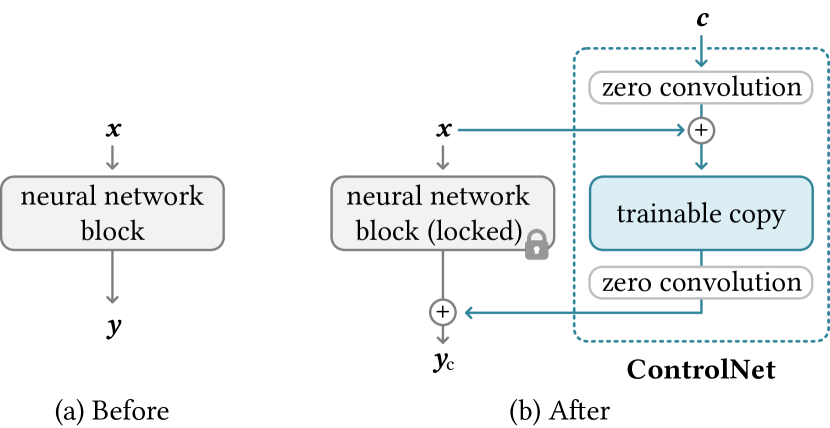
- ControlNet: precise control of generation through human pose, contours (canny edges), depth maps, or semantic segmentation. You draw a skeleton, Stable Diffusion generates a character in that pose.
- LoRA: lightweight fine-tuning to customize style, subject, or character. With a few dozen images and an hour of compute, you can train a unique style.
- ComfyUI: visual node-based workflow interface. You connect components like a circuit. Extremely flexible.
- Automatic1111 / Forge: full web interfaces with dozens of extensions.
- Civitai: community platform for sharing models and LoRAs. Thousands of specialized models (art styles, characters, textures).
With LoRA and DreamBooth, anyone can fine-tune Stable Diffusion on their own images (their face, their art style, a specific object) with a simple consumer GPU (an RTX 3060 is enough). This personalization has opened creative uses impossible with proprietary models: consistent visual identity, stylized video game assets, personalized concept art.
Turbulence at Stability AI
Stability AI has experienced significant difficulties:
- Departure of founder Emad Mostaque in March 2024
- Financial difficulties and successive restructurings
- Departure of key researchers (Robin Rombach and his team, who founded Black Forest Labs)
- Questions about the economic viability of the "all open-source" model without sufficient revenue
2024-2026: Refocusing on the Creative Industries
The company did not collapse; it changed course.
- New leadership (June 2024). A group of investors led by Sean Parker (Napster co-founder, who became executive chairman), including Coatue, Greycroft and Eric Schmidt, recapitalized the company. Prem Akkaraju, former head of the visual-effects studio Weta Digital, became CEO. Film director James Cameron joined the board in September 2024.
- A new target customer. Stability no longer tries to win the race for the most powerful image model open to all. It now presents itself as a supplier of AI tools for creative professionals: music, video games, advertising, film. Its range has spread beyond images: audio and music generation (Stable Audio, including a small open version that runs on a phone, built with Arm), video and 3D (for instance Stable Virtual Camera, which creates new viewpoints from a handful of photos).
- Partners who bring their catalogues. Advertising group WPP invested in March 2025; Electronic Arts and Universal Music Group signed co-development deals in October 2025, Warner Music Group in November 2025. The principle: build models with these partners' content and rights, rather than with images collected from the web without permission. That is the logic described in Training only on open or licensed data and The training data market.
- A $76 million round (August 2026), whose new investors included the three major record labels (Sony Music, Universal, Warner), Electronic Arts and AMD. The company, founded in London, closed its London office and shifted its focus to the United States, in Los Angeles, close to its entertainment clients.
The pioneer of open image generation has thus become a supplier to the entertainment industry, closer to rights holders than to the community that made its name in 2022.
Black Forest Labs and Flux: The New Generation
Founded by the Original Creators
Black Forest Labs, based in Freiburg im Breisgau in Germany (hence the name), was founded in 2024 by Robin Rombach and other key researchers from Stability AI, with initial funding of $31 million led by Andreessen Horowitz. These are the same people who created Stable Diffusion and invented the Latent Diffusion architecture (the foundational paper). It's the technical team leaving to better execute their vision.
Flux: The Technical Successor
Flux represents the new generation of image generation:
- Flux.1 [dev]: high-quality open-source model, for research and developers
- Flux.1 [schnell]: ultra-fast version (4 denoising steps instead of 20-50). Near-instantaneous generation.
- Flux.1 [pro]: proprietary maximum quality version, via paid API
- Diffusion Transformer (DiT) architecture with rectified flow
- 12 billion parameters, quality rivaling Midjourney and DALL-E 3
Flux's Technical Innovations
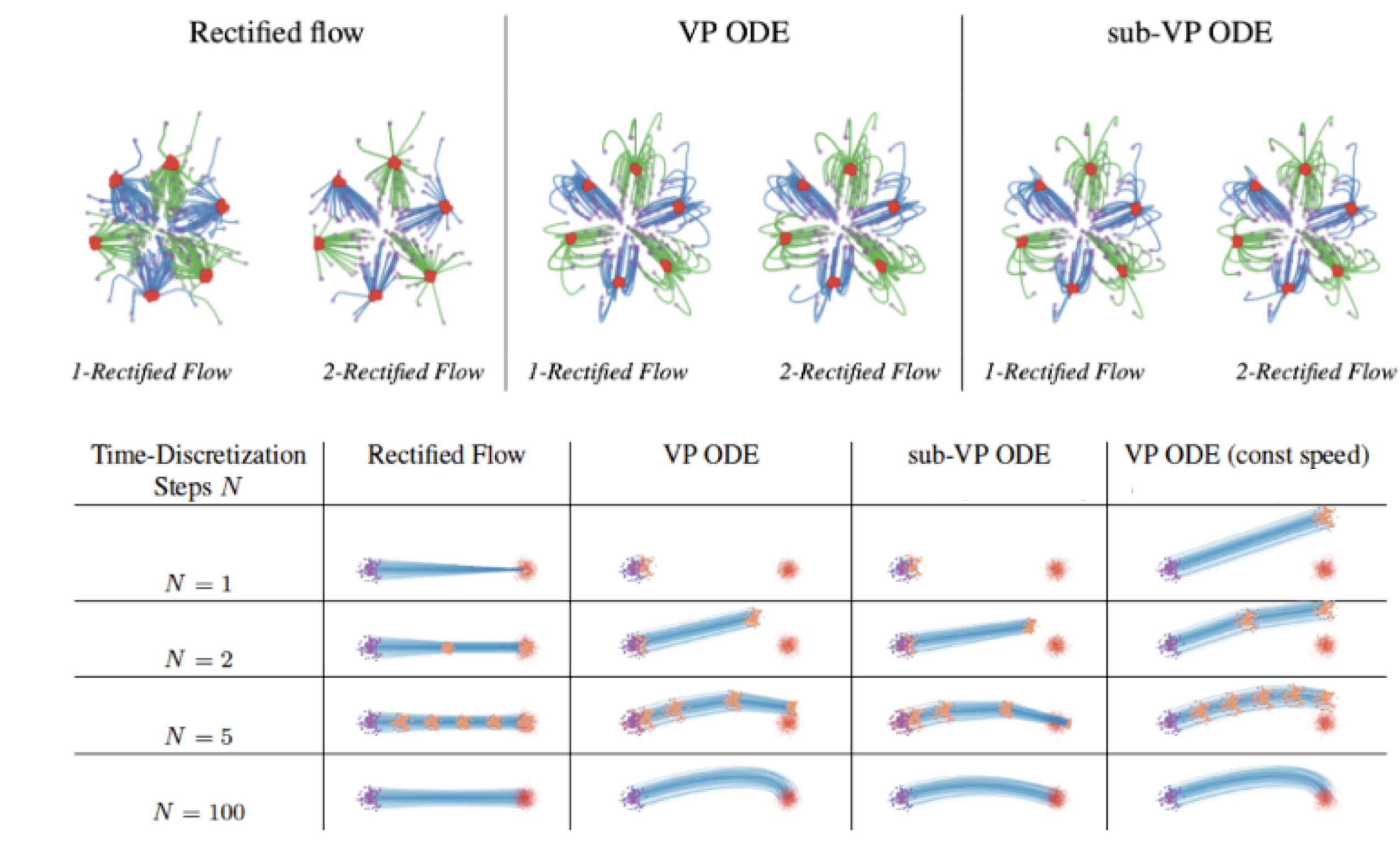
- Rectified Flow: denoising trajectories are more direct than in classic DDPM. Instead of following a winding path from noise to image, rectified flow traces a nearly straight line. Result: fewer steps needed, faster generation.
- DiT Architecture: the traditional U-Net is replaced by a Transformer. Better scaling (Transformers scale better with parameters), better overall image coherence.
- T5-XXL text encoder: a much more powerful text encoder than CLIP. Better understanding of complex, long, and nuanced prompts.
- Guidance distillation: a technique to reduce the number of inference steps while maintaining quality.
The evolution from Stable Diffusion 1.5 (U-Net, 860M parameters) to Flux (DiT, 12B parameters, then 32B for FLUX.2) reflects a trend touching all of AI: Transformers are replacing specialized architectures across all domains. In image generation, DiTs offer better scaling and better quality at large scale. The Transformer truly is the universal architecture.
Since 2025: Editing, Then Generating Everything
In two years Black Forest Labs has become one of the world's leading image labs, with a so-called open core strategy: open versions for the community and researchers, more powerful versions sold through an API.
- FLUX.1 Kontext (May 2025): the shift from generation to editing. You hand it an image and an instruction in plain language ("give her a hat", "change the background to a beach", "write SALE on the shop window") and the model changes the image while leaving the rest intact, including a character's face from one edit to the next. An open version (Kontext [dev], non-commercial licence) followed in June 2025. Adobe built Kontext into Photoshop in September 2025.
- FLUX.2 (25 November 2025): a new generation that combines generation and editing, accepts several reference images at once (to keep the same product or character across an entire campaign) and outputs images of up to 4 megapixels. The open [dev] version has 32 billion parameters (non-commercial licence); to understand prompts it relies on a 24-billion-parameter vision-language model from Mistral AI. The [pro], [flex] (specialized in text and typography) and [max] versions are sold through the API. January 2026 brought the small FLUX.2 [klein] versions (4 billion parameters under the Apache 2.0 licence, free to use, and 9 billion under a non-commercial licence), light enough for a consumer graphics card.
- Money and partners. A $300 million round in December 2025 (led by AMP and Salesforce Ventures) valued the company at $3.25 billion. Flux models are built into many products: Mistral AI's Le Chat as early as November 2024, Photoshop, Microsoft's cloud platforms, and a deal with Meta. The integration into xAI's Grok in summer 2024, on the other hand, was short-lived: xAI switched to its own model in December 2024.
- FLUX 3 (July 2026): a change of scale. Announced on 23 July 2026, FLUX 3 is presented as a multimodal model trained on images, video and sound, able to produce images, video clips of about twenty seconds with their soundtrack, and even robot actions (a strand developed with the Swiss startup mimic robotics). The announced performance comes mostly from Black Forest Labs' own evaluations, and access was opened gradually, first to selected testers. The link between video generation and robotics is explained in World models.
The contrast with Stability AI is striking: the researchers who left in 2024 kept their technical course (frontier models, partly open), while the company they left changed trades.
The Competitive Landscape
Proprietary Rivals
- Midjourney: the benchmark for aesthetic quality, long usable only through Discord, now through its website too. Version 7 in April 2025, first video model in June 2025.
- OpenAI: DALL-E 3 was replaced in March 2025 by ChatGPT's native image generation, which follows long prompts very well and can write legible text into the image.
- Google: Imagen 4 and above all Nano Banana (Gemini 2.5 Flash Image, August 2025), then Nano Banana Pro (November 2025), which became references for editing images by simple instruction.
- Ideogram: specialist in text rendering in images (signs, logos, posters).
- Seedream (ByteDance): one of the best-ranked Chinese models in comparisons.
Open Alternatives
- Qwen-Image (Alibaba, August 2025): 20 billion parameters, Apache 2.0 licence, known for text in images, in Chinese as well as English
- HiDream-I1 (2025): open model under the MIT licence
- HunyuanImage (Tencent): a family of open models
- PixArt: efficient DiT model, less resource-hungry
- Playground v2.5: optimized for aesthetic quality
- Kolors (Kuaishou): high-quality Chinese model
The centre of gravity of open image models has moved: in 2022 it was in London with Stability; in 2026 it is split between Black Forest Labs in Germany and the big Chinese groups, which often publish under more permissive licences.
Applications and Ethical Issues
Creative Applications
- Illustration and concept art (rapid visual idea prototyping)
- Graphic design and advertising (rapid variations, visual A/B testing)
- Texture and asset generation for video games
- Storyboarding for film and animation
- Fashion and product design (concept exploration)
The Ethical Issues Accompanying This Technology
- Copyright: models are trained on billions of web images, often without the original creators' consent. Artists are legitimately concerned.
- Deepfakes: realistic portrait generation of real people, with risks of identity theft and misinformation.
- Visual biases: reproduction and amplification of stereotypes (gender, ethnicity, professions).
- Economic impact on artists: disruption of the illustration, stock photography, and graphic design markets.
Stability AI and others face major lawsuits from artists and photo agencies (Getty Images) for unauthorized use of images in training data. The first major ruling came on 4 November 2025, when the High Court in London rejected most of Getty's claims against Stability (a model that does not store its training images is not an infringing copy of them), siding with Getty only on a narrow trademark point linked to watermarks, and Getty was granted permission to appeal. In the United States, where the question of fair use (the American exception allowing some uses of protected works without permission) is at stake, the cases brought by artists and by Getty are following their own timetable, and that is where most of the question will be settled. The state of the rulings is covered in What the courts have said about training.