The Forgotten Market: Companies That Need Real Tools
OpenAI targets consumers. Google too. Anthropic targets safety and power.
Cohere and AI21 Labs target something very different: the IT directors who are concretely wondering: "How do I integrate reliable AI into my existing system, without sending my confidential data to California, with technical support, and a guaranteed SLA (Service Level Agreement)?"
It's not sexy. It doesn't make the front page of tech news. But it's a multi-billion dollar market. Companies don't want a cool chatbot. They want a tool that works, integrates, is secure, and has someone on the other end of the line when things break.
In enterprise, the selection criteria are radically different from the general public. What matters: reliability (it has to work every day, not 90% of the time), confidentiality (customer data doesn't leave our servers), on-premise deployment (we install it on our infrastructure, not on the public cloud), support (a reachable technical contact), and compliance (GDPR, SOC2 for data security, HIPAA for healthcare). Cohere and AI21 are built around these requirements.
Cohere: The Search and RAG Specialist
Cohere was founded in 2019 by Aidan Gomez (co-author of the 2017 Transformer paper), Ivan Zhang, and Nick Frosst (former Google Brain, supervised by Geoffrey Hinton). It's top-tier technical pedigree: the guy who co-invented the architecture underlying all modern LLMs runs the company.
Command R: The Model Built for Enterprise
Command R and Command R+ are the flagship models, specifically designed for enterprise use cases:
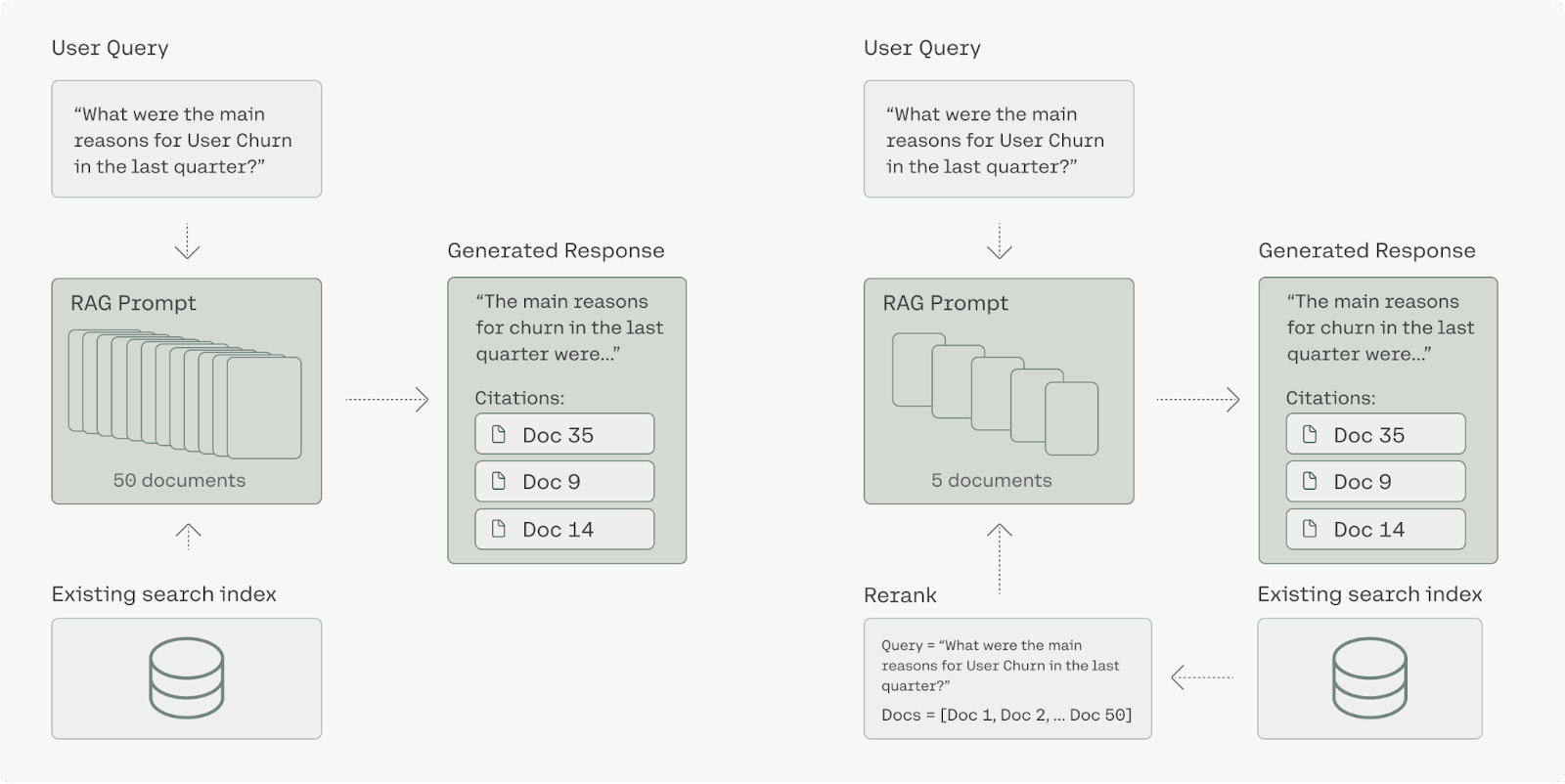
- Command R: 35 billion parameters. Specialized for RAG (Retrieval-Augmented Generation). The idea: instead of answering from memory (and risking hallucinations), the model first searches your documents, your database, your files. Then it answers by citing its sources.
- Command R+: 104 billion parameters. More powerful. Same philosophy.
- Grounded generation: the model cites its sources. It doesn't just say "the answer is X." It says "the answer is X, found in document Y, paragraph Z." For a company that needs traceability, that's essential.
- Tool use: the model can call APIs, interact with external systems, and execute actions. Not just a chatbot, but an agent.
Embed and Rerank: The Search Tools
Beyond language models, Cohere excels at search tools:
- Embed v3: transforms text into vectors (embeddings) for semantic search. It's the building block of RAG. You have a document collection? You transform them into vectors with Embed, store them in a vector database, and when a user asks a question, you find the relevant documents by vector similarity. Works in 100+ languages.
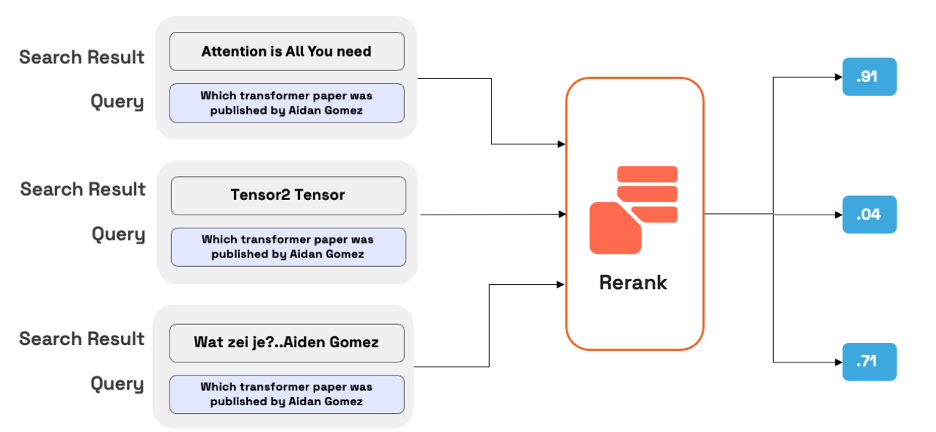
- Rerank: a re-ranking model. You have 100 raw search results? Rerank sorts them by actual relevance to the question. It dramatically improves RAG quality for minimal cost.
Command R works natively in 10+ languages. Embed v3 in 100+. For an international company with clients in French, Spanish, German, Japanese, Arabic? Cohere is a natural choice. American models (GPT, Claude) are optimized for English first. Cohere thinks global from the design stage.
Aya: Multilingual Open-Source
Aya is a remarkable project. Cohere trained multilingual models in 23 languages, with annotators in 119 countries. It's not an English model automatically translated. It's a model designed as multilingual from the start, with native data in each language. The instructions, preferences, and response styles are adapted to each linguistic culture.
AI21 Labs: Architectural Innovation from Israel
AI21 was founded in 2017 in Israel by Yoav Shoham (professor emeritus at Stanford), Ori Goshen, and Amnon Shashua. It's one of the oldest LLM companies, and it chose a different angle: architectural innovation.
Jamba: The Transformer + Mamba Hybrid
AI21's major innovation is called Jamba. It's a hybrid architecture that combines two fundamentally different approaches:
- The Transformer: excellent for global attention (every token sees all others), but quadratic complexity O(n^2) that makes long texts expensive.
- Mamba (State Space Model): linear complexity O(n), very efficient for long sequences, but without the Transformer's explicit global attention.
Jamba alternates Transformer layers and Mamba layers within the same model. The result combines the strengths of both:
- 256,000-token context window: multiple complete books. Analyze a 500-page report in one go.
- Memory efficiency: Mamba layers consume far less memory than attention layers.
- Speed: inference is faster than on a pure Transformer of comparable size.
Available versions:
- Jamba 1.5 Mini: 12 billion active parameters (52 total thanks to MoE)
- Jamba 1.5 Large: 94 billion active (398 total)
And it's open-source. Companies can deploy it on their own infrastructure.
The Transformer vs Mamba debate is often framed as a binary choice. Jamba shows you can take the best of both. Transformer layers for precise global attention (when the model needs to connect distant information). Mamba layers for efficient processing of long sequences (when context is vast). This might be tomorrow's architecture.
Who to Choose for What?
Cohere is the natural choice for:
- Enterprise RAG and semantic search
- International multilingual applications
- Automated customer support with source traceability
- Information retrieval pipelines
AI21 is the natural choice for:
- Processing very long documents (reports, contracts, books)
- Applications requiring a massive context window
- Companies interested in on-premise deployment of an innovative open-source model
Both compete in the same fundamental market: winning enterprise trust. Against the giants (OpenAI, Google, Anthropic), their weapon is specialization, innovation, and deployment flexibility.
GPT-5.4 dominates the generalist market. Gemini 3.1 Pro dominates through distribution (Google Workspace). Llama 4 is free and performant. Claude Sonnet 4.6 excels in safety and instruction-following. Cohere and AI21 need to innovate faster than ever to maintain their edge. The cost of inaction in AI is immense: every month without innovation, a competitor catches up.
2026 update
Positioning reminder: Cohere remains the enterprise-focused player, specialized in RAG (searching internal documents with source citations) and private / on-premise deployment.
In May 2026, Cohere released Command A+, an enterprise-oriented model that marks a step up from Command R / R+:
- Sparse Mixture-of-Experts (MoE) architecture: instead of activating the whole network for every word, only a subset of "experts" is engaged. The figures are on the order of ~218 billion total parameters, but only ~25 billion active per token. In practice: the richness of a very large model at an inference cost close to a much smaller one.
- Unified model: Command A+ brings vision (reading images and documents), reasoning, and agentic capabilities (tool calling, multi-step action execution) together in a single system.
- Open-weight under the Apache 2.0 license: the weights are released under a permissive license, allowing commercial use and deployment on your own infrastructure, consistent with the enterprise market's confidentiality requirements.
Sparse MoE answers a classic dilemma: you want a powerful model, but you don't want to pay a powerful model's inference cost on every request. By activating only a fraction of its parameters, Command A+ targets the best quality/cost trade-off, a decisive argument for large-scale internal deployments. The figures above are orders of magnitude.