Meta AI: LLaMA 1/2/3, Open-source Strategy
The Strategy: Democratize to Dominate
Meta could have built its own proprietary API. Copied OpenAI. Sold access to its models through a paid interface.
They chose the exact opposite: give the models to the world. For free. With a commercial license.
It's counterintuitive, but the logic is airtight:
- Prevent an OpenAI monopoly: if the best models are proprietary, OpenAI and Microsoft control the ecosystem. Meta doesn't want to depend on a competitor.
- Create a Meta ecosystem: thousands of developers and companies build on LLaMA. Meta's influence in AI grows.
- Benefit from free community improvements: the open-source community optimizes, fine-tunes, and improves the models. Meta reaps the insights.
- Reduce cloud providers' bargaining power: if models are free, AWS/Azure/GCP can't impose excessive prices to host them.
It's Google's Android strategy applied to AI: give away the operating system to control the ecosystem.
Meta is a massive company (2+ billion users on its platforms), but it doesn't have OpenAI's position in consumer AI or the cloud infrastructure of Amazon or Google. Open-source bypasses these problems: instead of selling models, Meta gives them away and benefits from the network effect. It's the "thousand flowers" strategy: let the ecosystem bloom and reap the indirect benefits.
LLaMA: Four Generations of Revolution
LLaMA 1 (February 2023): The Spark
- Sizes: 7B, 13B, 33B, 65B parameters
- LLaMA-13B outperforms GPT-3 (175B). How? Compute-optimal training, directly inspired by Chinchilla (more data, smaller model).
- Impact: triggered an explosion of derivatives (Alpaca, Vicuna, WizardLM)
- The weight leak (initially reserved for researchers) accelerated massive adoption
LLaMA 2 (July 2023): Going Commercial
- 7B, 13B, 70B parameters
- Permissive commercial license: commercial use allowed (unless you have more than 700M users)
- Chat versions fine-tuned with RLHF (Reinforcement Learning from Human Feedback) for dialogue
- Context: 4,096 tokens
LLaMA 3 and 3.1 (2024): Maturity
- 8B, 70B, 405B parameters (the largest open-weight model ever released)
- Context: 128K tokens. Multiple complete books.
- LLaMA 3.1 405B rivals GPT-4 and Claude 3.5 Sonnet on benchmarks
- 8 languages (not just English)
- Trained on 15 trillion tokens (50x LLaMA 1)
LLaMA 4 (2025): Efficiency
- Mixture of Experts (MoE) architecture: more efficiency, less compute per request
- Scout and Maverick models
- Scout: 10 million tokens of context (a record for open models)
- Competitive with the best proprietary models on benchmarks
Hundreds of derived models. Mistral is architecturally inspired by LLaMA. Alpaca showed that fine-tuning LLaMA costs $600. Dozens of companies use LLaMA as a foundation. It has truly become the "Linux of AI": an open base on which an entire ecosystem is built.
2026 Update: Muse Spark, the End of All-Open
Everything above describes a Meta that champions open weights. On April 8, 2026, that story stopped: Muse Spark, the first model of the next generation and the first product of Meta Superintelligence Labs, shipped closed, reachable only in the Meta AI app, on meta.ai and through an API. It is Meta's first frontier model since Llama 4 Maverick (April 2025), and the first not to publish its weights.
Meta gave two reasons, which converge on training-data governance: several Chinese companies had turned Llama 4 into competitive commercial products without giving anything back, and the EU AI Act coming into force in August 2026 made publishing weights heavier to shoulder. An open-weights version of Muse Spark 1.2 was promised on August 10, 2026 by Alexandr Wang ("soon"), but at the time of writing it has not shipped: the promise of openness has become an announcement, it is no longer the default delivery mode.
The pace, meanwhile, matches the competitors'. Muse Spark 1.3 (September 2, 2026) takes text, image and video over a one-million-token context, ranks sixth of 636 models on the Artificial Analysis index, and reports 75.4% on DeepSWE 1.1 with roughly 20% fewer tool calls and 25% fewer tokens than the previous version on agent tasks. Standard pricing is $1.25 input and $4.25 output per million tokens. One detail deserves attention: a second "contributor" endpoint, ten to twenty times cheaper, on condition that you let Meta train on your data. A discount in exchange for data is an explicit business model, to be read as such before accepting it.
What this changes for the rest of this page: the section below on Llama's impact stays true in the past tense. Open models did push prices down and forced closed ones to improve; but in 2026 that role is played by DeepSeek, Alibaba, Zhipu or Mistral, no longer by Meta.
Beyond LLMs: Contributions Across All Domains
Meta AI isn't limited to text. Its contributions span vision, audio, and infrastructure.
Vision and Multimodal
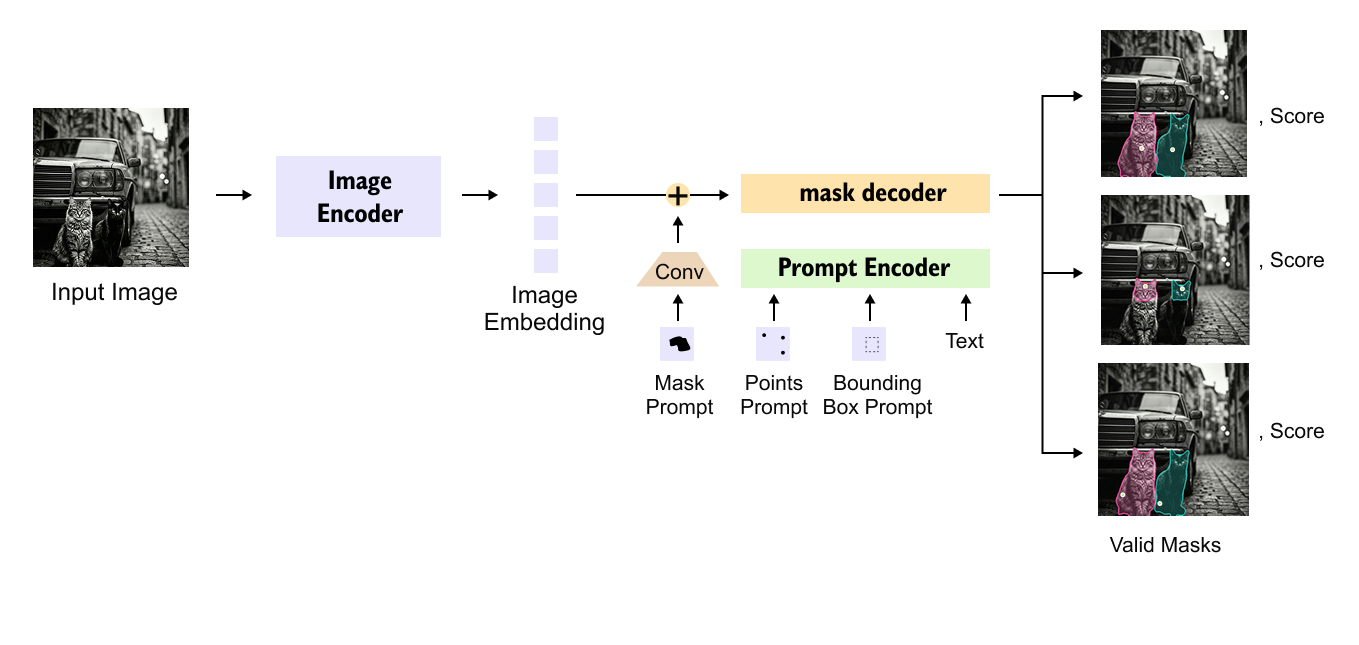
SAM (Segment Anything Model): a model that can segment (cut out) any object in any image, even objects it has never seen. Freely accessible. Massively used in industry (medicine, robotics, mapping). SAM 2 extends this to video.
DINOv2: self-supervised learning of state-of-the-art visual features. No need for annotated data: the model learns to "see" by comparing images to each other.
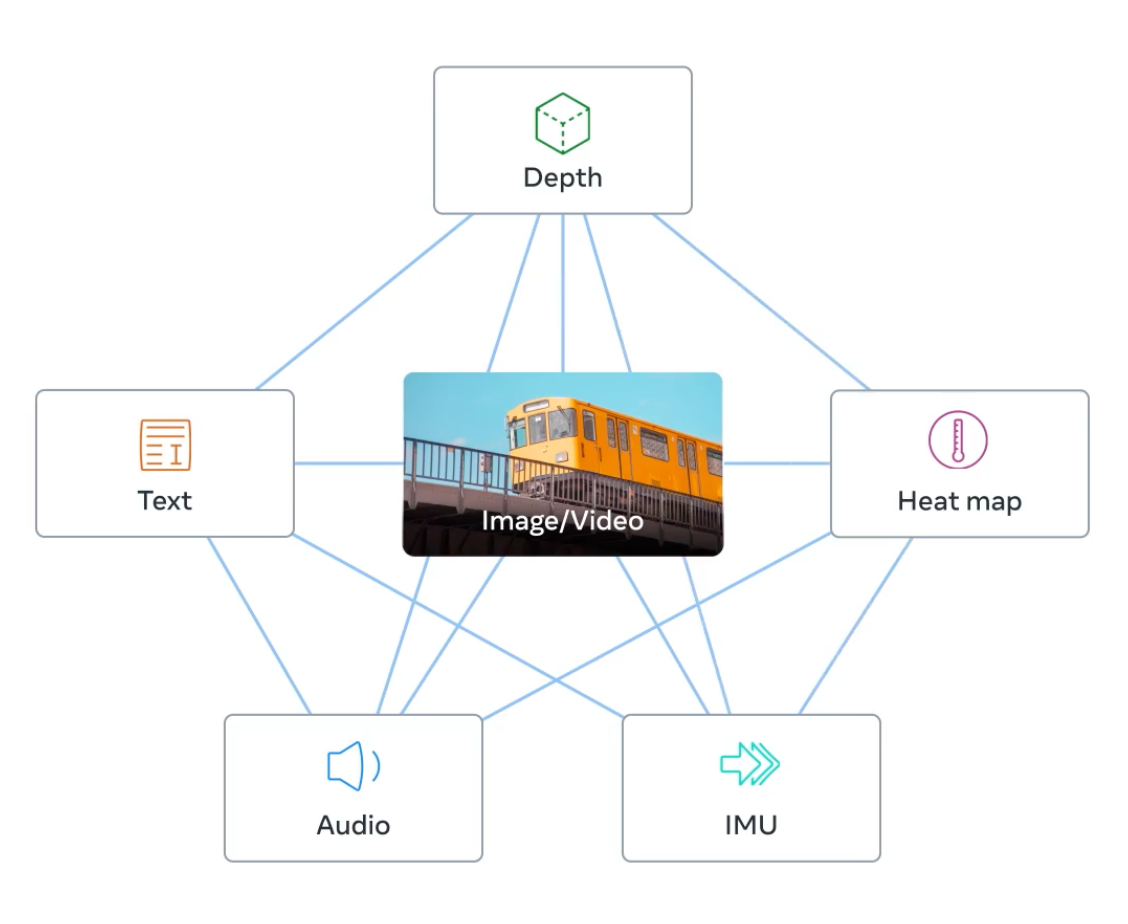
ImageBind: a multimodal embedding space that binds 6 modalities simultaneously (image, sound, text, motion, video, depth). You can search for a sound that matches an image, or a motion that matches a text.
Software Infrastructure
PyTorch: the most widely used deep learning framework in research and production. Created by Meta. It's the foundation on which virtually all current models are built. An indirect but immense contribution.
FAISS (Facebook AI Similarity Search): ultra-fast vector search library. It's the technical foundation of RAG (Retrieval-Augmented Generation) in practice. When you do semantic search across millions of documents, FAISS is probably behind it.
Llama Stack: unified infrastructure for deploying, fine-tuning, and customizing LLaMA models.
Fundamental Research
FAIR (Fundamental AI Research): Meta's research lab, one of the most prolific in the world in terms of publications.
Yann LeCun: Meta's Chief AI Scientist. Turing Award laureate (the equivalent of the Nobel Prize in computer science). Central figure of deep learning and vocal advocate of an alternative vision of AI.
Yann LeCun and the World Models Debate
Yann LeCun says something provocative: autoregressive LLMs (GPT, Claude, Gemini) won't lead to AGI. His thesis: predicting the next token isn't understanding the world. It's statistical mimicry, not intelligence.
His alternative vision: world models. Models that learn how the world works: physics, causality, relationships between objects. Not by generating pixels or tokens, but by predicting abstract representations (embeddings).
V-JEPA (Video Joint Embedding Predictive Architecture): the concrete project. Instead of predicting a video's pixels (expensive and unnecessary), V-JEPA predicts embeddings (compressed representations). The model learns the structure of the world: "an object thrown in the air falls back down," "a vehicle continues in its direction," without ever explicitly generating pixels.
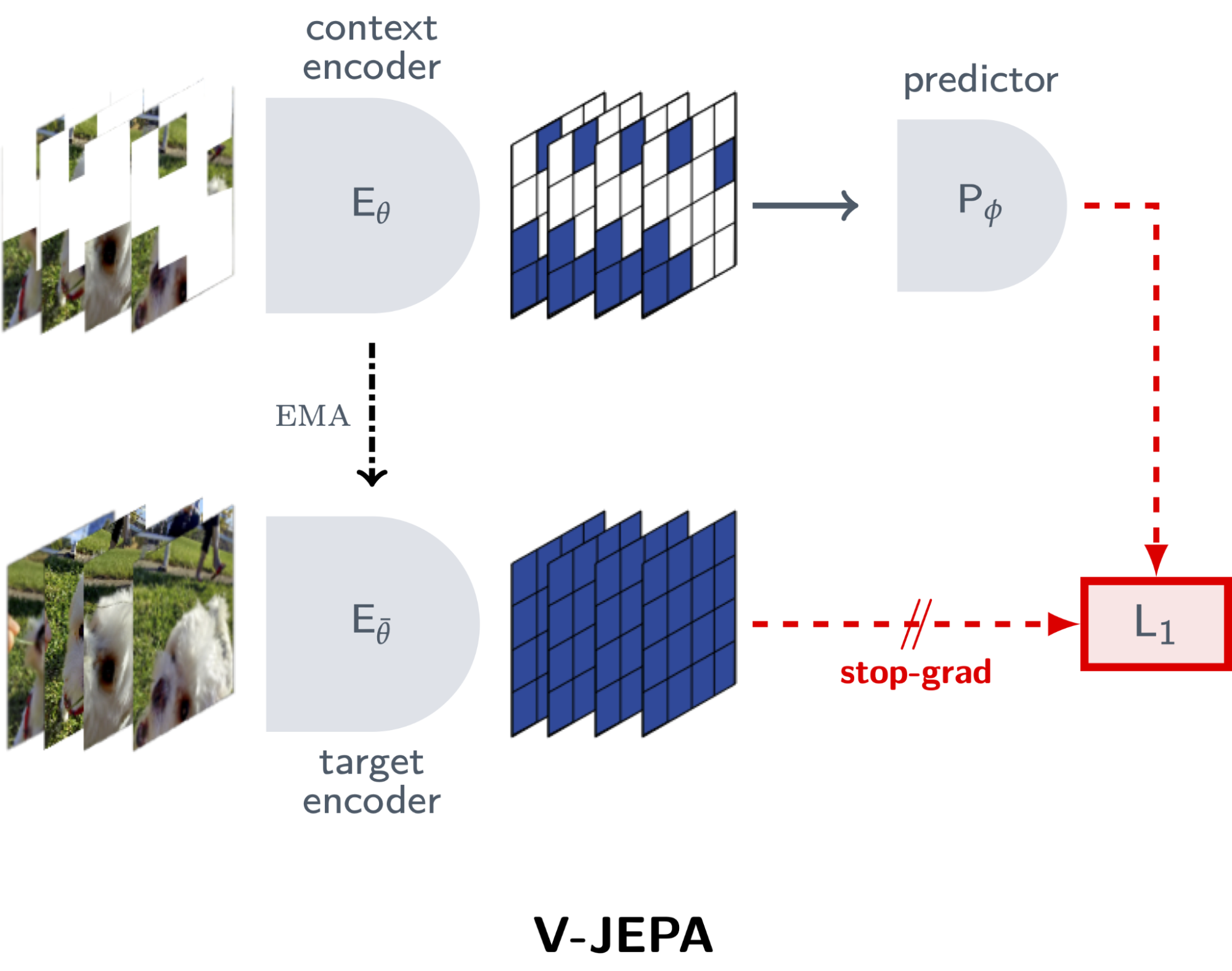
JEPA more broadly is a prediction architecture in latent space, not in data space. It's fundamentally different from the autoregressive approach that dominates today.
OpenAI, Anthropic, and Google are betting on autoregression: predicting the next token, again and again, until intelligence emerges. LeCun argues that this doesn't capture causal understanding of the world. JEPA learns what's invariant and what changes. It's a fundamentally different bet on the nature of intelligence. Both approaches are actively being developed. Only time will tell which one leads further.
The Systemic Impact on the AI Ecosystem
Meta has changed the very structure of the AI industry by making it open:
Democratization: thousands of companies, researchers, and independent developers use LLaMA. AI is no longer reserved for Big Tech.
Competition: open-source models force proprietary models to improve faster AND lower their prices. API prices (GPT-5.4, Claude, Gemini) have dropped dramatically, in part due to pressure from LLaMA and Llama 4.
Community innovation: the community has innovated in quantization (running models on consumer GPUs), efficient fine-tuning (QLoRA), RAG, and dozens of other techniques. These innovations benefit everyone.
Let's be precise: LLaMA is open-weight (public weights), not open-source in the strict sense. The training data remains secret. The training process is only partially documented. License restrictions exist. Open-source purists don't recognize LLaMA as truly open. Projects like OLMo (Allen AI) go further by publishing data, code, and intermediate checkpoints.