How Hugging Face Democratized AI
Before Hugging Face (founded in 2016 by Clement Delangue, Julien Chaumond, and Thomas Wolf), using an AI model was an obstacle course:
- Download the checkpoint (the file holding the model's learned weights). Where? The lab's website? An obscure Google Drive link? A torrent?
- Implement the architecture. From the paper? With incomplete code?
- Manage dependencies. PyTorch which version? CUDA compatible? cuDNN installed?
- Train or fine-tune. What learning rate? What batch size? What scheduler?
Each step could take hours or even days. Reproducing a research paper was an odyssey.
Hugging Face eliminated all this friction. Three lines of Python and you have a recent model working:
from transformers import pipeline
text_gen = pipeline("text-generation",
  model="HuggingFaceTB/SmolLM3-3B")
text_gen("Hello,")
It works. The model downloads automatically, dependencies resolve themselves, inference runs. That's the magic of Hugging Face: turning a complex research process into a "works on the first try" experience. The only limit is hardware: a small 3-billion-parameter model runs on a recent laptop, while a 70-billion-parameter one needs one or more data-centre graphics cards.
On the order of 3 million public models hosted in 2026 (the one-million mark fell in September 2024, two million in August 2025), somewhere between half a million and a million datasets depending on who is counting, roughly a million demo apps, and more than 18 million registered developers. A unified interface, storage built for very large files, Gradio for demos. It's more than a technical platform, it's a complete ecosystem. Just as GitHub transformed software development, Hugging Face is transforming AI development.
The Hub: AI's Central Registry
Model Hub: All Models in One Place
The Model Hub is the heart of Hugging Face. It's a centralized registry, similar to Docker Hub for containers, but for AI models:
- About 3 million public models of all types: LLMs, vision, audio, multimodal, diffusion, robotics. The pace is dizzying: more than a million new models were published in 2025, many of them variants (fine-tuned, quantized or merged versions) of a handful of big open models.
- Every model is a Git repository: you can track changes between versions, roll back, and branch.
- Storage built for weights: Xet. Git was never designed for files tens of gigabytes in size. For years the Hub relied on Git LFS (Large File Storage), which stores each big file as a single block: change one byte and the whole file has to be uploaded again. In August 2024 Hugging Face acquired XetHub, a startup founded by former Apple engineers, and from 2025 moved the Hub onto its Xet system. Xet cuts files into small chunks of roughly 64 KB and only transfers the chunks that changed. Publish a new version of a model that differs only slightly from the last, and only the difference travels. By mid-2025 about 500,000 repositories (on the order of 20 petabytes) had already moved to Xet, which had become the default.
- Model cards: standardized documentation for each model. Performance, known biases, limitations, recommended use cases. It's the equivalent of a standardized README.
- One-line download:
huggingface_hub.hf_hub_download(...)or directly via theAutoModelclass.
Dataset Hub: Data Too
Several hundred thousand datasets hosted (the one-million figure was being quoted by summer 2026), with features designed for practicality:
- Built-in viewer: browse the data directly in the browser, without downloading
- Streaming: large datasets download on the fly, no need to store everything locally
- Dataset cards: structured documentation (source, license, biases, collection procedure). These cards are often the only place you learn where the data came from, see Dataset provenance and licences.
Spaces: Demos in One Click
You train a model. You want to show it to the world. You create a Space: a Gradio or Streamlit script, upload it, and a public web interface appears in minutes. Basic hosting (on an ordinary CPU) is free; graphics cards cost money.
ZeroGPU: dynamic GPU allocation for demos that need power. The GPU activates when a user sends a request and frees up afterward. Economical and practical.
Inference Providers: One Front Door for Calling Models
Since January 2025, a model's page on the Hub also lets you call it remotely through partner hosting companies, with nothing to install. Four partners at launch (fal, Replicate, SambaNova, Together AI); the list has since grown (Cerebras, Groq, Nebius, Cohere and others). The idea is a single front door: same code, change the provider's name to switch from one to another, and billing can run through your Hugging Face account. Hugging Face says it adds no markup on provider prices. The Hub, once a catalogue, has become an access point as well.
Hugging Face copied GitHub's formula: free for open-source, paid for enterprise. The Hub is free for public models and datasets. But large private repositories, Inference Endpoints (production deployment), enterprise support? Paid. According to The Information, annualized revenue was running at around $150 million in summer 2026, with the company describing itself as close to profitability.
The Libraries: The Real Technical Strength
Transformers: The Centerpiece
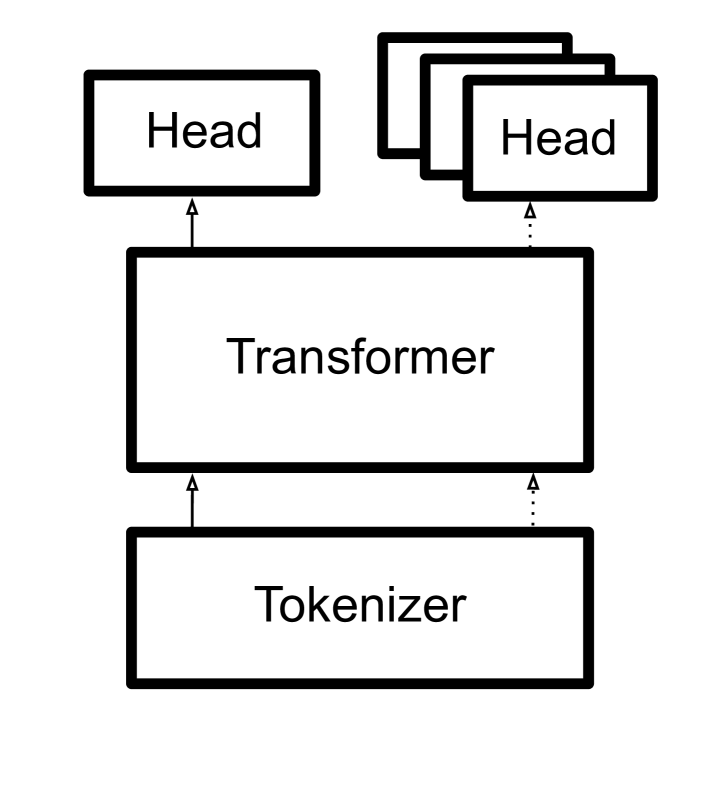
This is the reference library for using language models. Unified interface for thousands of architectures: BERT, GPT, LLaMA, Mistral, Gemma, Qwen, and hundreds more. A single AutoModel class loads any model. Same code, different models. Long compatible with PyTorch, TensorFlow and JAX, the library refocused on PyTorch alone with version 5, announced in December 2025: TensorFlow and Flax (the JAX flavour) were dropped. Its role has shifted too: Transformers now serves mainly as the reference definition of each model, which other tools (inference servers, training frameworks) reuse.
The Complementary Library Ecosystem
- Datasets: efficient loading and processing of massive data. Streaming, mapping, filtering.
- Tokenizers: ultra-fast tokenization, implemented in Rust (not Python). 10-100x faster than pure Python alternatives.
- Accelerate: distributed training (multi-GPU, multi-node) with minimal code. You add 3 lines and your code runs on 8 GPUs.
- PEFT: efficient fine-tuning (LoRA, QLoRA, and other methods). Adapting models without fully training them. This is the reference library for accessible fine-tuning.
- TRL: training models with human feedback or rewards (RLHF, DPO, PPO, and since 2025 GRPO, the method popularized by DeepSeek-R1). The library that makes alignment accessible to small teams.
- Diffusers: the reference library for diffusion and image generation (Stable Diffusion, Flux, SDXL).
- Gradio: web interfaces for models. Simple and powerful. You create an interactive demo in 5 lines of code.
- smolagents (late 2024): a small library for building agents, models that chain actions (search the web, call a tool, read a file) to get a task done. Its distinctive feature: the agent writes its actions as Python code rather than in a rigid format, which lets it combine several tools in a single step. The core fits in about a thousand lines, so it stays readable.
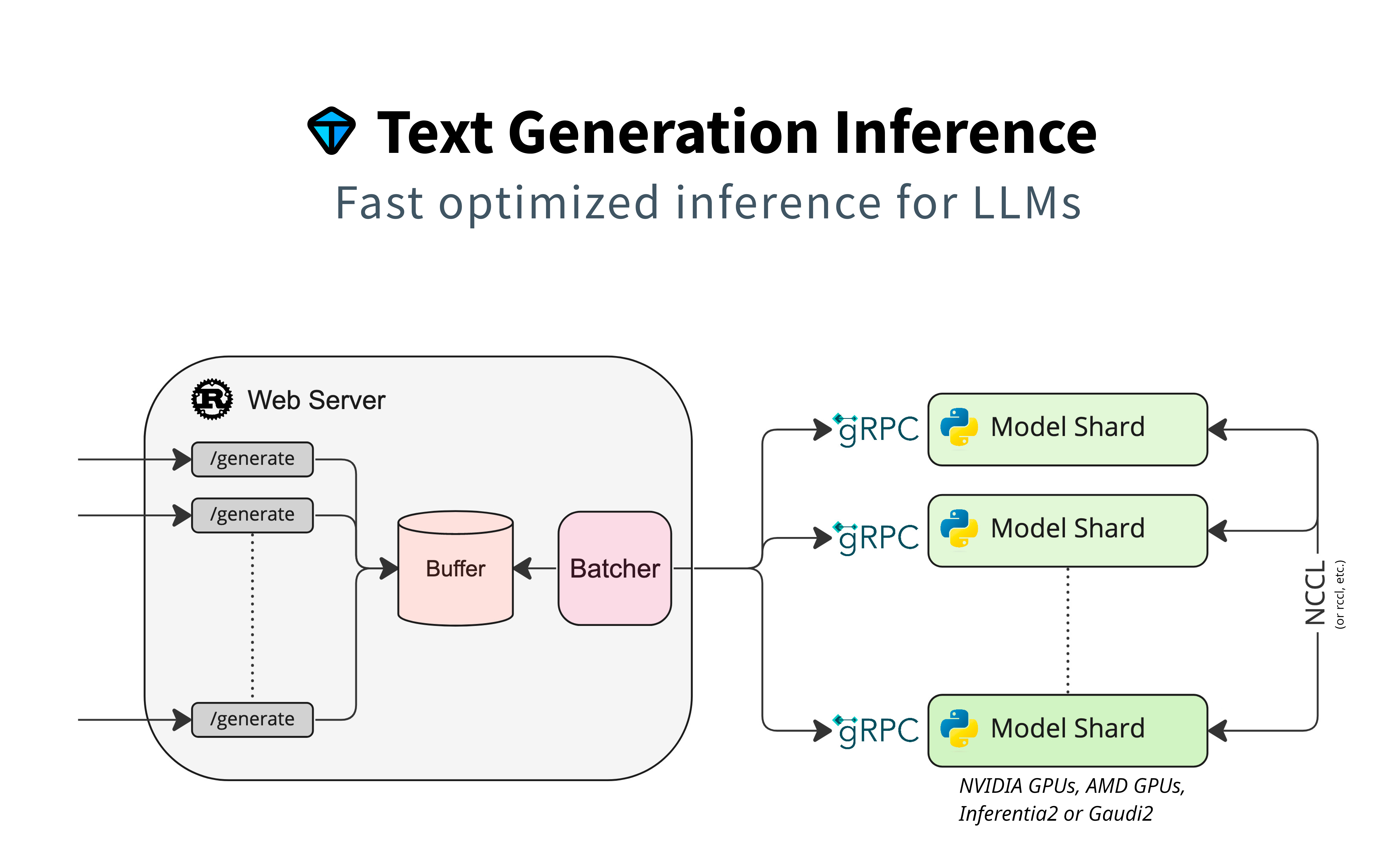
- Text Generation Inference (TGI): optimized server for fast LLM inference in production. Continuous batching, paged attention, quantization. TGI was a pioneer, but Hugging Face put it into maintenance mode in December 2025 and now recommends the open servers vLLM and SGLang, which have become the industry standards. The diagram below is still a good picture of what any inference server does.
Evaluation Tools
- Open LLM Leaderboard: for two years the go-to public ranking of open models, scored automatically on standard benchmarks. A second, tougher version relaunched it in June 2024 because the original tests were saturated. It was shut down and archived in 2025: benchmarks were saturating ever faster, and some models were being tuned for the leaderboard rather than for real use. Its results remain available as an archive. The phenomenon is explained in The limits of benchmarks.
- LightEval: lightweight framework for evaluating LLMs on a battery of benchmarks.
- Evaluate: standardized machine learning metrics.
Before Hugging Face, reproducing a research paper could take weeks. Now: a link to the model on the Hub, the code on GitHub, and it's done in a few hours. Hugging Face has changed the norm of the community. Reproducibility in AI is now expected, and papers that don't publish their code and model are increasingly criticized. The company practises what it preaches: in January 2025 its Open R1 project set out to rebuild, in public, the training recipe of DeepSeek-R1, whose weights alone had been released.
Hugging Face's Own Models and Datasets
Hugging Face doesn't just host other people's models. The company also creates its own, with one constant: publishing the full recipe (data, code, settings), not just the weights.
- SmolLM: small efficient models. The first generation (2024) and SmolLM2 (135M, 360M and 1.7B parameters, trained on 11 trillion tokens) were followed in July 2025 by SmolLM3: 3 billion parameters, six languages including French, a 128,000-token context, and a "thinking" mode you can switch on or off. Proof that you don't need 70B parameters for every task. A sibling family, SmolVLM, does the same for models that read images.
- Zephyr: LLM aligned via DPO (Direct Preference Optimization), a simpler and more stable alternative to RLHF.
- StarCoder: open-source code generation, trained on The Stack (a massive source code dataset), as part of the open BigCode project.
- FineWeb: high-quality web pre-training dataset. 15 trillion tokens. One of the largest public datasets. It spawned FineWeb-Edu (the subset a classifier rates as most educational) and FineWeb2, which extends the approach to more than a thousand languages. See Pre-training datasets and Training only on open or licensed data.
- LeRobot: the robotics project, now one of the company's strategic bets (next section).
Robotics: From Software to Hardware
Launched in 2024, LeRobot set out to do for robotics what Transformers did for language: a shared library, shared data formats, ready-to-use models. The project soon outgrew software.
- Cheap arms. With partners, LeRobot popularized 3D-printable robot arms (SO-100, then SO-101) whose parts cost on the order of a hundred dollars. Thousands of hobbyists and labs built them, then published their demonstrations on the Hub.
- A model trained on that community data. In June 2025 Hugging Face released SmolVLA, a 450-million-parameter vision-language-action model pre-trained on about 480 community-shared datasets (on the order of 23,000 demonstrations). It runs on a single consumer graphics card, even on a MacBook. See VLA models.
- The Pollen Robotics acquisition (April 2025). Hugging Face bought this Bordeaux company, known for its Reachy 2 humanoid robot, and with it gained a hardware team.
- Reachy Mini (July 2025). The first product of the acquisition: a small self-assembly desktop robot with an expressive head, a camera, microphones and a speaker, priced from $299 at launch and fully open (designs and software). It is an entry point: you plug Hub models into it so it can see, listen and talk. Units have been shipping in batches since the second half of 2025.
Robotics' bottleneck is data: every demonstration has to be produced by a real robot. By putting cheap, open hardware into people's hands, Hugging Face is building the community that will produce that data and upload it to the Hub, just as open language models fed the Hub in 2023. It is a bet, not yet a result: community datasets remain small and uneven compared with those of the big labs.
The Economic Challenge: Staying Open While Making Money
Hugging Face needs to monetize to survive. The paid offerings:
- Pro: accelerated GPUs, execution priority, monthly inference credits, advanced features
- Enterprise Hub: private models, fine-grained access control, SSO (Single Sign-On), audit trail
- Inference Endpoints: production deployment on dedicated infrastructure, with SLA
- Expert Support: technical guidance from Hugging Face engineers
On the funding side, the company raised on the order of $400 million in total. Its last round, $235 million in August 2023 led by Salesforce Ventures (with Google, Amazon, NVIDIA, Intel, AMD, Qualcomm and IBM), valued it at $4.5 billion. According to the Financial Times, it later turned down an NVIDIA investment that would have valued it at $7 billion.
The fundamental challenge: maintaining the community spirit (which is the platform's strength) while generating enough revenue to be viable.
2026: The Sale to NVIDIA
In August 2026 the press reported that Hugging Face was exploring a sale. On 2 September 2026, NVIDIA signed a definitive agreement to buy it: about $11.9 billion for shareholders plus an employee retention programme worth up to $1 billion, on the order of $12.9 billion in all, nearly three times the 2023 valuation. Closing is expected in the first half of 2027, subject to competition authorities' approval. In late September Reuters reported that the US Department of Justice had begun asking questions about the deal's effects, and whether a European review was needed was still an open question.
NVIDIA has publicly committed to keeping the platform open to the whole ecosystem: everyone stays free to pick their models, clouds and inference providers, and according to Jensen Huang, NVIDIA hardware will not be required to publish or deploy through Hugging Face.
AWS, Google Cloud and Microsoft all offer their own model hosting services (Amazon Bedrock, Google Vertex AI, Microsoft Foundry, formerly Azure AI Studio), and inference prices keep falling. Against those giants, Hugging Face's edge has always been its community and its neutrality: belonging to no cloud provider and no chipmaker. Being bought by the leading seller of AI chips changes that. NVIDIA's commitments (open platform, no chip imposed) point toward continuity, and the buyer has every interest in open models thriving, since nearly all of them run on its cards. But a commitment is not a structure: the trust of NVIDIA's competitors (AMD, Google with its TPUs, Amazon with its in-house chips) will depend on what happens once the deal closes, and that is exactly what competition authorities are looking at.