The Surprise That Shook Silicon Valley
January 2025. DeepSeek releases R1. A reasoning model that rivals OpenAI's o1. Open-source. Announced training cost: $5.5 million (compared to hundreds of millions, even billions for o1).
The impact was immediate: stock prices plummeted. NVIDIA lost 17% in a single day. The assumptions of the entire industry were called into question. Do you really need billions in investment to create competitive AI?
The term "Sputnik moment" was used by Marc Andreessen, Sam Altman, and dozens of analysts. Like the Soviet satellite in 1957, DeepSeek shows that competition comes from where you least expect it.
Founded in 2023 by Liang Wenfeng, a quantitative hedge fund founder (High-Flyer Capital). Based in Hangzhou, China. The goal: create competitive LLMs without depending on American GPUs. The context: the US banned the export of H100s to China. DeepSeek has to innovate with H800s (a downgraded version, with less inter-GPU bandwidth).
Innovation Under Constraint: When Necessity Is the Mother of Invention
American export restrictions ban H100s from China. DeepSeek has H800s (reduced interconnect, less bandwidth for parallelism). Instead of complaining, they innovated to work around the limitations.
DeepSeek V2 (May 2024): Architectural Efficiency
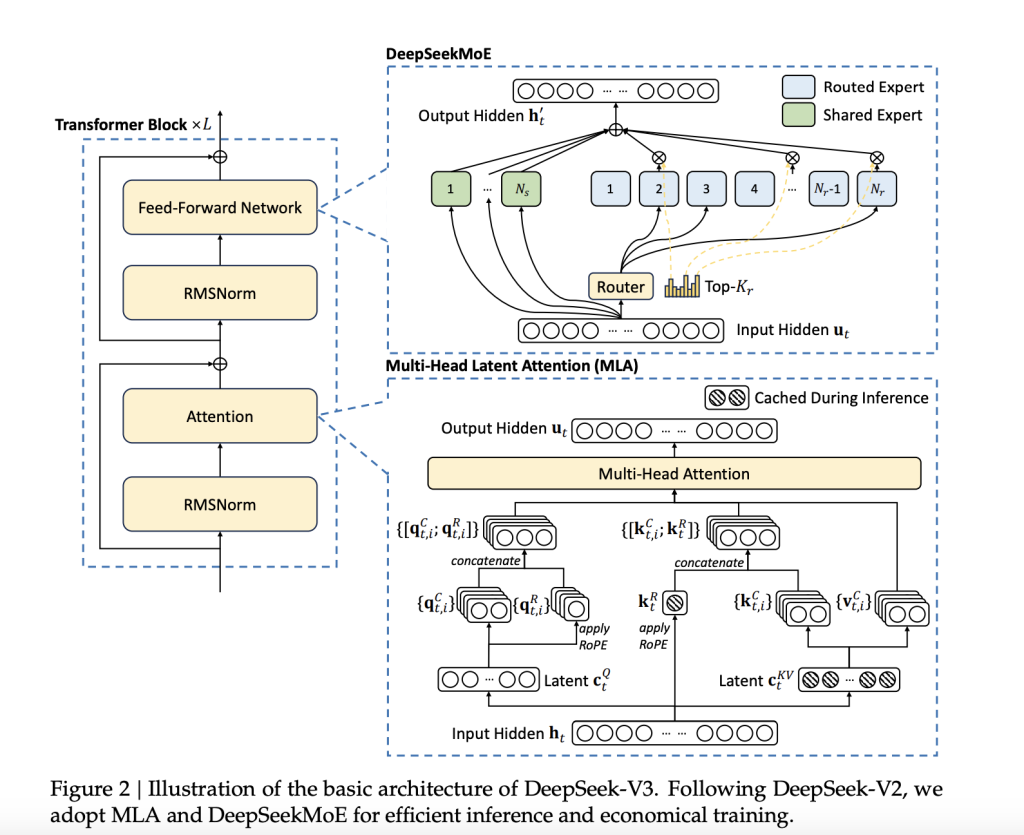
The key innovation: Multi-Head Latent Attention (MLA). It's an intelligent compression of the attention mechanism. Instead of storing full keys and values for each token (the infamous KV-cache that explodes in memory), MLA compresses these representations into a much smaller latent space.
- 236 billion total parameters, only 21 billion activated (Mixture of Experts architecture)
- 10-30x cheaper to use than the OpenAI API
- Competitive performance with the best models of the time
The low prices aren't a marketing argument. Users immediately see the difference on their bill.
DeepSeek V3 (December 2024): The Shock
- 671 billion total parameters, 37 billion activated
- Performance similar to GPT-4o and Claude 3.5 Sonnet
- Announced training cost: $5.5 million. 2,048 H800 GPUs for 2 months.
- FP8 training: training in 8-bit precision instead of 16-bit. Half the memory, faster training. An engineering feat.
- Multi-token prediction: predicting multiple tokens at once, not just one. Speeds up training.
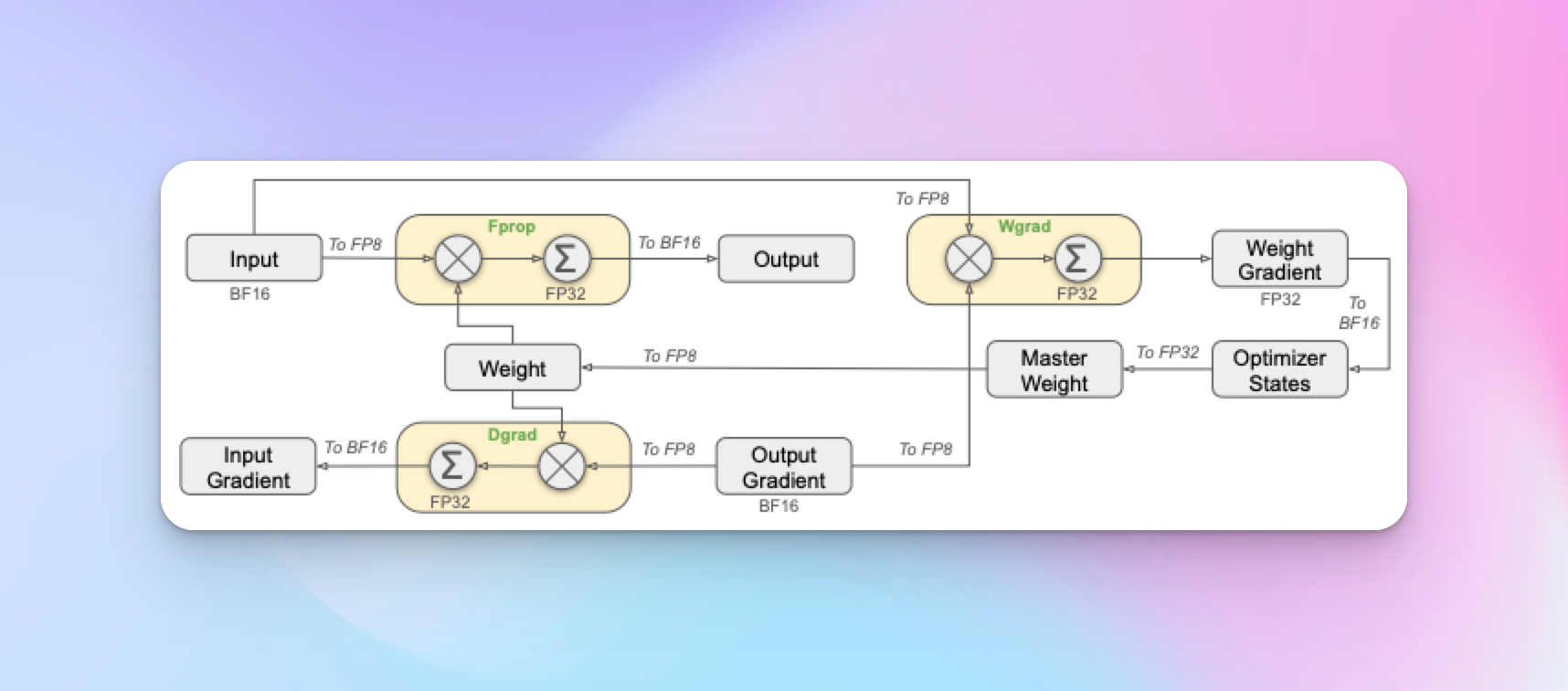
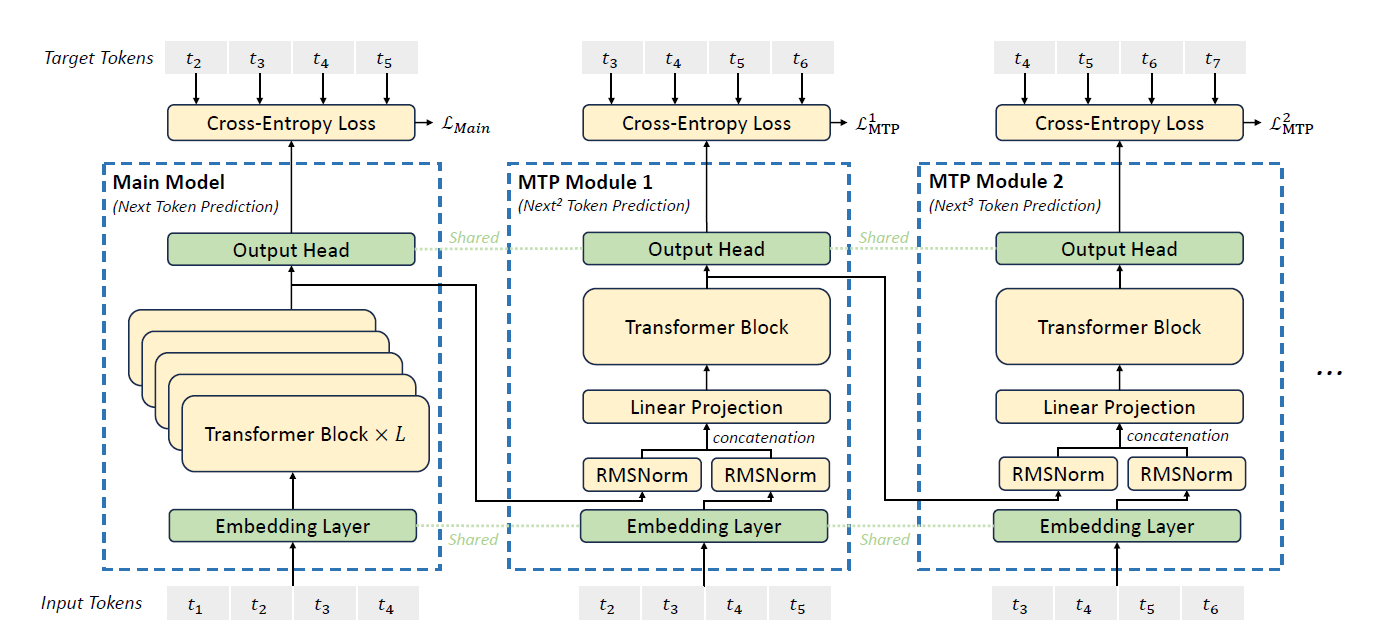
American giants pay for brute force: more GPUs, more memory, more time. DeepSeek innovates on architecture and engineering. KV-cache compression (MLA). Highly efficient MoE (5-6% activated/total ratio). Low-precision training (FP8). Each innovation saves compute. Accumulated, they're game-changing. It's proof that smart engineering can compensate for a lack of brute force.
R1: Learning to Think Without a Teacher
DeepSeek R1 is the reasoning model. A direct competitor to o1. But the way it was trained is even more fascinating than its results.
R1-Zero: the foundational experiment. Training through pure RL (Reinforcement Learning). No prior supervised fine-tuning. No examples of "good reasoning" provided by humans. Just a simple reward: "is the final answer correct?"
The model explores. It tries approaches. Some work, others don't. It learns.
And spontaneously, behaviors emerge that nobody programmed:
- Chain-of-thought: the model starts thinking step by step before answering
- Verification: it double-checks its results, like a careful student
- Exploring alternatives: when an approach fails, it tries another one
Reasoning emerged from RL, without being explicitly taught. It's a profound discovery.
R1 (refined version): an additional step. You filter the best reasoning traces produced by R1-Zero, use them as supervised learning data, then do RL again. Result: record performance, cleaner and more reliable reasoning.
Distilled versions: R1 is greedy with reasoning tokens (it "thinks" for a long time). DeepSeek distilled the knowledge into smaller models:
- R1-Distill-Qwen 32B, 14B, 7B, 1.5B
- R1-Distill-Llama 70B, 8B
The small versions retain much of the reasoning capabilities. A 7B model that reasons like a 600B+ model? That's the promise of distillation.
Before DeepSeek R1, it was thought that reasoning had to be explicitly taught. Constitutional AI supervises it through principles. RLHF guides it through human feedback. DeepSeek shows that pure RL with a simple reward (right/wrong) is enough. Reasoning emerges spontaneously. It's a profound discovery about the nature of learning and how cognitive capabilities can appear without explicit process supervision.
The Shockwave
In the Industry
Financial markets react violently. Questions pop up everywhere:
- Do we really need clusters of 100,000 GPUs?
- Are billion-dollar investments justified, or can you do just as well for 10x less?
- Is the American technological advantage as solid as we thought?
DeepSeek challenges the fundamental assumption that AI competitiveness requires superhuman investments.
DeepSeek V4 is expected in 2026 with 1T parameters and native multimodal capabilities (2026 update).
Open-Source Contributions That Accelerate Everyone
DeepSeek publishes its innovations, and they're adopted quickly:
-
Multi-Head Latent Attention: other labs implement it to reduce memory costs
-
Auxiliary-loss-free load balancing: a better technique for MoE architectures
-
FP8 training methodology: recipes for stable low-precision training
-
Infrastructure building blocks (February 2025 "open source week"): FlashMLA (the latent attention kernel), DeepEP (GPU-to-GPU exchanges for mixture-of-experts models), DeepGEMM (FP8 matrix multiplications), DualPipe and the EPLB expert load balancer, the 3FS file system
-
The inference engine itself (October 20, 2026): DeepInfer, after announcing in April 2025 that it would not be published
These contributions benefit the entire ecosystem, including DeepSeek's competitors.
The Questions That Remain Open
Censorship. Chinese models refuse to answer certain politically sensitive questions in China (Tiananmen, Tibet, Taiwan, etc.). This is a limitation for international users who expect an unrestricted model. The question is broader: every AI reflects the values of whoever builds it.
Access to compute. Chip export restrictions could tighten further. If DeepSeek can no longer obtain performant GPUs, its progress could slow down. But history suggests that constraints stimulate innovation.
Cost verifiability. The $5.5 million figure is hard to verify independently. Does it include failed experiments? Preliminary trials? The total cost of the research program? Skeptics are asking for more transparency.
Geopolitics. Using Chinese models raises questions about technological sovereignty and data security. For some applications (defense, government, sensitive data), it's an obstacle. For others (research, personal use), it's a non-issue.
DeepSeek isn't just a startup. It's a piece in the US-China competition over AI. Chip export restrictions haven't stopped China. They've motivated it to innovate. DeepSeek's architectural efficiency is a direct consequence of sanctions. The debate over the effectiveness of these restrictions is just beginning. The irony: by limiting access to compute, the US may have accelerated Chinese algorithmic innovation.
The question of whether the "DeepSeek moment" was repeatable is settled: it has become a cruising rhythm. In the first two weeks of August 2026 alone: Alibaba's Qwen3.8-Max (a 2.4-trillion-parameter MoE, 1M token context, weights published shortly after), Zhipu's GLM-5.3 (coding and cybersecurity, open weights announced, see the GLM-5.2 lesson), ByteDance's Seed 2.1 Turbo. And DeepSeek itself opened a new front on August 13 by publishing its complete agent harness under an MIT license (see the DeepSeek Harness lesson). Chinese labs now publish, weeks apart, open-weights models their authors compare to the closed American lineups, and those models are picked up by Western offerings: Mistral has served GLM-5.2 on its platform since August 11. DeepSeek itself moved V4-Pro from preview to official release on August 12, after nearly four months of public trial. Then, on September 10, V4.1-Flash introduced a new architecture, the causal encoder-decoder, which spends half as much to read as to write and cuts the cache by four; V4-Pro has been routed to it since September 14. The dedicated lesson: DeepSeek V4.1-Flash. On September 22, Xiaomi took the lead of the open-weight rankings with MiMo-V2.6 under the MIT license: a Pro with 1,020 billion parameters (42 billion active), a Flash with 309 billion (15 active), both omnimodal with a one-million-token context, released with the technical report, the reinforcement-learning code and more than 7,000 training environments. The team is led by Luo Fuli, formerly of DeepSeek.
On September 10, 2026, Anthropic published a report accusing seven Chinese labs (Alibaba, Moonshot AI, DeepSeek, Zhipu, Xiaomi, SenseTime and MiniMax) of running unauthorised distillation campaigns: nearly 190 million exchanges with Claude between May and July 2026, more than 151 million of them attributed to Alibaba-linked operators, targeting reasoning traces in particular. These are one party's accusations, not settled, but they explain why providers hide or encrypt their models' reasoning (see encrypted reasoning).