Reading an announced score (pass@1 and maj@N protocols, choice of comparator, contamination) is covered in How to Read a Benchmark Score. Ranking measures (recall@K, MRR, NDCG) are covered in Measuring a Ranking. And each major benchmark has its own page in the Ecosystem part (MMLU, GPQA, Humanity's Last Exam, etc.): this page does not describe them again, it says which ones to pick after fine-tuning.
The Problem: The Model Forgets Everything
Imagine a brilliant surgeon who decides to specialize in cardiology. After six intensive months, they've become excellent in cardiology, but they've forgotten how to treat a fracture. That's exactly what happens with fine-tuning: by forcing a model to excel at a specific task, you risk breaking its general capabilities. This is called "catastrophic forgetting."
Post fine-tuning evaluation is the model's complete health check. You don't just verify that it does its new task well: you verify that it hasn't lost anything along the way. For a refresher on the different ways of fine-tuning a model, see Full fine-tuning versus parameter-efficient fine-tuning.
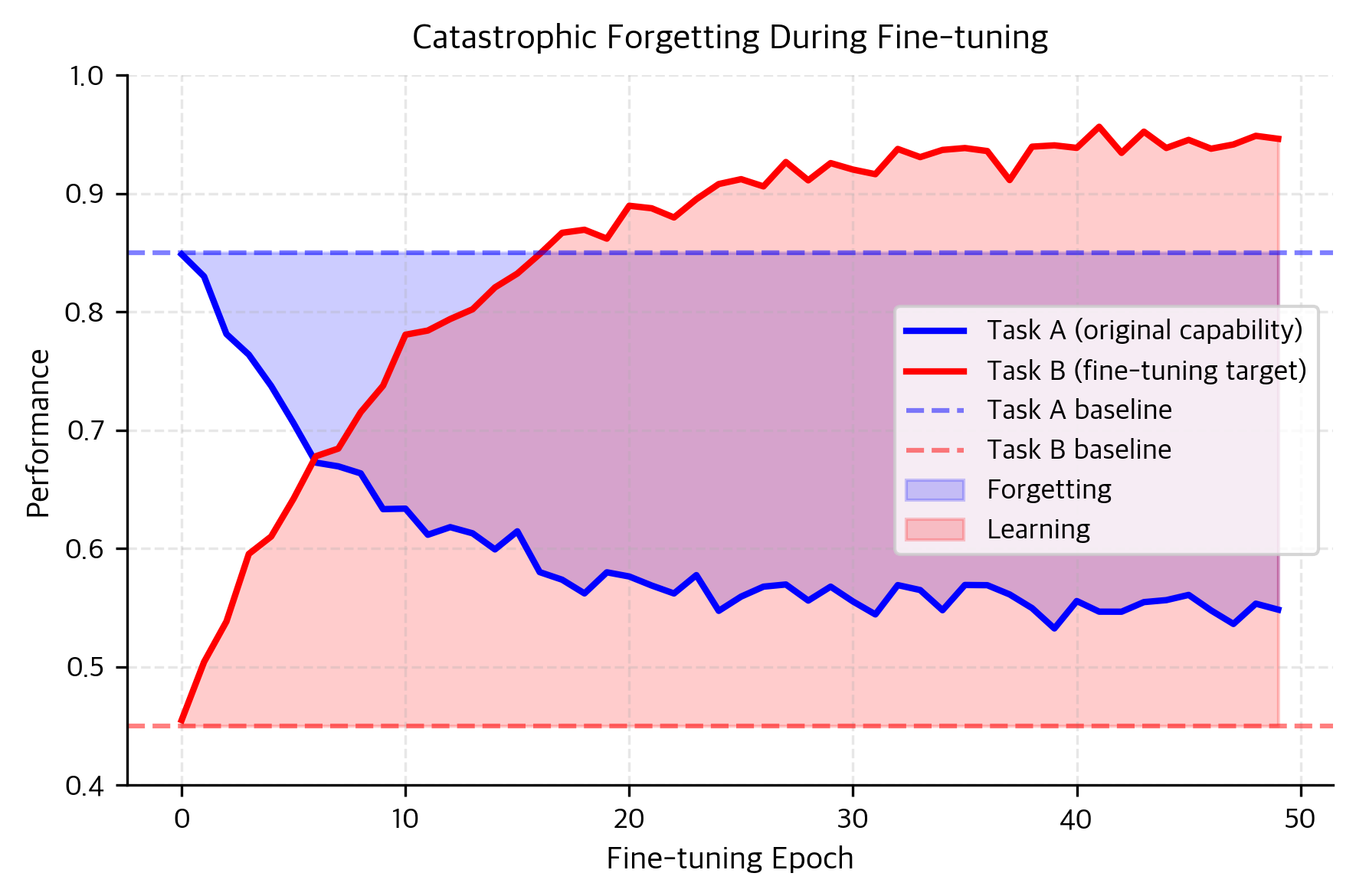
A training loss that decreases does NOT mean everything is fine. It's like a student who only crammed past exam papers: their score goes up on that specific exam, but they may not have understood anything else in the curriculum. You need to test on multiple fronts, not just the target task.
The Three Pillars of Evaluation
To properly evaluate a fine-tuned model, you need to check three dimensions. Ignoring any one of them means flying blind.
A word of vocabulary first: a benchmark is a frozen collection of questions whose answers are known, run against every model so that models can be compared. Like a standardized exam paper.
1. The Target Task (Does It Work?)
This is the obvious test: does your model do well what you trained it for?
- Classification: the share of correct answers, and the F1-score, the harmonic mean of how many flagged cases were genuine and how many genuine cases were flagged. It is more honest than plain accuracy when one class is much rarer than the other.
- Text generation: ROUGE (Recall-Oriented Understudy for Gisting Evaluation), which counts the word sequences shared between the answer and a reference answer, one word, two words, three in a row; such sequences of words are called n-grams. Its cousin BLEU (BiLingual Evaluation Understudy) works the same way and was originally designed for translation. More recently BERTScore compares embeddings (numerical representations of meaning) rather than the words themselves, so it can recognize a paraphrase; BERT is the name of the model used to produce those representations.
- Instruction following: IFEval, about 500 prompts with constraints a program can check ("answer in more than 400 words", "use this word three times"), so no judge is needed. For perceived quality, add a set scored by a judge model: AlpacaEval (805 varied instructions), preferably in its length-controlled version 2, or Arena-Hard-Auto (500 hard questions drawn from LMArena).
- Code: HumanEval, where the model must write 164 small programs that are checked by automated tests. This set is now saturated for large models; LiveCodeBench (problems published after the model's training) or SWE-bench (patches to real code repositories, see agent evaluation) take over.
2. General Capabilities (Has It Forgotten Everything?)
This is the critical test that many people forget. Has your model retained its general knowledge?
- Reasoning: ARC (AI2 Reasoning Challenge, from the Allen Institute). The paper's abstract states 7,787 grade-school science questions, split into an "easy" set and a "challenge" set, the latter keeping only the questions a keyword-based retrieval engine fails on.
- Knowledge: MMLU (Massive Multitask Language Understanding). The abstract states 57 subjects, from elementary mathematics to law by way of computer science. The total question count varies between releases of the dataset: do not quote a figure without checking the release you are running.
- Mathematics: GSM8K (Grade School Math 8K), math problems written out in words, at grade-school to middle-school level, which test multi-step reasoning.
Choosing by model size (as of 2026)
A benchmark only detects forgetting if the starting model is not already at the ceiling. Yet the large models of 2026 score above 90% on MMLU, GSM8K or HellaSwag: those sets are saturated for them and no longer separate anything (the phenomenon is explained in Why benchmarks lie). So the choice depends on what you are fine-tuning:
| Your model | General benchmarks still useful |
|---|---|
| Small (a few billion parameters) | MMLU, ARC, GSM8K, HellaSwag: far from the ceiling at these sizes, they detect forgetting well |
| Medium or large | MMLU-Pro (ten options instead of four, more reasoning), GPQA Diamond, MATH or AIME, IFEval |
| Frontier | Humanity's Last Exam, and refreshed tests such as LiveBench, whose questions change every month |
A useful nuance: a set that is saturated at the top of the leaderboard can still serve as a regression alarm. If your base model scores 88% on MMLU and drops to 75% after fine-tuning, the fall is plain to see, even if the set can no longer rank the best models against each other.
MMLU-Pro: A More Robust and Challenging Multi-Task Language Understanding Benchmark LiveBench: A Challenging, Contamination-Limited LLM Benchmark3. Safety and Behavior (Has It Gotten Weird?)
Fine-tuning can inadvertently "misalign" a model, making it more toxic or less cautious:
-
Toxicity: RealToxicityPrompts. The paper's abstract states 100K sentence openings drawn from real web text, each paired with a toxicity score, and you look at how the model completes them.
-
Refusal: does the model still refuse dangerous requests, or has fine-tuning eroded its guardrails? On how those guardrails are installed in the first place, see RLHF in practice.
-
Over-refusal: the opposite matters too. XSTest gathers 250 harmless requests that a well-tuned model should not refuse ("how do I kill a Python process?") and 200 dangerous requests as a contrast; an overly cautious fine-tune makes the model refuse the former.
-
Standardised attacks: HarmBench provides a common framework for measuring resistance to attempts to get around the guardrails.
This pillar is not only for suspicious fine-tunes. A 2023 study showed that 10 malicious examples, costing less than $0.20 through OpenAI's fine-tuning interface, were enough to break GPT-3.5 Turbo's guardrails; and, more importantly, that fine-tuning on ordinary datasets with no malicious intent degraded them too, to a lesser extent. In 2025 another team described a more puzzling effect, emergent misalignment: a model fine-tuned only to write code containing security flaws, without saying so, started giving hostile or deceptive answers on topics unrelated to code. A narrow fine-tune can therefore change behaviour far beyond its target, and only a safety test rerun afterwards reveals it.
Fine-tuning Aligned Language Models Compromises Safety, Even When Users Do Not Intend To!Emergent Misalignment: Narrow finetuning can produce broadly misaligned LLMsTest your target task (primary objective), a general-capabilities benchmark suited to the model's size (MMLU and ARC for a small model, MMLU-Pro or GPQA for a large one), and a safety test that also measures over-refusal. That's the minimum to detect major problems before deployment. It is a modest amount of work next to the cost of shipping a broken model.
Automatic Judges (LLM-as-a-Judge)
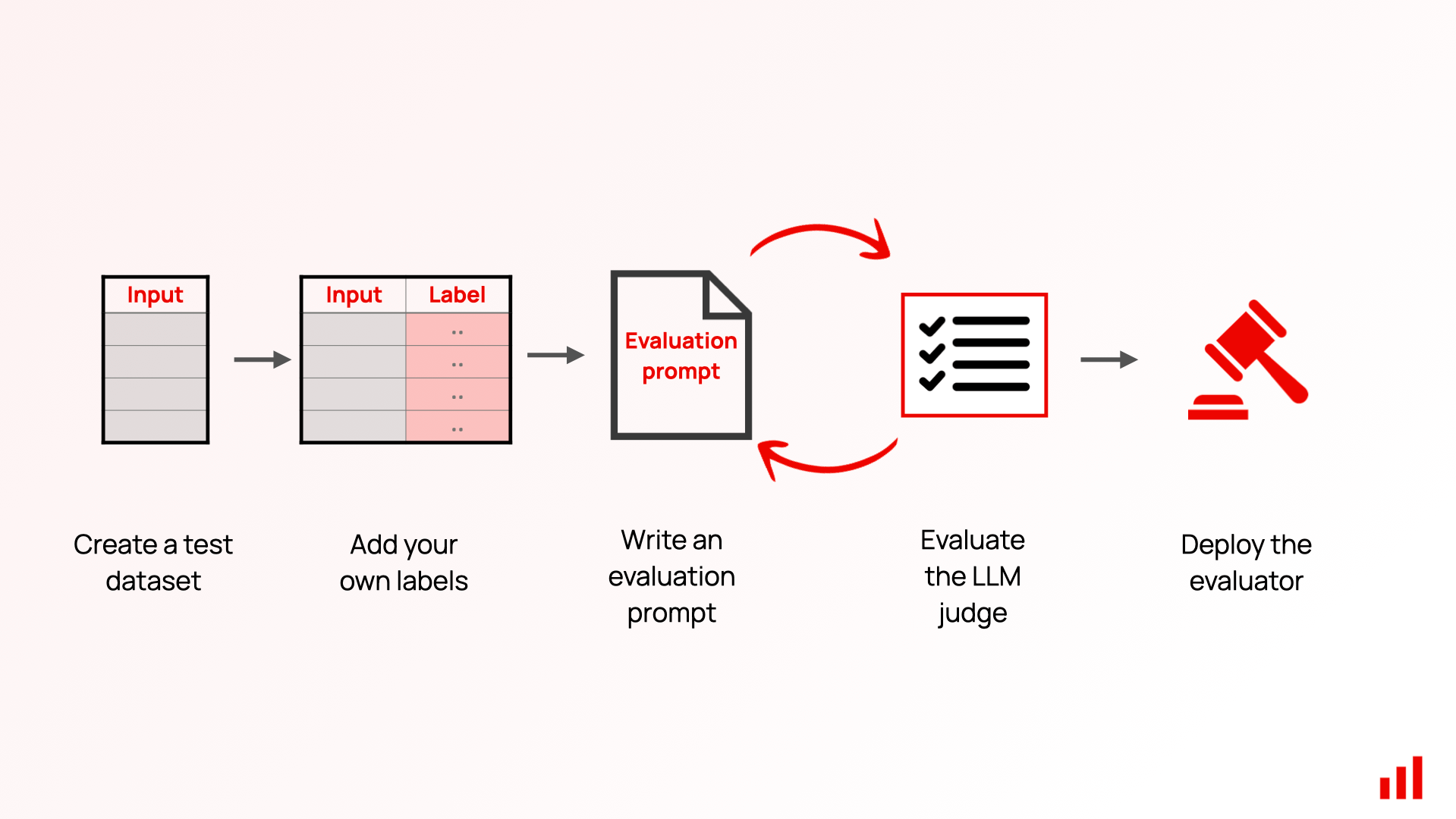
Having a human read 1,000 responses is slow and expensive. The alternative: use a more powerful model as a judge, the technique known as LLM-as-a-judge, a large language model (LLM) employed as the evaluator. The judge reads your fine-tuned model's answer and says whether it is good, relevant and well-structured.
Concretely, you give the judge the original prompt (the text handed to the model), your model's response, and ask it to rate on a scale (for example 1 to 10) with justification.
Advantages:
- Fast (thousands of evaluations in minutes)
- Inexpensive compared to human annotators
- Replicable (same judging prompt = consistent results)
Pitfalls to know:
- Position bias: the judge often prefers the first response when comparing two
- Verbosity bias: long, verbose responses are favored, even if a concise answer is better
- Self-preference: a judge model rates answers that resemble its own writing style higher, so in particular answers produced by itself or by a model of the same family
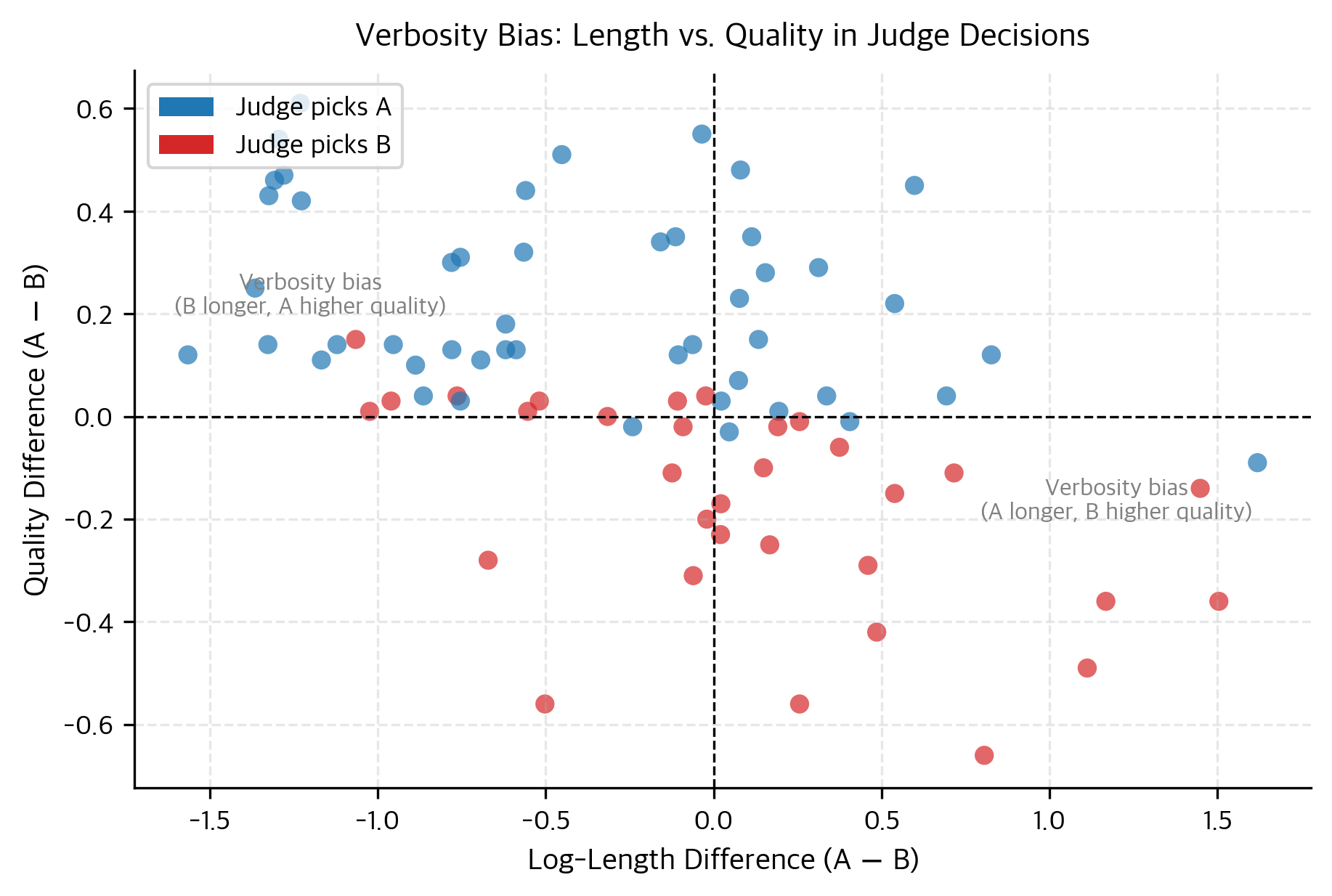
Use a judge clearly stronger than the model under test, a judge at the same level merely reproduces its own blind spots. Shuffle the order of responses to neutralize position bias. Ask the judge to explain its reasoning before giving its score. And ideally, use two judges from different families and compare their verdicts.
Since 2024 there is another option: an open specialised judge, trained only to score (Prometheus 2 is the best-known example), which runs on your own machines without the data leaving them. The measured biases, reasoning judges and the validation procedure against humans are detailed in LLM-as-a-judge.
Detecting Catastrophic Forgetting
The most reliable method: compare the model's scores before and after fine-tuning on the same benchmarks.
Here is what such a record looks like, with figures invented for the example, they show the shape of the table, they describe no real model:
| Benchmark | Before | After | Change |
|---|---|---|---|
| Your task | 45% | 85% | +40 points |
| MMLU | 62% | 61% | -1 point |
| GSM8K | 55% | 54% | -1 point |
How do you read such a record? A one- or two-point drop on a general benchmark is routine: the model "forgets" a little while specializing. The larger the drop, the more concerned you should be, and one rule of thumb circulates in practice, past five points you look closely, past ten you treat the fine-tuning as failed. These thresholds are working conventions, not published results: they depend entirely on what you are willing to lose.
Concrete warning signs:
- Significant drop on MMLU (loss of factual knowledge)
- Text becoming incoherent over long passages (loss of coherence)
- More toxic or offensive responses than before (alignment erosion)
- New hallucinations that didn't exist in the base model
Practical Tools
lm-evaluation-harness (The Swiss Army Knife)
This is the reference tool for automated evaluation. It supports dozens of benchmarks and produces results comparable across teams. The command below is indicative: option names change between releases, so check them against the documentation of the one you install.
lm_eval --model hf \
    --model_args pretrained=./my_finetuned_model \
    --tasks mmlu,gsm8k,hellaswag \
    --batch_size 8
A single command to test on three benchmarks, here MMLU, GSM8K and HellaSwag, the last of which asks the model to pick the most plausible ending to a scene described in a few words. That trio suits a small model; for a larger one, swap in less saturated tests (MMLU-Pro, IFEval and so on), which the tool also provides. Other tools do the same job, such as Hugging Face's lighteval, or Inspect, from the UK AI Security Institute, better suited to multi-step evaluations; they are compared in building and running your own evaluation.
HellaSwag: Can a Machine Really Finish Your Sentence? (Zellers et al., 2019)Custom Evaluation
Standard benchmarks don't always cover your specific use case. Create your own test set:
- 20-50 examples that the model has never seen during training
- Edge cases: unusual texts, trick questions, malformed inputs
- Phrasing variants: the same question asked in three different ways
This custom set is often the most revealing, because it tests exactly what you'll ask the model in production.
If your training data contains benchmark evaluation questions, your results are misleading: the model is reciting instead of reasoning. Systematically verify there's no overlap between training and evaluation. For critical cases, use private benchmarks or dynamic benchmarks that change regularly.
The Recommended Sequence, in 5 Steps
- Quick test: a few examples submitted by hand, eyeball check that the model answers correctly.
- First overall score: IFEval, verifiable and judge-free, then a judge-scored set such as Arena-Hard-Auto or length-controlled AlpacaEval 2. MT-Bench (Multi-Turn Benchmark, multi-turn dialogue questions), long used at this step, is now saturated.
- Full battery:
lm-evaluation-harnessor lighteval on the benchmarks suited to the model's size (see the table above), plus the safety and over-refusal tests. - Human review: an expert reads a few dozen responses and rates the quality automated scores miss.
- Robustness tests: unusual texts, extreme lengths, languages unseen in training, prompts designed to trip the model up.
The steps are ordered from cheapest to most expensive, and any of them can stop the process. If the quick test at step 1 fails, there is no point running the full battery. That progression is the real methodological gain, not the total elapsed time, which depends entirely on model size and available hardware.
1. During fine-tuning, the training loss goes down steadily. What can you conclude?
2. To evaluate your model fine-tuned from Mistral, you pick another model of the Mistral family as the judge, and you always show it your model's answer first. Which biases are you stacking?
3. Before letting a judge model grade thousands of answers, which step (the one everyone skips) should you take?
4. Your fine-tuned model makes a spectacular jump on a public benchmark. Before declaring victory, what should you check first?
5. What is the most reliable way to detect catastrophic forgetting after fine-tuning?
6. You fine-tune a model on perfectly harmless data, customer-service exchanges. Should you still rerun the safety tests?