The Universal Benchmark (Maybe Too Universal)
MMLU (Massive Multitask Language Understanding, Hendrycks et al., 2020). 14,042 multiple-choice questions covering 57 domains of human knowledge. From constitutional law to nutrition, from virology to moral philosophy, from astronomy to marketing.
Since its publication, it has become THE benchmark that everyone reports. Every new model, every press release, every blog post mentions its MMLU score. Why? Because no other test covers such a wide range of knowledge in a single number.
It's the general knowledge grade of AI. A model with 90% on MMLU "knows stuff" across many domains. It's a useful proxy, quick to compute, and easy to compare.
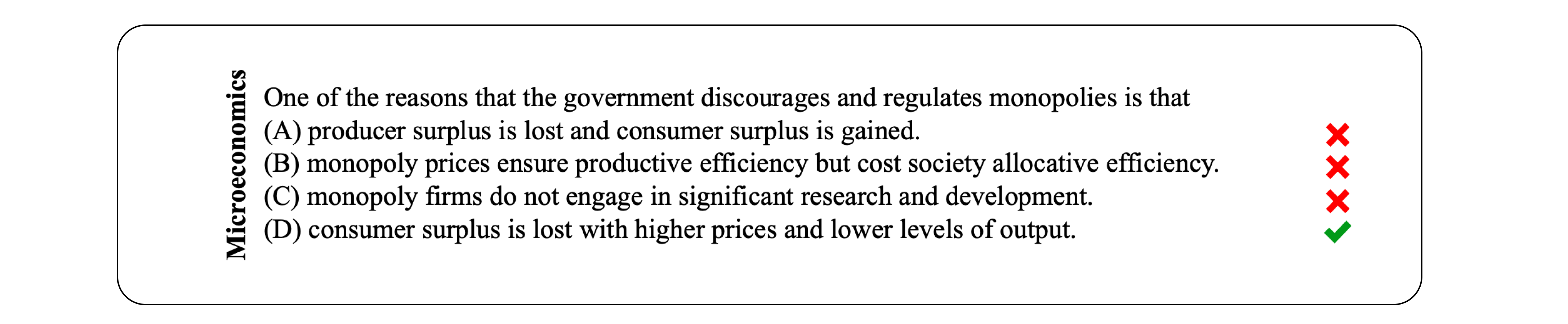
MMLU combines three rare qualities: breadth (57 domains), size (14,000 questions), and ease of evaluation (4-choice MCQ, automatic scoring). That's why everyone uses it. Even though everyone knows its limitations.
The 57 Domains in Detail
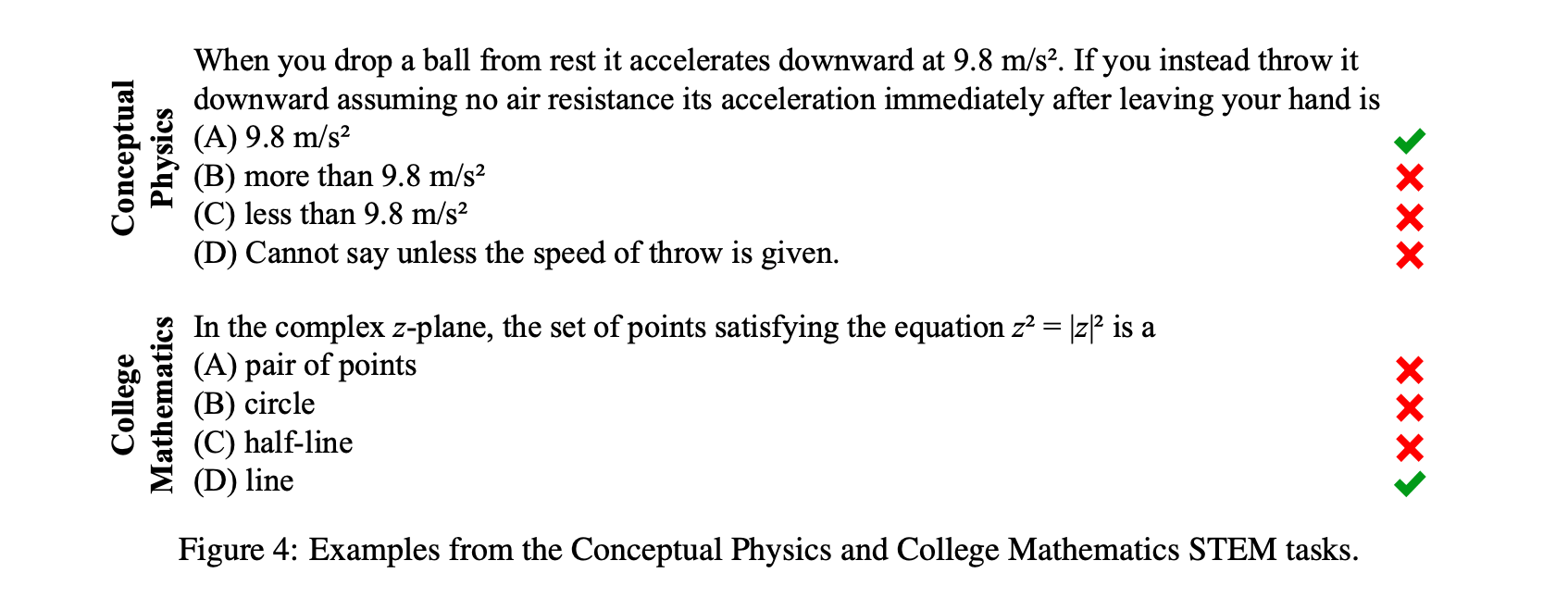
STEM (Science, Technology, Engineering, Mathematics): high school and college mathematics, physics, chemistry, biology, computer science, electrical engineering, astronomy, statistics.
Humanities: world and American history, philosophy, international law, ethics, prehistory, formal logic.
Social Sciences: psychology, sociology, economics (micro and macro), geography, political science, public safety.
Professional and Other: accounting, clinical medicine, marketing, management, nutrition, professional law, medicine.
Each question comes from real exams: SAT, GRE, professional exams, university courses. These aren't made-up or synthetic questions. It's authentic academic material, which gives weight to the results.
Few-Shot Evaluation
MMLU is typically tested in 5-shot: the model receives 5 example question-answer pairs from the same category before having to solve a new question.
Why? Because it tests the ability for in-context learning, not just brute memorization. The model must understand the format, the domain, and the difficulty level from the examples, then apply that understanding.
It's more realistic than zero-shot (no examples) and more demanding than simply regurgitating memorized facts.
Score Progression: A Meteoric Rise
The evolution is spectacular:
- GPT-3 (2020): 43%. Even a 175B parameter model struggles with general knowledge.
- Chinchilla (2022): 67%. Compute-optimal training makes a real difference.
- GPT-4 (2023): 86%. The qualitative leap.
- Claude 3.5 Sonnet (2024): 89%. Nearly at the human ceiling.
- GPT-4o (2024): 88%. Consolidation at the top.
- Gemini Ultra (2024): 90%. The first to officially reach 90%.
- GPT-5.4, Claude Sonnet 4.6, Gemini 3.1 Pro (2026): all above 90%, benchmark saturated (2026 update).
The expert human score sits around 89-90%. The best models are now there. The curve naturally flattens: it's hard to surpass the level of the human experts who created the questions.
When all cutting-edge models score between 88% and 90%, MMLU loses its discriminating power. The difference between 88% and 90% can come from statistical noise, the prompt used, or the evaluation setup. There's no longer enough room to distinguish between models.
MMLU-Pro: The Tougher Successor
Faced with MMLU's saturation, researchers created MMLU-Pro in 2024:
- 10 choices instead of 4: drastically reduces the role of chance. With 4 choices, random guessing gives 25%. With 10, it's 10%. Noise decreases.
- Questions requiring more reasoning: not just facts, but multi-step problems to solve.
- Better quality: ambiguous or flawed questions from MMLU have been filtered out.
Result: the best models top out at 70-75% on MMLU-Pro. There's still room to improve and compare.
MMLU-Redux is another initiative: a cleaned subset of the original MMLU, correcting known errors in questions and answers (yes, some "official" MMLU answers are wrong).
The Limitations: What MMLU Doesn't Measure
The contamination problem is serious. The 14,042 MMLU questions have been public since 2020. They circulate on the web, in forums, blogs, and discussions. When a model is pre-trained on the entirety of the internet, it has probably seen some of these questions. A model that "remembers" an answer isn't "reasoning." And it's nearly impossible to tell the two apart.
The MCQ format is reductive. Recognizing the right answer among 4 options is fundamentally different from formulating an open-ended answer. You can eliminate absurd answers through statistics without understanding the subject. MCQ measures a mix of knowledge, reasoning, and statistical elimination.
The cultural bias is real. The questions primarily come from the American educational system. The perspective is Anglo-Saxon. The historical, legal, and cultural references are American. A model trained primarily on English content is naturally advantaged.
The granularity is coarse. An overall score of 88% hides enormous variance: a model can score 95% in computer science and 60% in law. The average score doesn't tell the whole story.
A 90% score on MMLU doesn't mean a model "understands" 57 domains of knowledge. It can succeed through memorization, statistical elimination of wrong answers, or exploiting biases in question phrasing. MMLU is a useful indicator of factual knowledge. It's not proof of deep understanding.
MMLU in the Industry: Indispensable Despite Everything
Despite its well-known limitations, MMLU remains ubiquitous. Every new model reports it. Every leaderboard includes it. Press releases feature it prominently.
Why? Because there's no single alternative that's as comprehensive. MMLU-Pro and MMLU-Redux are gradually correcting the weaknesses. But the original MMLU remains the reference through inertia: everyone uses it, so everyone continues using it, because it's the only way to compare with past results.
It's a good example of Goodhart's Law: MMLU has become a target, and as a target, it has ceased to be a perfectly reliable measure. But for lack of a better option, it remains indispensable in the evaluation toolkit.