How Do You Test Whether an AI Really Understands Science?
Easy questions? AIs solve them effortlessly. MMLU (90%)? Saturated. GSM8K (96%)? Saturated. HellaSwag (95%)? Saturated. When all models score near perfection, the test is useless.
What was needed was a truly hard test. One that resists surface-level pattern matching and demands deep understanding.
GPQA (Graduate-Level Google-Proof Q&A, Rein et al., 2023) answers this need: 198 doctoral-level questions in quantum physics, organic chemistry, and molecular biology.
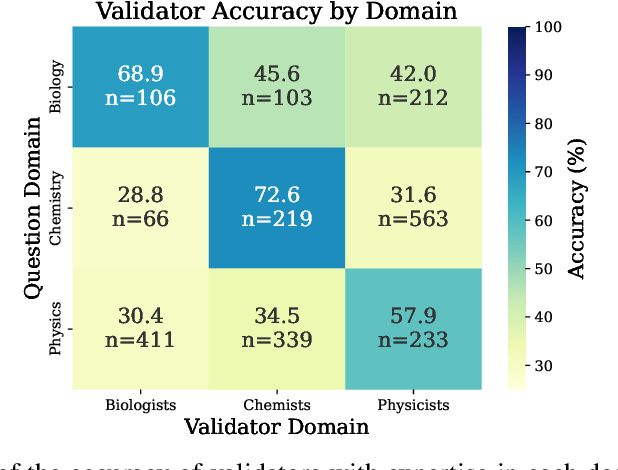
The "trick" of GPQA? Even with Google and 30 minutes of searching, a non-expert can't solve these questions. A domain expert scores 81%. A smart non-expert with internet access? 34%. That's barely above chance for a 4-choice MCQ (25%).
If you don't truly understand the subject, Google won't save you. It's a real test of understanding.
The idea behind "Google-Proof" is brilliant: if a question can be solved by searching the web, it's not a good intelligence test. GPQA ensures that each question requires combining multiple concepts, making inferences, and reasoning deeply. No copy-pasting from Wikipedia.
The Benchmark's Structure
The Three Scientific Domains
- Physics: quantum mechanics, general relativity, particle physics, thermodynamics, electrodynamics. The heavy hitters of the hard sciences.
- Chemistry: organic chemistry (reaction mechanisms), quantum chemistry, spectroscopy (IR, NMR, UV-Vis). Requires visualizing molecular structures and predicting reactivities.
- Biology: molecular biology, genetics, biochemistry, evolutionary biology. Pointed questions requiring cross-referencing multiple levels of analysis (gene, protein, organism).
The Filtering: GPQA Diamond
The full dataset contains 448 questions. But the reference subset is GPQA Diamond: 198 carefully filtered questions.
The filtering criterion is elegant: only questions that genuinely discriminate expertise are kept. Experts must reach 81%+ accuracy. Non-experts must stay below 34%. If a question is too easy (even non-experts solve it) or poorly worded (even experts fail), it's eliminated.
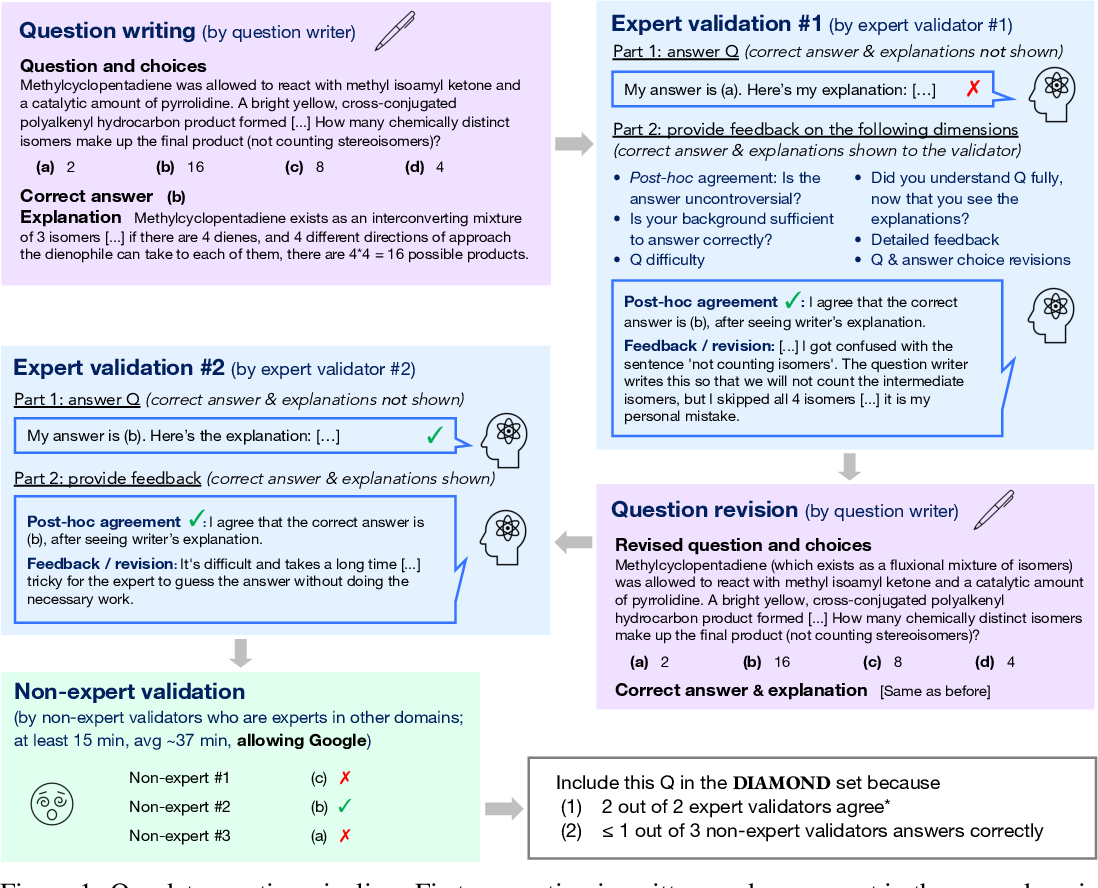
The format is a 4-choice MCQ. Simple in appearance, but each question requires mastering and combining several advanced concepts. There are no shortcuts.
The 47-point gap between experts (81%) and non-experts (34%) is the signature of a good benchmark. If a non-expert reaches 50% on a question, it's either too easy or it tests general knowledge rather than expertise. GPQA requires a minimum gap for each retained question. That's what makes the benchmark so discriminating.
Score Evolution: The Arrival of Reasoning Models
The history of GPQA scores is fascinating:
- GPT-4 (2023): 36-39%. A 175B+ parameter model struggling with doctoral-level questions. Disappointing for some, expected by others.
- Claude 3 Opus (2024): 50%. The first model to significantly surpass chance.
- Claude 3.5 Sonnet (2024): 59%. Steady progress.
- Gemini Ultra (2024): 49%. Mixed performance despite the model's power.
- o1 (September 2024): 78%. The spectacular leap. Nearly at the level of human experts.
- o3 (2025): 80%+. Virtually indistinguishable from experts.
- GPT-5.4 / Claude Opus 4.6 / Gemini 3.1 Pro (2026): all above 80%, extended reasoning is now standard (2026 update).
The turning point is clear: o1 and reasoning models. The jump from 36-59% to 78% isn't incremental progress. It's a paradigm shift.
Why? Because o1 takes the time to think. For a single GPQA question, it can produce 10,000 tokens of internal reasoning: exploring hypotheses, checking its logic, backtracking when a lead goes nowhere. This "computational thinking time" is exactly what's needed for questions that require combining several advanced concepts.
Why GPQA Is an Important Benchmark
It's a Test of Real Understanding
GPQA doesn't test memorization. It doesn't test surface-level pattern matching. The questions require combining multiple concepts, making inferences about novel situations, and reasoning deeply. A model that succeeds on GPQA has demonstrated something non-trivial.
A model at 78% on GPQA Diamond could theoretically help a researcher clarify an idea, verify a line of reasoning, or suggest an approach. It's a threshold where AI-assisted science becomes credible.
Resistant to Contamination
Unlike MMLU (whose questions have been circulating on the web since 2020), GPQA questions are original, specifically created by domain experts for this benchmark. The risk that models have seen them in their training data is much lower.
A Good Discriminator
Unlike ARC or HellaSwag (saturated at 95%+ for all recent models), GPQA ranges from 35% to 80% depending on the model. That provides enough resolution to compare and rank models meaningfully.
If an AI reaches 78% on GPQA Diamond, it can potentially assist researchers in domains adjacent to its expertise. That's a strong claim. And probably close to the truth: users report that modern reasoning models are indeed useful for verifying calculations, exploring hypotheses, and clarifying complex concepts.
Limitations to Keep in Mind
Small dataset: 198 questions is statistically few. A "lucky" model on a few questions can see its score vary by 3-5 points. The margin of error is significant.
MCQ format: the format tests selection, not formulation. A real researcher doesn't choose among 4 options: they build proofs, develop open-ended reasoning, and write demonstrations. The MCQ is a proxy, not a faithful mirror of expertise.
Only three domains: physics, chemistry, biology. No humanities, no engineering, no theoretical computer science, no clinical medicine. The coverage is narrow.
Heterogeneous difficulty: some questions are notably harder than others, even within GPQA Diamond. The average score can mask very uneven performance across sub-domains.
When o1 reaches 78% on GPQA Diamond (comparable to the 81% of human experts), it's undeniably impressive. But it doesn't mean "AI thinks like a physicist." The model may succeed through advanced pattern matching what an expert solves through deep, embodied understanding. The mechanisms are probably very different. But the practical result (the ability to answer correctly) is real, and that's what matters for applications.