How Do You Really Test an AI's Brain?
Imagine a math championship for high schoolers where the country's best compete. That's the AIME (American Invitational Mathematics Examination). It's a prestigious American exam: to qualify, you already need to be in the top 5% of math students. And since 2024, it's become the most revealing test for evaluating whether an AI can truly reason.
Why AIME, and not some other math test? Because there's no way to cheat. Each problem requires 5 to 15 chained reasoning steps. The answer is an integer between 0 and 999, no MCQ, no ambiguity, no approximation. It's a benchmark created by professional mathematicians, reviewed each year, with original problems never seen before.
You can't "guess" the right answer. You have to build a complete reasoning chain, step by step.
15 problems, numerical answers between 0 and 999. Average high schoolers (already qualified!) solve 5-6. To advance to USAMO (the next step toward the International Olympiad), you need to solve about 10. Almost nobody solves all 15 perfectly.
The Shock: From Failure to Excellence in One Year
The progression of models on AIME is dizzying:
- GPT-4 (2023): 2-4/15 problems. Disappointing. Below the average qualified high schooler.
- Claude 3.5 Sonnet (2024): 4-6/15. A bit better, but still modest.
- o1 (September 2024): 12-13/15. The giant leap. USAMO qualification level.
- o3 (2025): 13-14/15. Nearly perfect. Potential medal level.
- DeepSeek R1 (2025): 12-13/15. China reaches the same level.
- GPT-5.4 / Claude Opus 4.6 / Gemini 3.1 Pro (2026): 13-15/15. Natively integrated reasoning makes the benchmark nearly saturated (2026 update).
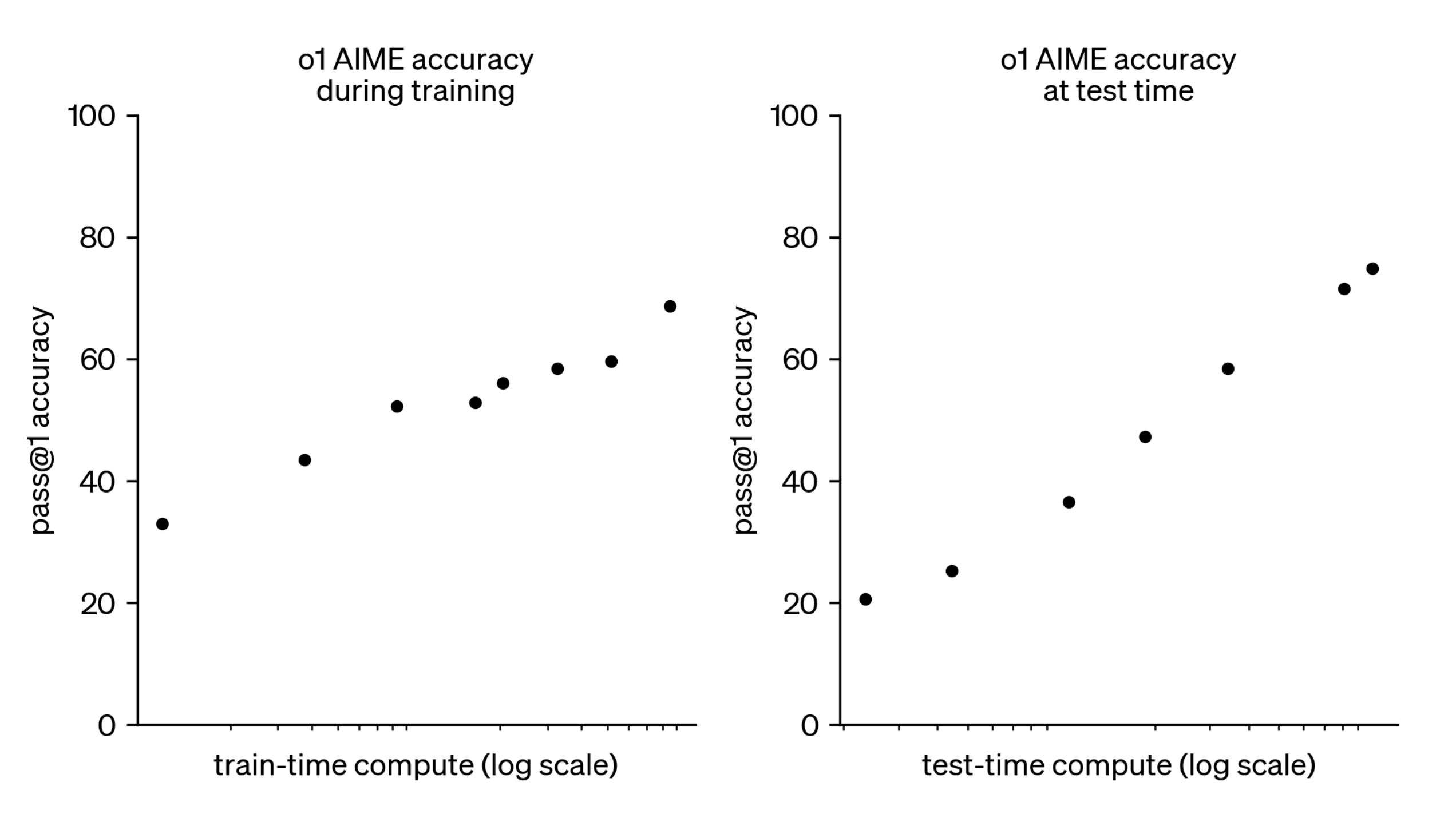
The jump from GPT-4 (2-4) to o1 (12-13) is the most significant leap in AI benchmark history. It's not an incremental improvement. It's a change in nature.
How does o1 go from 2-4 to 12-13? It's not more parameters. It's a fundamentally different approach: compute at inference. Before giving its answer, o1 produces an internal chain of thought that can reach 10,000 tokens for a single problem. It tries one approach, checks, backtracks, tries another way. It's like giving the AI not a bigger brain, but more time to think. And that changes everything.
The analogy: imagine a student who has 5 minutes for a math test vs. the same student who has 2 hours. Same brain. Radically different results.
The Measurement Protocol
How exactly are performances measured on AIME?
- Problem selection: AIME 2024 or 2025 problems are used, never seen in training data
- Multiple attempts: the model solves each problem multiple times (typically 16 to 64 attempts)
- Consensus@k: among the k attempts, the most frequent answer is taken. It's like asking a student to redo the exercise multiple times and keeping their best strategy
- Counting: correct answers out of 15 are counted
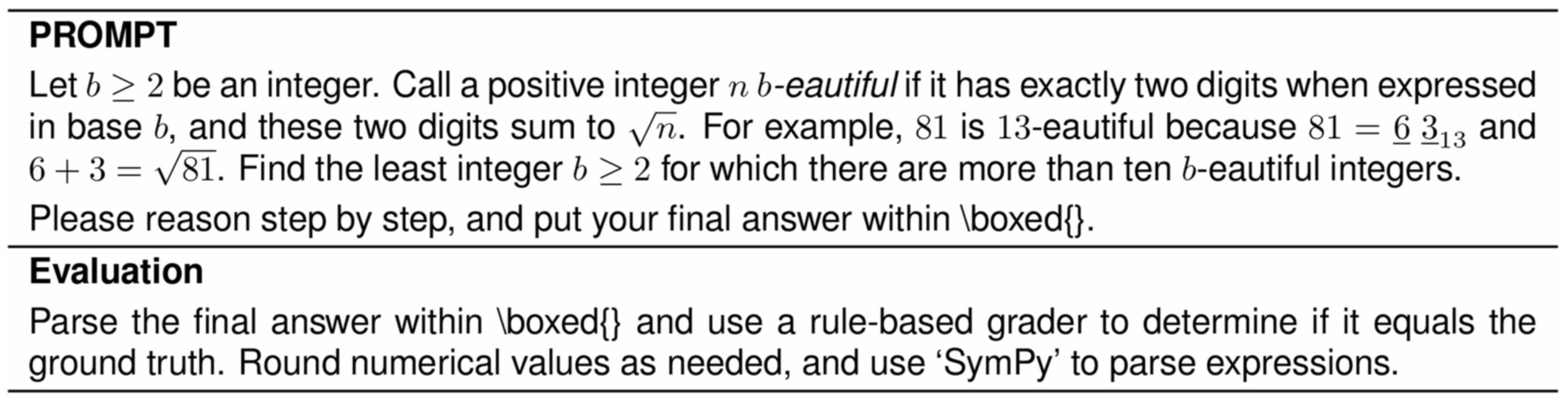
But watch out for subtleties: scores vary significantly depending on the prompt used, the number of attempts, the model temperature, and even timing (some models have non-deterministic results). A score of "12/15" might mean 11 or 13 depending on conditions.
Reasoning models (o1, o3, R1) benefit massively from their ability to produce very long chains of thought. It's a structural advantage: they spend compute on each problem, which mechanically improves their results.
AIME vs Other Math Benchmarks
| Benchmark | Difficulty | Current Best Score | Status |
|---|---|---|---|
| GSM8K | Easy (elementary math) | 96%+ | Saturated, no longer useful |
| MATH (high school competition) | Medium | 96% (o3) | Nearly saturated |
| AIME 2024 | Hard (national competition) | ~90% (o3) | Still discriminating |
| FrontierMath | University research level | Less than 10% | The next challenge |
AIME occupies an interesting position: hard enough to discriminate current models, but not so hard that the best models are helpless. It's the current "sweet spot" for measuring mathematical reasoning.
FrontierMath, created by Epoch AI, poses problems at the level of real mathematical research. Not competition problems, but problems that professional mathematicians take hours or days to solve. The best models barely solve 2-5% of problems. It's designed to remain relevant for years, even in the face of major advances.
AIME's Limitations as a Benchmark
Statistically small size: only 15 problems per edition. That's very little statistically. A variation of 1 or 2 answers can completely change the model rankings. Is the difference between "12/15" and "13/15" significant or noise? Hard to say with so few data points.
A single domain: it's competition mathematics. A very specific type of reasoning, focused on combinatorics, number theory, geometry, and algebra. Not at all representative of reasoning in general. A model that's excellent on AIME can hallucinate on a biology text or get a common sense question wrong.
Final numerical answer only: the result is tested, not the quality of reasoning. If the AI arrives at 999 through the right method or through a compensating error, the benchmark can't tell the difference. We don't know if the model "understands" the solution or got lucky on a flawed path.
Risk of indirect contamination: although AIME problems are new each year, similar problems (in structure, in techniques) circulate widely on the internet (competition forums, prep books). Models may have learned the techniques on analogous problems.
A model that shines on AIME can be weak at common sense reasoning, understanding human nuances, or creative generation. AIME measures a very specific form of mathematical reasoning. It's important and impressive, but it's a narrow facet of intelligence. A mental calculation champion isn't necessarily a good philosopher.