Moving with Legs: Harder Than Arms
Controlling a robotic arm? You manage 6 motors with precision, and if it doesn't work the first time, you calmly try again. Controlling a quadruped robot? That's 12 motors that must coordinate at over 100 Hz to maintain balance while moving forward. If coordination fails for a fraction of a second, the robot falls. That's real-world physics in all its brutality: chaos, stochasticity, and no "undo" button.
Before reinforcement learning, quadruped robots walked using mathematical formulas (like the Zero-Moment Point). The result: rigid, fragile movements, completely inadequate as soon as the terrain got even slightly uneven. Then RL arrived with a radically different approach: train the robot thousands of times in simulation, let the algorithm discover how to walk, run, and climb stairs. No explicit formula, just a pattern learned through experience. And it works incomparably better.
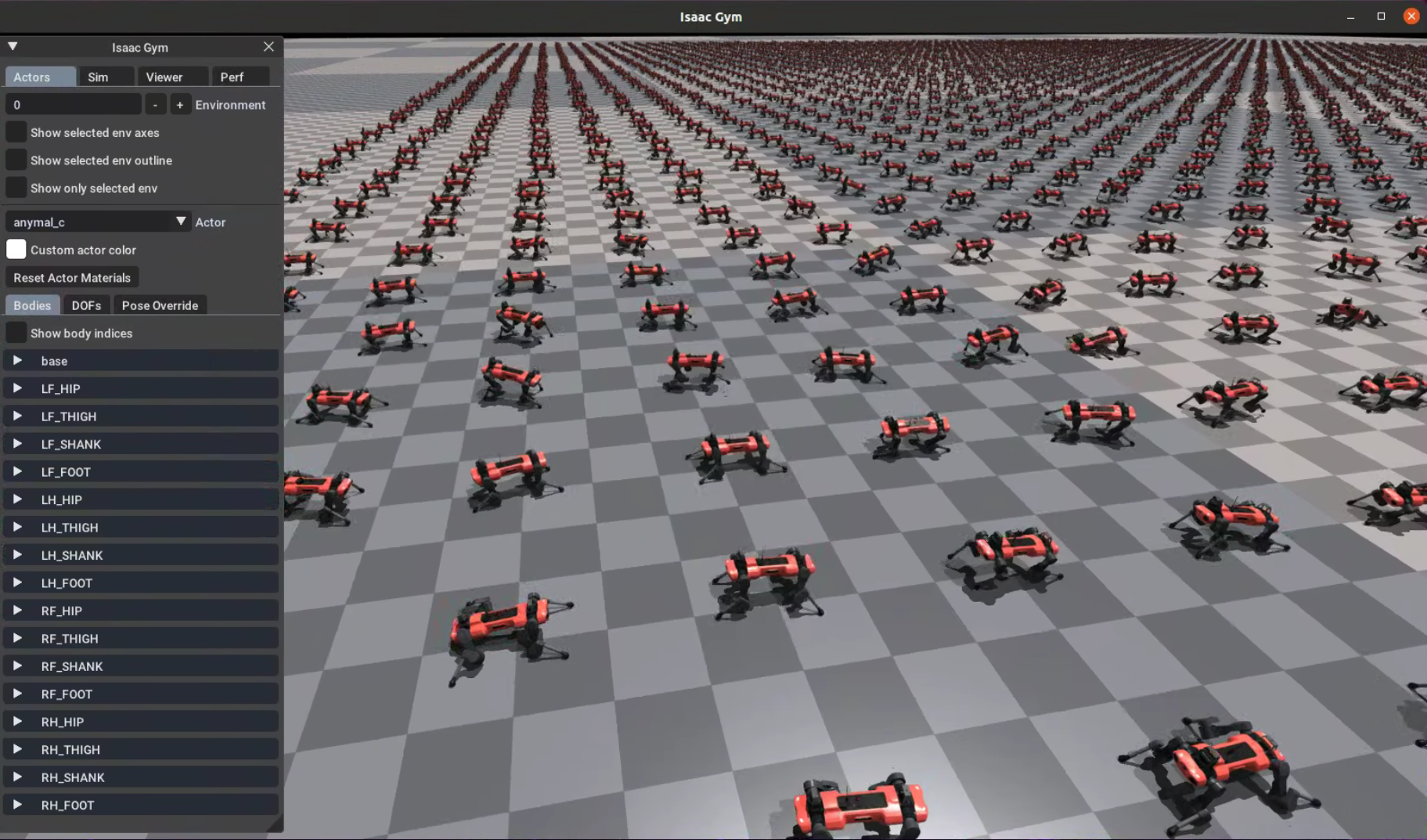
Locomotion is a continuous, high-frequency control problem (100-1000 Hz). The robot must coordinate 12 to 30+ motors simultaneously to maintain balance, move forward, and navigate the environment. This is fundamentally different from controlling a robotic arm that operates quasi-statically and can afford to think for a few milliseconds between each movement.
Quadrupeds: RL Changed Everything
Modern quadruped robots like Spot (Boston Dynamics), Go2 (Unitree), and ANYmal (ETH Zurich) have made spectacular progress thanks to RL:
- Millions of episodes are played in simulation (Isaac Sim, MuJoCo), in parallel on GPUs. In one night, the robot accumulates the equivalent of dozens of years of experience
- Domain randomization is the key to real-world transfer: terrains are varied (flat, stairs, rocks, slopes), physical parameters perturbed (mass, friction), noise added to sensors and motors. The mechanism is detailed on Sim-to-real
- Sim-to-real transfer is sometimes direct: the policy learned in simulation runs on the physical robot untouched. This is the most favourable case in all of robotics, and it holds for a precise reason: in locomotion the robot feels the terrain through its feet instead of looking at it, and touch simulates better than light
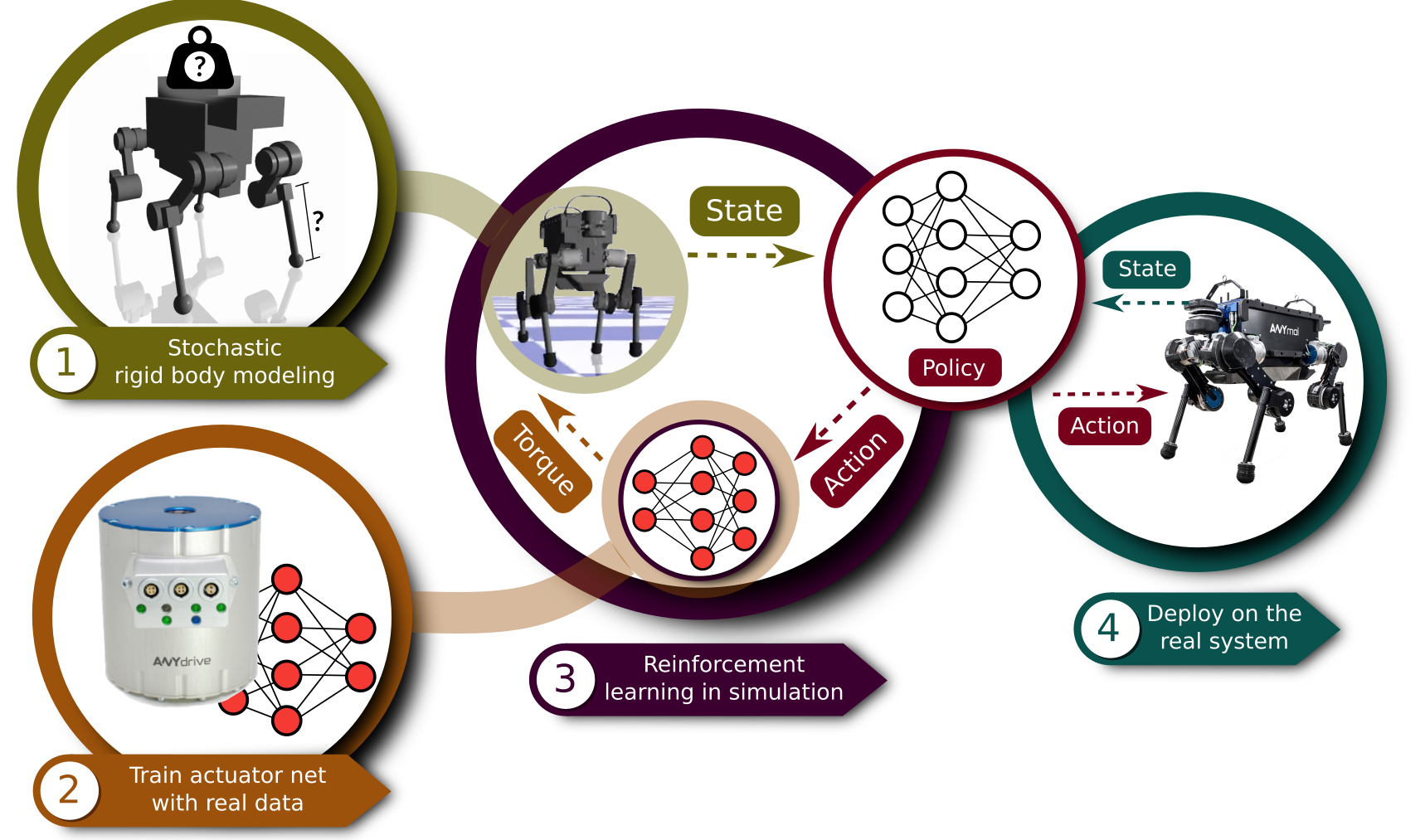
The results are impressive: traversing stairs, rocky terrain, mud, all using only proprioception, meaning the sense of its own joints. No camera to see the terrain, the robot "feels" the surface through its legs, exactly like you feel the ground through your shoes when walking in the dark.
The best locomotion controllers often use only proprioception: joint angles plus data from the inertial measurement unit (IMU, a small box of accelerometers and gyroscopes reporting the body's tilt and accelerations). No vision. The robot "feels" the terrain through direct contact. Vision serves at a higher level: planning where to go in the medium term (avoiding an obstacle, choosing a path). This separation of roles is simple and effective.
Bipedal: The Infernal Balance
Going from four legs to two adds a considerable level of difficulty. Two legs mean a tiny support surface, a high center of gravity, and a robot that is inherently unstable at every moment. Add the flight phase (when one foot leaves the ground) and the 30+ degrees of freedom of a humanoid, and you have a formidable control problem.
The classical approach, the Zero-Moment Point (used by Honda for ASIMO), guarantees mathematical stability but produces unnatural, robotic movements. The robot walks as if it's afraid of falling, because that's exactly the case.
RL changes the game: by learning to walk in simulation, then imitating human motion capture data, you get much more natural and dynamic gaits. The robot learns that falling a little and catching itself is normal. That's exactly what humans do: walking is a perpetual controlled fall.
Agility Robotics with its Digit robot is the first bipedal humanoid in commercial production, deployed for logistics tasks in warehouses. It combines classical optimal control and learning, drawing the best from both worlds.
Digit transports bins in Amazon warehouses. A bipedal humanoid that works. Not science fiction, it's happening now. It uses hybrid control combining classical optimization and learned policies, showing that the best current approach mixes paradigms.
Autonomous Navigation: SLAM + Planning + Semantic Understanding
Moving through an environment is more than putting one foot in front of the other. The robot must locate itself and map its environment simultaneously.
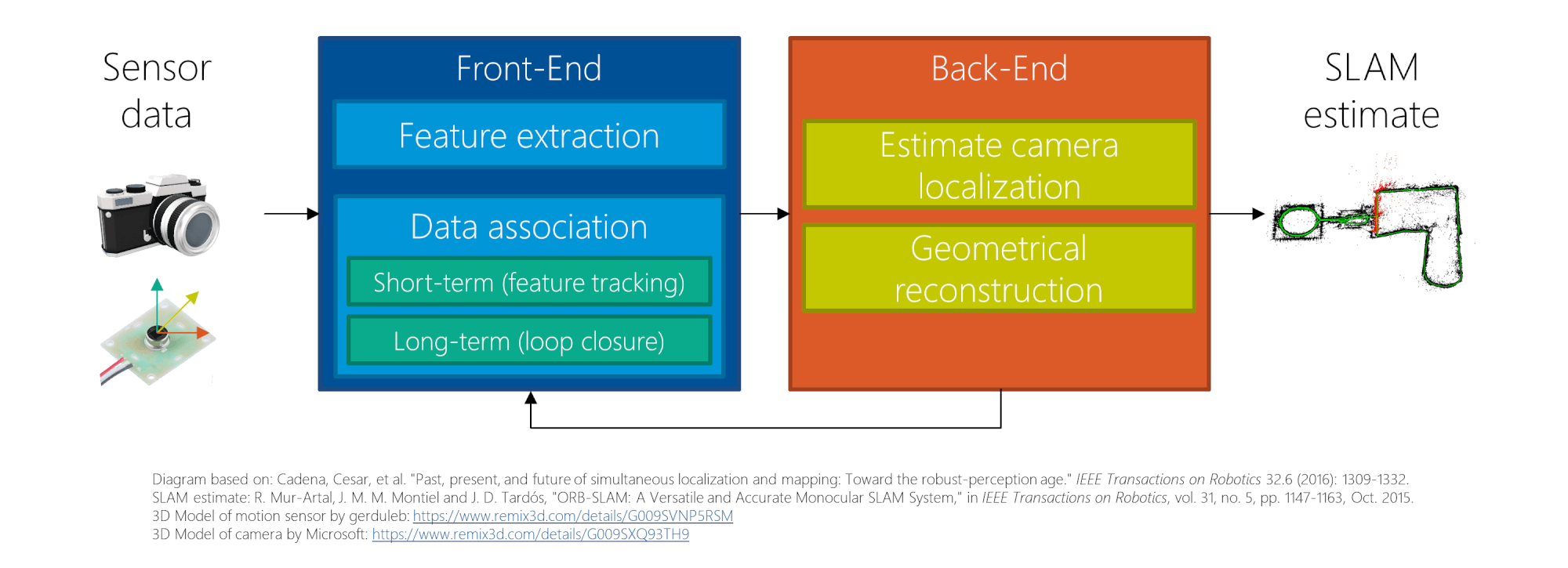
SLAM (Simultaneous Localization and Mapping) is the foundational technology. The robot localizes itself and builds a map at the same time, solving a chicken-and-egg problem: you need the map to localize, and you need your position to build the map. LiDAR SLAM (with a 3D laser scanner) is the most precise, while Visual SLAM (with cameras) is cheaper and lighter.
Semantic navigation: the robot understands natural language instructions ("go to the kitchen") and reasons logically (the kitchen is next to the living room, the living room is that way). Foundation models combined with navigation produce agents capable of understanding a living space the way a human would.
Vision-Language Navigation (VLN): an agent that follows natural language instructions in 3D environments. The R2R (Room-to-Room) benchmark evaluates this capability, combining linguistic understanding and spatial navigation in a single model.
Outdoor Navigation: Cars and Drones
Tesla FSD (Full Self-Driving) adopts an end-to-end approach with vision only (no LiDAR). Waymo combines LiDAR, cameras, and radar. Both increasingly integrate VLMs for complex scene understanding (hesitant pedestrian crossing, unexpected construction zone).
Delivery robots: Starship and Serve Robotics navigate sidewalks in several cities. Drones: navigation in GPS-denied environments (indoors, under forest canopy) is an active challenge requiring onboard visual SLAM.
A robot navigating among humans must guarantee it won't injure anyone, even in case of software or hardware failure. Functional safety standards (ISO 13482 for service robotics) govern these deployments. This is one of the main barriers to adoption: demonstrating safety takes time and is expensive.
Outlook
Foundation models are progressively integrating locomotion, manipulation, and language understanding into a single system. NVIDIA GR00T aims for a unified model for humanoid robots. The ultimate goal: you say "bring me a glass of water." The robot navigates to the kitchen, opens the cabinet, grabs a glass, fills it, and returns to you. No disaggregated pipeline with dozens of modules, just an intelligent model that understands and acts. We're not there yet, but the trajectory is clear.
1. Locomotion is presented as the most favourable case in all of robotics for direct sim-to-real transfer. What reason does the page give?
2. One often reads that Digit works at Amazon. What actually happened?
3. Honda's ASIMO, controlled by the zero moment point (ZMP) criterion, walked as if it were afraid of falling. Why?
4. Why is SLAM said to solve a chicken-and-egg problem?
5. According to the page, what is the real difficulty in letting an autonomous robot move among people?