From Understanding to Action: The Conceptual Leap
For 70 years, robotics and natural language lived in separate worlds. A robot didn't need to understand "bring me a glass of water." It executed a predefined program, step by step: "go to coordinates (3.2, 1.5) then activate the gripper then return to coordinates (0, 0)." No semantic understanding, just machine instructions.
RT-2 (Robotic Transformer 2, Google DeepMind, 2023) makes a major conceptual leap: it takes a vision-language model (VLM, a model that can describe and discuss images but cannot move anything) pre-trained on massive web data (billions of images and texts from the Internet) and turns it into a robotic controller. Instead of building a robotic system from scratch over years of specialized development, RT-2 transfers the world knowledge the VLM already has into the robotics domain.
The acronym VLA (Vision-Language-Action) names exactly that combination: images plus an instruction in ordinary language as input, motion commands as output, inside a single model. RT-2 is the paper that fixed the term.
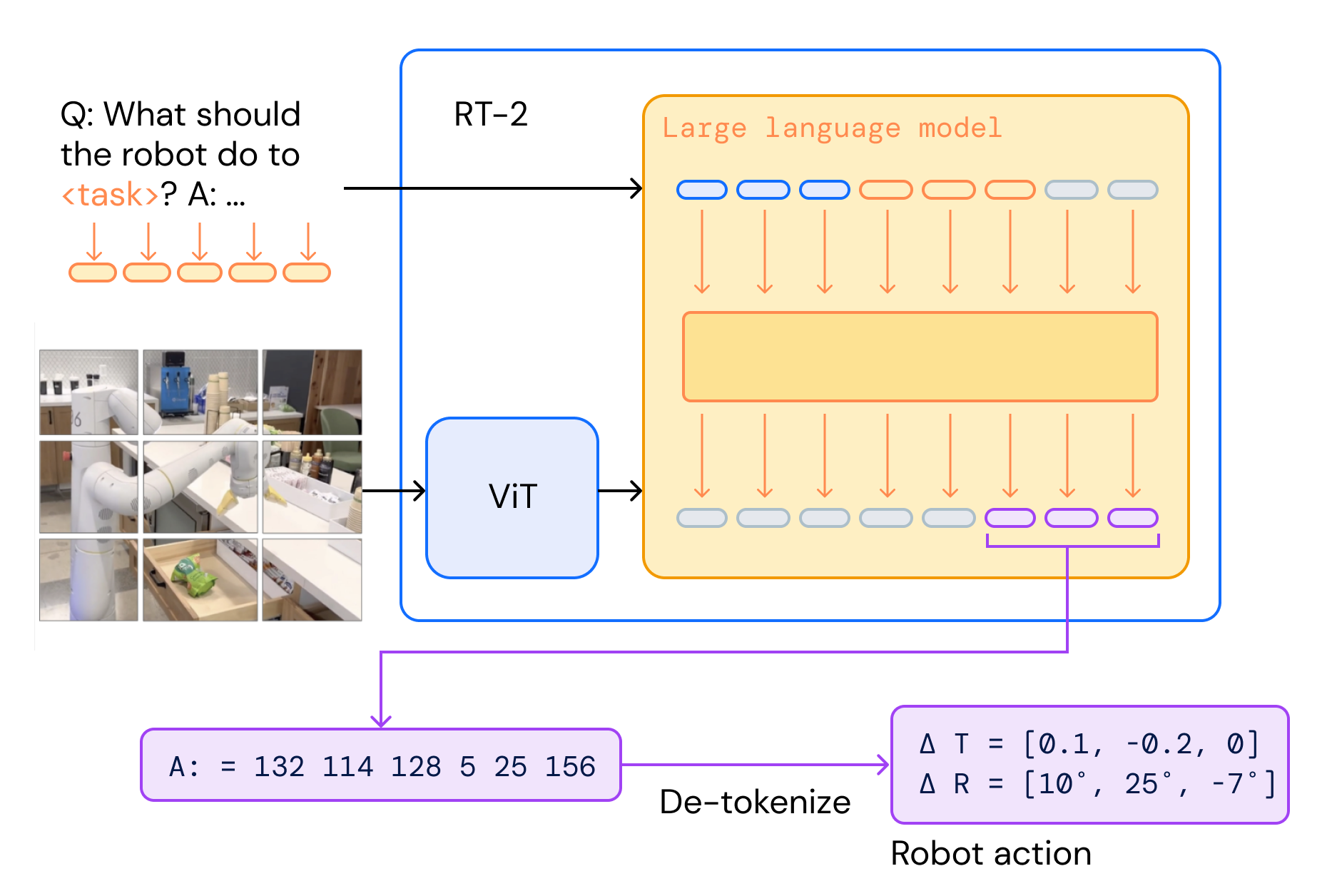
RT-2: Vision-Language-Action Models Transfer Web Knowledge to Robotic Control (Brohan et al., 2023)RT-2's key innovation: representing the robot's actions as text tokens. Coordinates (x, y, z), rotations, and grasp commands are discretized and added to the language model's vocabulary. Generating a motor action becomes strictly equivalent to generating the next word in a sentence. The model already knows how to do this, it was trained on it for months.
RT-2's VLA Architecture
Vision input: the environment image captured by the robot's camera. The model sees what the robot sees.
Language input: the user's text instruction, for example "move the can to the dinosaur figure." The model understands what it's being asked.
Action output: the robot's motor commands, tokenized as text. Each movement dimension (position, rotation, gripper) is discretized into bins and generated token by token.
Base models: RT-2 uses either PaLI-X (55 billion parameters) or PaLM-E (12 billion parameters) as its backbone. These models are then fine-tuned on robotic data to learn to generate actions on top of their existing visual and textual understanding capabilities.
The Magic Transfer: From Web Knowledge to Robotics
What makes RT-2 truly revolutionary is its ability to leverage knowledge acquired on the web for robotic tasks it never saw during robotic training:
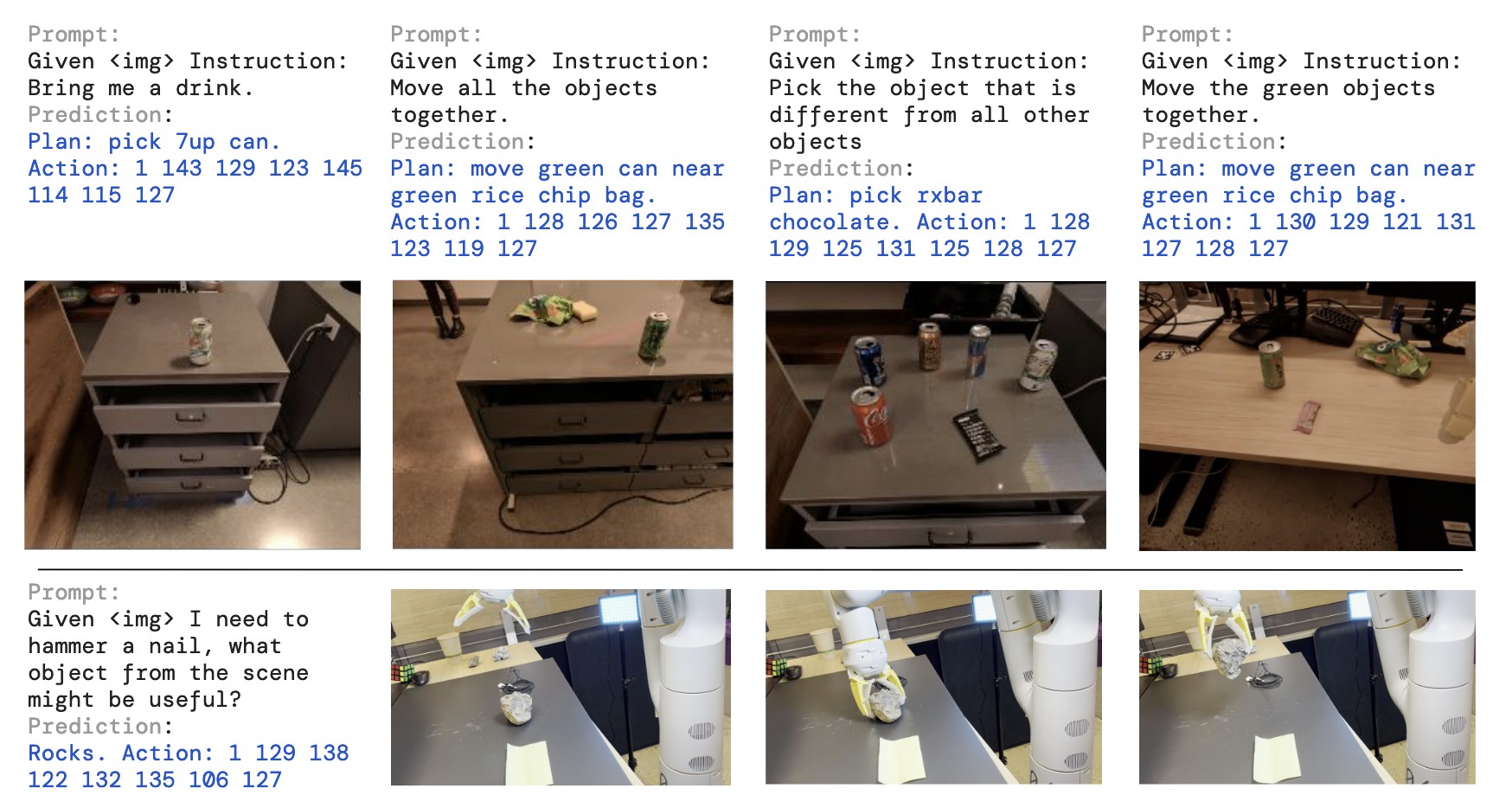
- Semantic reasoning: the instruction "put the object in the right bin" works because the model knows, thanks to its web pre-training, that paper goes in recycling and bananas go in organic waste. No robot taught it that
- Symbol recognition: identifying logos, flags, celebrities on objects. The robot recognizes Taylor Swift on a photo because the VLM has seen thousands of her photos on the Internet
- Mathematical reasoning: "move to the smallest number" works without specific training. The model knows how to compare numbers
- Chain of reasoning: breaking down complex instructions into logical sub-steps
RT-2 can use chain-of-thought before generating its actions: it "thinks" in natural language. For example, facing the instruction "pick up something to write with," the model identifies the objects on the table, reasons that the pen is the appropriate writing object, and generates the action to grasp the pen. Thought precedes action.
Zero-Shot Generalization: Proof of Transfer
Two different tables from the paper are often quoted as if they were one. They are worth separating, because they measure different things.
First table, generalization. Objects, backgrounds and environments never seen during robot training. Averaged across those three categories: 62% for both versions of RT-2, against 32% for RT-1, its predecessor trained without web data. Note what this number is not: it measures robustness to new scenes, not reasoning.
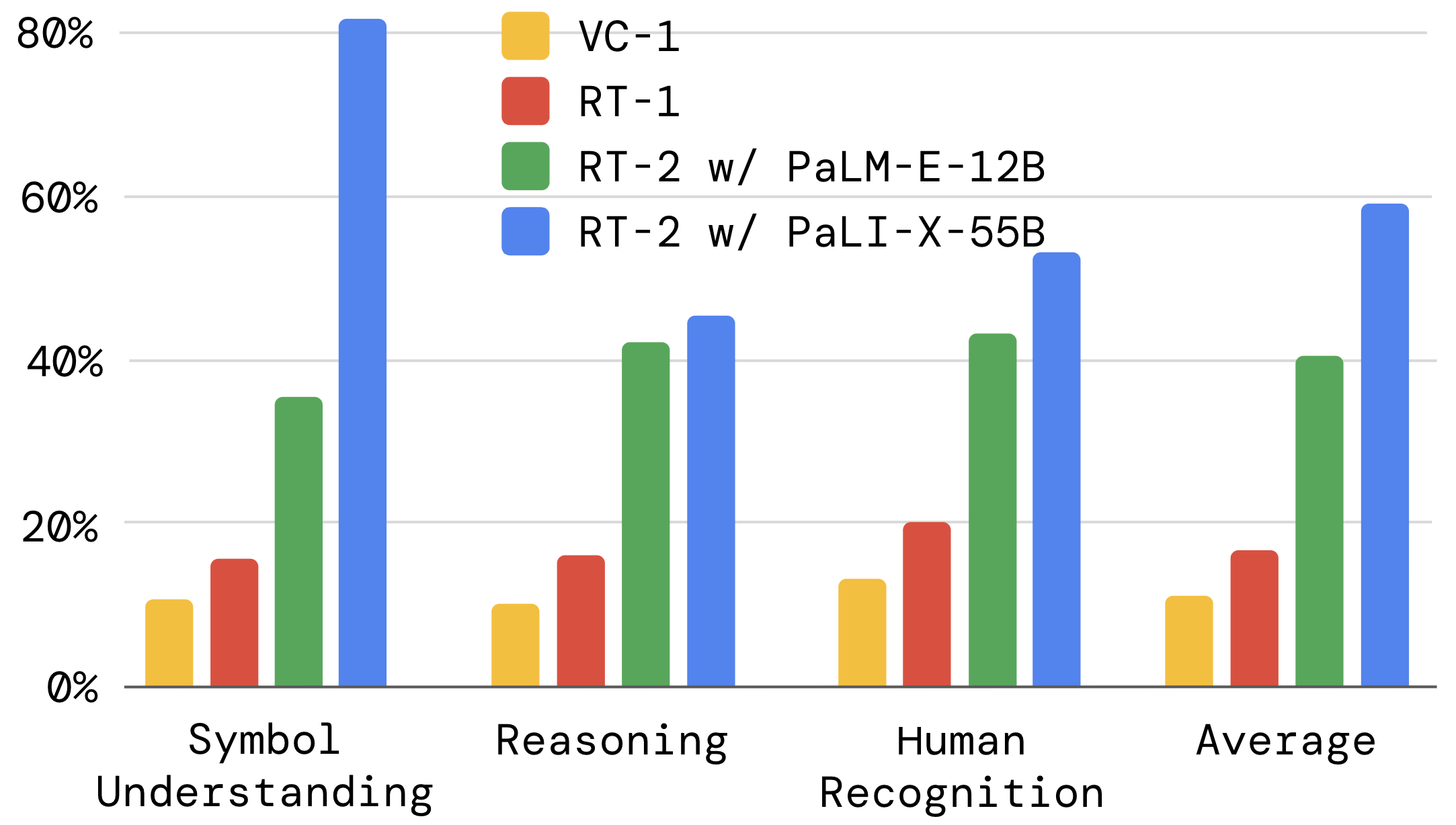
Second table, so-called emergent capabilities. Symbol understanding, reasoning, human recognition. Average: 60% for the PaLI-X-based RT-2, 40% for the PaLM-E version, against 17% for RT-1. The authors summarize their own result as a 2x to 3x improvement over RT-1 on these novel instructions.
It is this second table that demonstrates transfer: these are tasks no robot demonstration could have taught, only web pre-training.
The rates come from roughly 6,000 real trials run by the authors, on one robot, on Google premises. The exact protocol (objects, lighting, layout) cannot be reproduced by an outsider, and no third party has re-run the measurement. A 62% obtained this way is not comparable to a 62% announced by another team on different hardware. The checklist is on How to read a benchmark score.
From RT-1 to RT-2: The Game-Changing Evolution
RT-1 (2022): a robotic model trained only on robotic demonstration data. Performant on tasks seen during training, but with weak generalization and no semantic understanding of the world. The robot knew "how" but not "what" or "why."
RT-2 brings fundamental improvements:
- Web pre-training: world knowledge acquired from billions of Internet pages
- Change of scale: 35 million parameters for RT-1, up to 55 billion for RT-2 in its PaLI-X version, a factor of roughly 1,500
- Reasoning: symbolic and semantic reasoning capabilities entirely absent from RT-1
- Co-fine-tuning: simultaneous training on web and robotic data in the same batches, which prevents catastrophic forgetting (the model doesn't lose its web knowledge while learning robotics)
RT-X and Open X-Embodiment: Toward a Universal Dataset
After RT-2, Google launched Open X-Embodiment (models trained on it are called RT-X): a collaborative effort gathering data from 22 robot morphologies collected by 21 research institutions, covering 527 skills. The goal: a unified, diverse robot dataset, much as ImageNet was for computer vision. The more heterogeneous the data (different robots, tasks, environments), the more the model is forced to learn principles rather than memorized gestures.
Open X-Embodiment: Robotic Learning Datasets and RT-X Models (2023)RT-2 showed that a vision-language model could be turned directly into a robotic controller, with measurable knowledge transfer from the web. The VLA paradigm it named became the reference for the field. It is the paper that tipped robotics over, with the caveat above that the measurement was made by one team on one robot.
Important Limitations
- Latency: 55 billion parameters is too slow for high-frequency control. The robot is responsive, not agile
- Single robot: demonstrations were run only on Google's mobile robot (Everyday Robots). Nothing was demonstrated on any other morphology
- Closed weights and data: neither the model nor the training data is public, which rules out independent reproduction. No third party has been able to check the numbers above
- Simple tasks: demonstrations stay within table-top manipulation (moving, grasping, placing)
Despite these limitations, RT-2's influence is considerable. It paved the way for OpenVLA and Octo, which redo the same recipe in the open, and for π0, which changes the output. RT-2 is to robotics what GPT-3 was to language processing: the feasibility demonstration that reoriented a whole field.
1. What is RT-2's fundamental innovation for getting a language model to produce movements?
2. RT-2 succeeds at 'put the object in the correct bin' or 'move to the smallest number' although no robotic demonstration ever taught it those notions. What do these successes demonstrate?
3. RT-2 reports 62 percent success in generalization. Another team reports 62 percent on its own robot. Can the two systems be compared?
4. During robotic fine-tuning, RT-2 keeps training on web data mixed with robot data in the same batches (co-fine-tuning). Why?