What Those Three Letters Mean
VLA stands for Vision-Language-Action. The three words name the two inputs and the one output of a single model:
- Vision: the model receives images, from the robot's cameras.
- Language: it receives an instruction in ordinary language ("put the cup in the cabinet") not code.
- Action: it produces the motion commands sent to the motors.
The point is not that these three capabilities exist; they existed separately already. The point is that they fit inside one model.
For 50 years, classical robotics separated everything into distinct modules: perception (what does the robot see?), planning (what should it do?), and control (how do we move the motors?). Each module was built independently, each had its own output format, and errors propagated from one to the next with nobody able to say which one was at fault. VLA models make the conceptual leap: one model, end to end, running from the image all the way to the motor command.
The paradigm inherits from two lineages: the sequence-to-sequence (seq2seq) tradition in language processing (turning one string of symbols into another, as in machine translation) and vision-language models (VLMs), which can describe and discuss an image in words. VLAs extend that lineage to generating physical action.
A VLA is essentially a vision-language model augmented with the ability to produce actions. Actions become a new type of token, exactly like text or visual tokens. Generating a robot movement becomes formally the same operation as generating the next word in a sentence, and that is precisely what lets you recycle an entire language model instead of starting from scratch.
A VLA turns images and words into movement. It says nothing about whether the movement is any good. A model that emits motor commands emits motor commands even when the scene makes no sense to it: there is no "I don't know" output. Every capability claim therefore has to be traced back to a measurement protocol, see How to read a benchmark score.
General Architecture
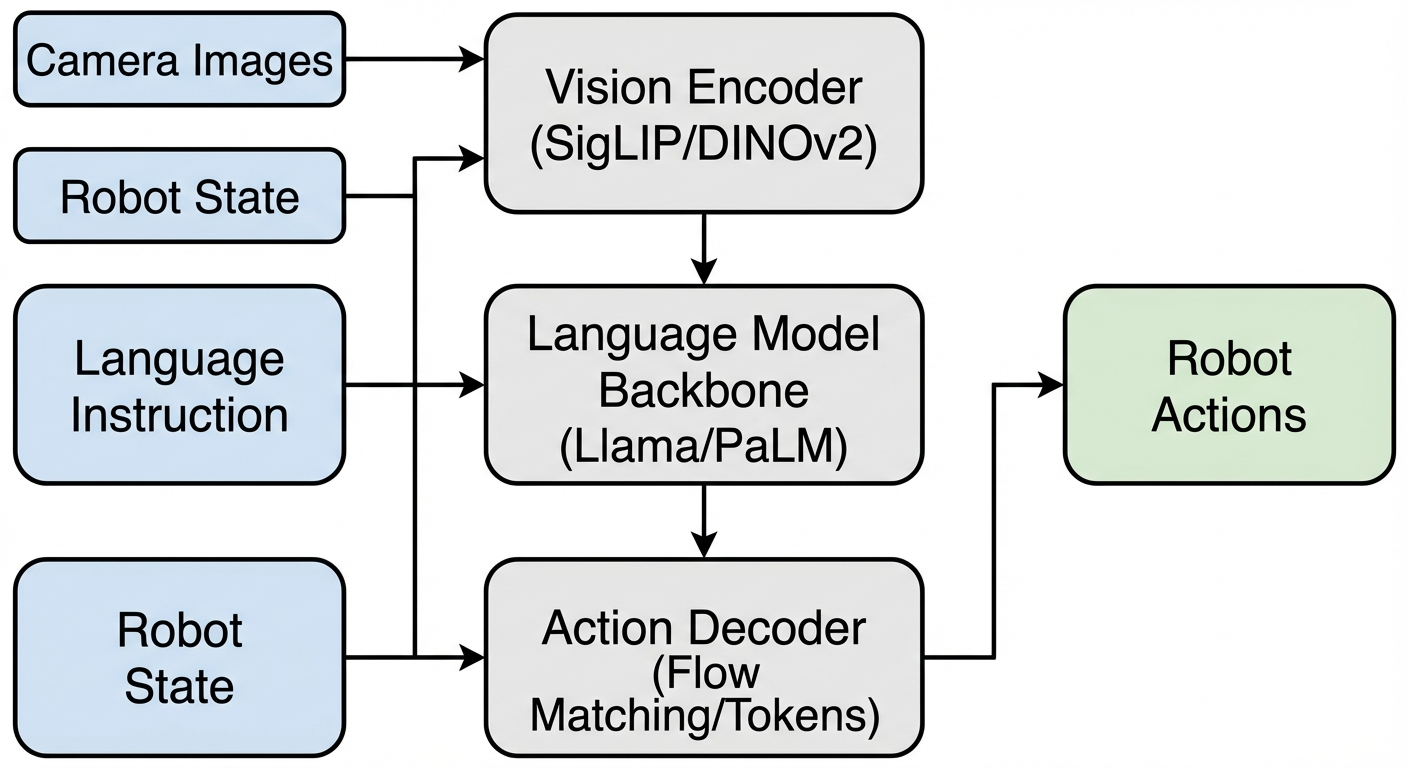
The Three Inputs
- Vision: images from the robot's cameras. Typically an overview of the scene and/or a wrist camera to see up close what the robot is manipulating
- Language: the user's text instruction, such as "put the cup in the cabinet"
- Proprioception (optional): the robot's internal state, its joint positions and the forces read by its sensors. It's the equivalent of your kinesthetic sense: the feeling that tells you where your arm is even with your eyes closed
How many cameras, and whether there is a depth sensor, are not details: they set the cost and the portability of the robot. Robostral Navigate is the extreme case (a single ordinary colour camera, no depth sensor at all) and it copes by outputting, instead of a displacement in metres, a point picked out inside the image.
Encoding: Turning the World into Tokens
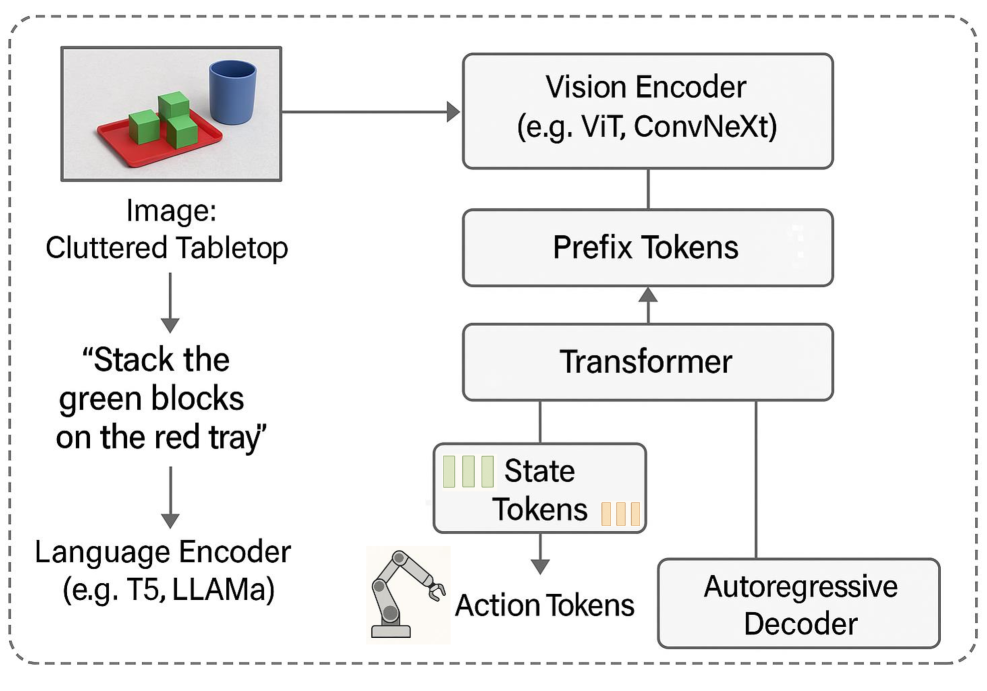
Visual encoder: the image is transformed into visual tokens via a pre-trained encoder. Several options exist:
- ViT (Vision Transformer): cuts the image into square patches (typically 16 by 16 pixels) and encodes each patch as a token
- SigLIP: a variant of CLIP (Contrastive Language-Image Pre-training) optimized for vision-language alignment. SigLIP captures the relationship between what you see and what you describe in words
- DinoV2: a self-supervised encoder (trained without human labels) that captures rich spatial features, good at telling where objects are rather than what they are
- Some models combine multiple encoders (OpenVLA uses SigLIP + DinoV2) to benefit from each one's strengths
Text encoder: the instruction is split into tokens by the language model's standard tokenizer (SentencePiece, or byte pair encoding, BPE, a scheme that cuts text into frequently occurring fragments), exactly as with ordinary text.
The Transformer Backbone: The Brain
Visual and text tokens are laid end to end in a single sequence and processed by a decoder-only transformer (the GPT or Llama architecture: the model only ever predicts the continuation of a sequence, with no separate reading module). This is the heart of the system:
- It learns the relationships between pixels (what I see) and words (what I'm being asked)
- Because visual and text tokens sit in the same sequence, attention relates them without any dedicated module: that is what connects the instruction to the observation
- Deep layers learn to plan and reason: understanding that "put the cup away" involves locating the cup, grasping it, finding the cabinet, opening it, and placing the cup inside
The architecture is autoregressive: it emits tokens one at a time, each conditioned on all the previous ones. So it generates actions exactly as a language model generates text, word by word. The decisive advantage: you can reuse, unchanged, the weights of a language model already trained on billions of texts, weights being the learned parameters, frozen once training ends, as opposed to tokens, which are computed afresh for each new scene. The robot inherits the language model's understanding of the world.
Action Generation: Where the VLA Stands Apart
This is the part that distinguishes a VLA from a simple VLM. Three approaches have followed one another:
Discrete tokenization: the robot's actions are continuous, a joint position can take any real value. A language model, however, can only pick from a finite vocabulary. So each dimension of movement is cut into bins, typically 256 per dimension, and those 256 bins are added to the model's vocabulary. The dimensions are the three positions x, y, z, the three rotations, and the gripper opening. Concretely, an action looks like:
Action = [x_bin_142, y_bin_87, z_bin_203, rx_bin_12, ry_bin_45, rz_bin_78, gripper_open]
It's as if the robot learned 256 words for each direction of movement, and constructs a sentence describing its gesture.
Continuous regression head: the other route adds a small network on top (a multi-layer perceptron (MLP), that is, a few stacked layers of neurons) projecting the transformer's last internal representation straight onto continuous values. This avoids the loss caused by binning, but gives up autoregressive generation: every dimension comes out at once, none able to account for the others.
Generative head (diffusion or flow matching): the third route, dominant since 2024. A small specialized network plugged into the vision-language model starts from a noisy trajectory and turns it, in a few steps, into a smooth sequence of movements, just as an image generator starts from noise and ends with a photo. The decisive advantage: when several gestures are valid (going around an obstacle on the left or on the right), the model commits to one instead of averaging them into an absurd path straight through the obstacle. This is the route taken by π0, GR00T and SmolVLA, described below.
Architectural Variants: Concrete Models
RT-2 (Google): fine-tunes a large existing VLM (PaLI-X (55 billion parameters) or PaLM-E (12 billion)) with actions written as text and co-fine-tuning that mixes web and robot data.
OpenVLA (Stanford, Berkeley, Toyota Research Institute): built on Prismatic-7B (Llama 2 + SigLIP + DinoV2), 7 billion parameters, fully open-source, actions binned into 256 levels per dimension.
Octo (Berkeley): a transformer designed from scratch, far smaller (93 million parameters) and modular, with a diffusion head to represent complex action distributions.
π0 (Physical Intelligence): a VLM of roughly 3 billion parameters (SigLIP 400 million + Gemma 2.6 billion) with a 300-million-parameter module grafted on that generates actions by flow matching (progressively turning noise into a trajectory) rather than by binning. Details on Physical Intelligence π0.
An important innovation: instead of predicting a single action at each time step, the model predicts a chunk of several future actions at once, executes them in sequence, and only then looks again. This reduces compounding error (the small deviations that build on each other step after step) and produces smoother trajectories. ACT (Action Chunking with Transformers) popularized the approach; in the original paper the chunk is 100 steps long.
Learning Fine-Grained Bimanual Manipulation with Low-Cost Hardware (ACT / ALOHA, Zhao et al., 2023)2025-2026: The Current Generation
The 2023 models (RT-2, OpenVLA) were proofs of concept: one big, slow network, on a fixed arm, in front of a table. Two years later the landscape has changed in three ways: the architecture has split in two, models have started to plan before acting, and most of the progress comes from big industrial players (Google DeepMind, NVIDIA, Figure, Physical Intelligence) rather than from university labs.
The Two-Speed Brain
The starting problem is simple: a vision-language model with several billion parameters takes on the order of a hundred milliseconds to answer, while a hand grasping a fragile object has to correct its movement hundreds of times per second. The solution that took hold in 2025 borrows from psychology the distinction between a slow, deliberate System 2 and a fast, reflexive System 1:
- a big, slow model looks at the scene, understands the instruction and decides what to do, a few times per second;
- a small, fast model receives that intention as an internal representation and produces motor commands at high frequency.
Helix (Figure, February 2025) is the clearest example: a 7-billion-parameter vision-language model runs at 7-9 decisions per second, and an 80-million-parameter network produces the upper-body commands of a humanoid at 200 per second. Helix 02 (January 2026) adds a third, even faster layer in charge of whole-body balance, so the robot can walk and manipulate at the same time. GR00T N1 (NVIDIA, March 2025), presented as the first open foundation model for humanoids (about 2 billion parameters), follows the same split. The robots involved are covered in Humanoid robots.
GR00T N1: An Open Foundation Model for Generalist Humanoid RobotsGoogle DeepMind: Gemini Robotics
In March 2025 Google DeepMind introduced Gemini Robotics, a VLA built on its Gemini 2.0 model, together with Gemini Robotics-ER (embodied reasoning), a model that moves nothing itself but understands space: where to grasp a mug, in what order to put objects away. A lighter version that runs directly on the robot, with no cloud connection, followed in June 2025.
Gemini Robotics: Bringing AI into the Physical WorldIn September 2025 Gemini Robotics 1.5 and ER 1.5 formalized a site-manager-and-worker division of labour. ER 1.5 breaks a long mission ("sort this rubbish according to my city's recycling rules") into steps, can look up missing information on the web, then passes each step in plain language to the action model. The action model writes a short line of reasoning before moving ("the bottle is plastic, so the yellow bin"), which improves multi-step tasks and makes its behaviour easier to read. Another novelty: a single model drives very different robots (a two-arm lab platform, Franka industrial arms, Apptronik's Apollo humanoid) and carries what it learned on one body over to the others. ER 1.5 is available to developers through the Gemini API; the action models remain reserved for partners.
Gemini Robotics 1.5: Pushing the Frontier of Generalist Robots with Advanced Embodied Reasoning, Thinking, and Motion TransferAt the end of July 2026 DeepMind announced Gemini Robotics 2, a family of three models (action, reasoning, on-board version) aimed at whole-body control of humanoids. Announced partners include Apptronik, Boston Dynamics (whose new Atlas is to use Gemini Robotics, as announced at CES in January 2026) and Agile Robots. According to early reports, only the reasoning model is open to developers, as with the previous generation, and the published performance figures are Google's own.
Physical Intelligence: π0.5 and Beyond
After π0 (late 2024), Physical Intelligence released π0.5 in April 2025 with a precise goal: getting a robot to work in a house it has never seen. The method is joint training on highly varied data: in the first phase, 97.6% of the examples do not come from mobile robots doing housework, but from other robots, web data and verbal instructions. The authors observe that the ability to generalize rises steadily with the number of distinct places seen in training, approaching the performance achieved in familiar places once about a hundred locations are included. The family continued with π0.7 in April 2026, covered on Physical Intelligence π0.
π0.5: a Vision-Language-Action Model with Open-World GeneralizationNVIDIA: Open Models Fed on Synthetic Data
NVIDIA releases its GR00T models openly, to sell its chips and simulators. GR00T N1.5 (May 2025) was partly trained on trajectories generated by a video model from a single image: NVIDIA says it produced that data in 36 hours, against nearly three months of manual collection (the company's figure, not independently verified). GR00T N1.6 (late 2025, about 3 billion parameters) swaps its understanding module for Cosmos Reason, a vision-language model specialized in physical reasoning, and adds whole-body control. This synthetic-data factory is described on Sim-to-real.
The Open World Catches Up
Two pieces of work show that small teams are not out of the game.
OpenVLA-OFT (Stanford, February 2025) takes OpenVLA and changes how it is fine-tuned: instead of emitting action bins one at a time, the model outputs a whole block of actions at once (parallel decoding), as continuous values. The result: action generation 26 to 43 times faster depending on block size, and a success rate rising from 76.5% to 97.1% on the simulated LIBERO benchmark, above π0 (94.2%) on the same test. The lesson goes beyond this model: binning into 256 levels, the emblem of 2023 VLAs, is no longer the norm.
Fine-Tuning Vision-Language-Action Models: Optimizing Speed and SuccessSmolVLA (Hugging Face, June 2025) bucks the race for size: 450 million parameters, a flow-matching action head, and pre-training on about 480 datasets shared by hobbyists on the Hub, recorded with arms costing around a hundred dollars. It runs on a consumer graphics card and, according to its authors, beats much larger models on their tests. The background is on Hugging Face.
SmolVLA: A Vision-Language-Action Model for Affordable and Efficient RoboticsAt a Glance
| Model | Who, when | Size | How actions are produced | Access |
|---|---|---|---|---|
| RT-2 | Google, 2023 | 12 to 55 billion | Discrete bins | Closed |
| OpenVLA | Stanford et al., 2024 | 7 billion | 256 bins per dimension | Open |
| π0 / π0.5 | Physical Intelligence, 2024-2025 | ~3 billion | Flow matching | Weights released |
| Helix / Helix 02 | Figure, 2025-2026 | 7 billion + 80 million (then 3 layers) | Two speeds, commands at 200 per second | Closed |
| Gemini Robotics 1.5 | Google DeepMind, 2025 | Not disclosed | Reasons in text before acting | Partners |
| GR00T N1 to N1.6 | NVIDIA, 2025 | 2 to 3 billion | Two speeds, generative head | Open |
| OpenVLA-OFT | Stanford, 2025 | 7 billion | Continuous block, parallel decoding | Open |
| SmolVLA | Hugging Face, 2025 | 450 million | Flow matching | Open |
One warning applies to all these numbers: success rates are almost always measured by the model's own authors, on their own tasks and often in simulation. Demo videos do not show the failed attempts. Comparing two VLAs seriously requires the same robot, the same objects and the same instructions, which remains rare.
Training a VLA: From Web to Robot
Training happens in several phases:
VLM pre-training: the model learns vision and language on massive web data (billions of image-text pairs). This is where it acquires its world understanding: what a cup is, a drawer, a robot.
Robotic phase: fine-tuning on robot demonstrations, typically from the Open X-Embodiment dataset, assembled from 22 robot morphologies collected by 21 institutions and covering 527 skills. Octo used 800,000 of its trajectories, OpenVLA 970,000. The model learns to turn its world understanding into concrete actions.
Open X-Embodiment: Robotic Learning Datasets and RT-X Models (2023)Co-fine-tuning: joint training mixing web and robot data in the same batch. This prevents catastrophic forgetting: without it, robotic fine-tuning would gradually erase the model's web knowledge.
Robotic data collection: data is typically collected through teleoperation: a human controls the robot via a haptic device (gloves, controller) while observations (images) and actions (movements) are recorded. It's laborious but currently the most reliable method.
Open Challenges
- Real-time: models of 7 billion parameters and up are too slow for high-frequency control (100 commands per second leaves 10 milliseconds per decision). The two-speed architecture, chunked prediction and small models like SmolVLA work around the problem more than they solve it: the big model is still slow to react to the unexpected
- Dexterous manipulation: a five-fingered robotic hand has roughly twenty degrees of freedom, twenty numbers to produce simultaneously and coherently at every instant. Action spaces that large remain hard to model
- Cross-embodiment generalization: a single model for all robot types, from industrial arms to humanoids
- Safety: how do you guarantee the model never generates actions dangerous to nearby people? And, a separate and harder question, how do you prove it, see Sim-to-real
The main bottleneck remains the quantity and diversity of robot data. VLMs draw on billions of web images that somebody else already collected. The best robot datasets hold on the order of a million trajectories (Physical Intelligence cited more than 10,000 hours of demonstrations for π0), often on narrow tasks, and every one of them had to be produced by a real robot driven by a real person. Closing that gap is the most limiting factor for VLA progress, which is why industry is pouring money into large-scale teleoperation, first-person video of humans at work, and trajectories generated by video models.
Two routes get around it. The first is simulation: manufacture the trajectories instead of collecting them, at the price of a transfer problem (Sim-to-real). The second is reinforcement learning, which lets the model generate its own experience by trying and failing: that is the second training stage of Robostral Navigate, which uses the CISPO algorithm, a GRPO variant borrowed from language-model post-training (GRPO variants). The basics are in Reinforcement learning.
1. Faced with an incomprehensible scene (an object never seen, aberrant lighting) what does a VLA model do?
2. A robot's movements are continuous: a joint position can take any value. Why do VLAs like OpenVLA cut them into 256 bins per dimension?
3. Why do almost all VLAs use a decoder-only transformer, the architecture of GPT and Llama?
4. According to the page, what is the most limiting factor for VLA models today?
5. ACT predicts a block of 100 future actions at once, executed in sequence before looking again. What problem does this chunked prediction reduce?
6. Helix (Figure) pairs a 7-billion-parameter vision-language model with an 80-million-parameter network. Why the split?