The Convergence: 50 Years of Separate Evolution, Suddenly Together
For decades, robotics and generative AI evolved in parallel without crossing paths. Industrial robots executed fixed trajectories programmed by engineers, repeating the same motion millions of times. Language models understood and generated text, with no connection to the physical world. Two neighboring but unrelated disciplines.
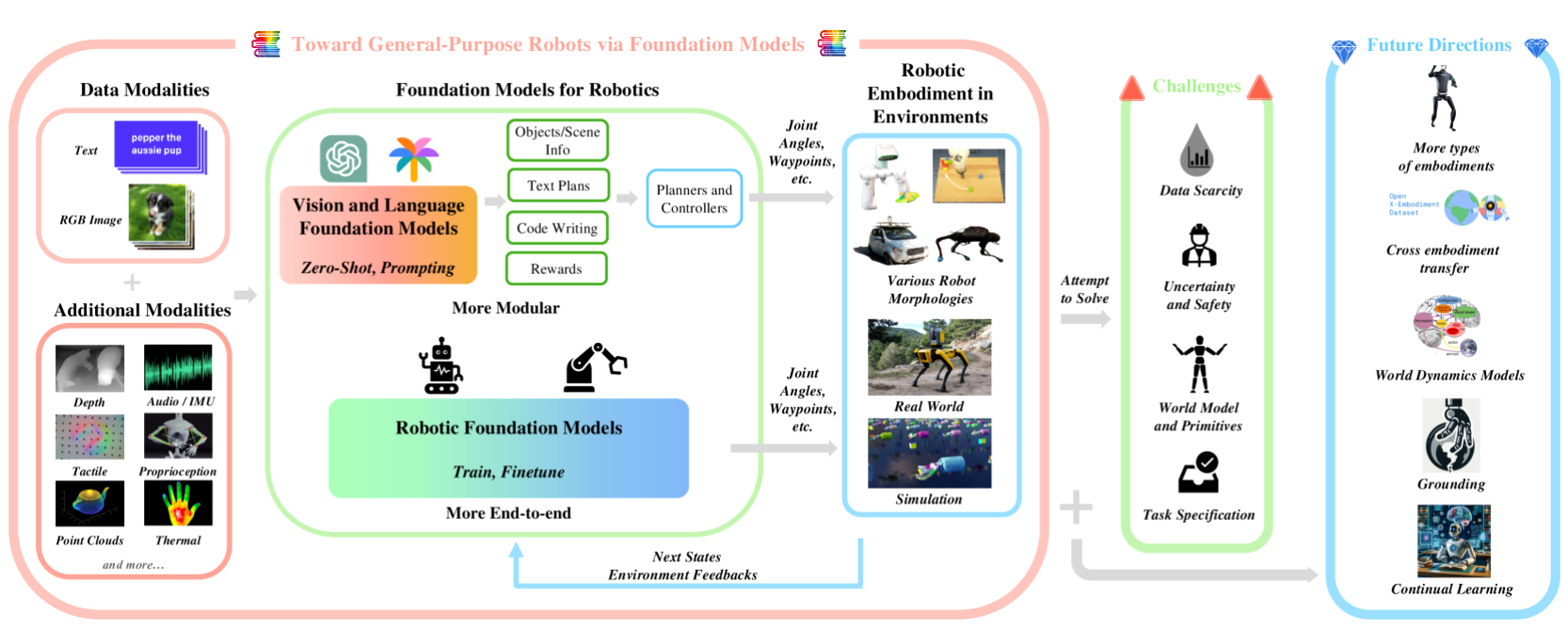
Since 2022-2023, a revolution has been underway. Foundation models, those giants pre-trained on immense data corpora (text, images, videos), are being applied directly to robotics. The core idea is compelling: transfer the world understanding acquired by these models (language, vision, reasoning, knowledge of objects and their uses) to the control of physical robots. A model that knows what a cup is, that understands the instruction "put the cup in the cabinet," and that can generate the movements to do it.
A robotic foundation model is a pre-trained model capable of understanding natural language instructions, perceiving the environment through vision, and generating motor actions. It unifies perception, reasoning, and action in a single system, where classical robotics used dozens of separate, specialized modules.
The whole module turns on three letters. VLA stands for Vision-Language-Action. A VLA is a single model that receives:
- images (what the robot's cameras see),
- an instruction in ordinary language ("put the cup in the cabinet"),
and that outputs the motion commands sent to the motors, directly.
What is new is none of those three pieces on its own: it is that they fit inside one model. In the robotics that came before, one system reported what was on the table, a second decided what to do, a third drove the motors, three pieces of software, written by three teams, passing messages to each other. In a VLA there is no seam between them: one chain of computation runs from the image all the way to the torque applied at the joint. The page VLA model architecture works through the details.
Why This Changes Everything: The Historical Problem of Robotics
Before foundation models, robotics suffered from deep limitations that held back its deployment outside factories:
- Limited generalization: a robot trained to grasp cups couldn't grasp bottles. Every new object required new training or reprogramming
- Scarce and expensive data: collecting robotic demonstrations requires physical hardware, human time, and often controlled conditions. Reaching web-scale data volumes is impossible
- Lack of semantic understanding: the robot didn't know WHAT it was manipulating, only HOW to manipulate it. It moved an object from point A to point B without understanding it was a pen, a cup, or a tool
- Fragility: the slightest change in the environment (lighting, object positions, background) could cause the system to fail
Foundation models solve several of these problems simultaneously:
- Language understanding: the robot can receive instructions in natural language, not in code
- World knowledge: the large language model (LLM) has absorbed an immense amount of knowledge about objects, their properties, and their uses. It knows that a knife cuts, that a cup gets filled with water, that a drawer opens by pulling
- Reasoning: breaking down a complex task into logical sub-tasks ("to make coffee, first find a cup, then the coffee machine, then...")
- General-purpose vision: recognizing thousands of objects without specific training on each one
Natural language processing (NLP) experienced its revolution with BERT and GPT: the shift from specialized models (one model per task) to generalist models (one model for everything). Robotics is following exactly the same path, with a few years' delay. Foundation models are doing to robotics what Transformers did to language.
The Three Main Approaches
Vision-Language-Action (VLA): the most direct approach, the one described in the box above. The model takes an image and a text instruction as input, and directly generates the robot's actions. Google's RT-2 is the flagship example: a vision-language model (VLM, a model that can describe and discuss images, but cannot move anything) pre-trained on the web, then fine-tuned on robot data, inheriting its understanding of the world. A VLA is simply a VLM with a motor output bolted on.
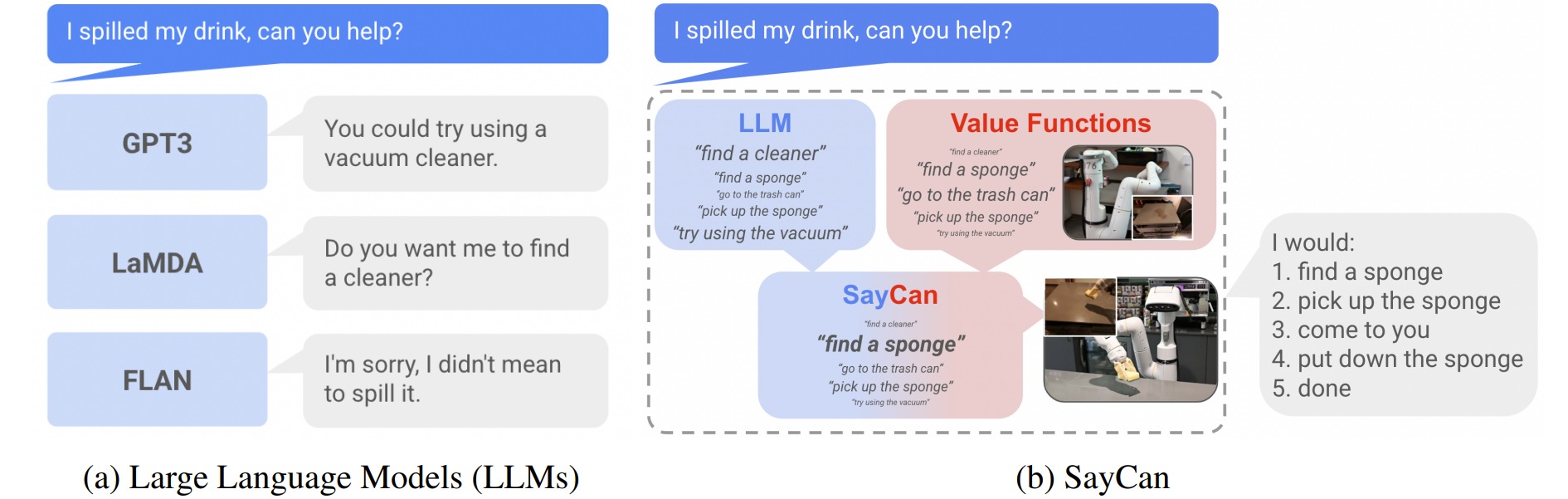
LLM as High-Level Planner: the LLM doesn't directly control the motors. It breaks down a complex instruction ("prepare breakfast") into simple steps ("open the fridge, grab the milk, close the fridge, get a bowl...") and delegates each step to specialized low-level controllers. Google's SayCan and Code as Policies illustrate this approach. The advantage: you can use a standard LLM without any robotic modification.
World models: the robot learns an internal model of the world's physics. It mentally simulates the consequences of its actions before executing them. It's like playing chess by imagining moves ahead of time. Useful for short-horizon planning and complex object manipulation; the page World models explains why the horizon stays short.
Major Challenges
The sim-to-real gap: models pre-trained in simulation (Isaac Sim, MuJoCo) operate in an idealized world. Transferring to the real world remains a considerable challenge: textures, contact physics, and the imprecisions of reality differ from simulation in ways that are sometimes subtle, sometimes brutal. This is the hardest problem in the field, and it has its own page: Sim-to-real.
Safety: an LLM that hallucinates produces incorrect text. A robot that hallucinates can cause physical damage: break an object, knock something over, or worse, injure a human. The reliability and safety of foundation models in robotics are critical issues that don't yet have a satisfactory solution.
Latency: robotic control loops often run at 100 Hz or more, a fresh command goes to the motors a hundred times per second. Fitting a multi-billion-parameter model inside the ten milliseconds that leaves, on an onboard computer constrained in weight, power, and cost, is a major engineering challenge. Model distillation and quantization are active research directions.
Despite spectacular progress, robotic foundation models are largely at the research stage. The demos are impressive but carefully controlled. Scaling to industrial deployment, with the reliability and robustness that implies, remains largely ahead of us.
Reading a Robotics Announcement Without Getting Fooled
This is the field where the gap between what you see and what has been demonstrated is widest. Three reflexes are enough to sort it out:
- A video is not a success rate. A successful demo says nothing about how many attempts it took to get it. Until you know how many tries it was filmed over, it measures nothing.
- A success rate is nothing without its protocol. How many trials? Which object? What lighting? What environment? And above all: had the scene been seen during training? A number obtained on a learned scene and a number obtained in an unseen building are not the same number. The full checklist is in How to read a benchmark score.
- Check who is driving. Many humanoid demos are partly teleoperated, that is, remotely piloted by a person. See Humanoid robots.
Key Players
Google DeepMind: pioneers with RT-1, RT-2, RT-X, SayCan. They defined the VLA paradigm. Tesla: Optimus, an end-to-end approach inherited from its self-driving stack (Full Self-Driving, FSD). Figure AI: humanoids, integrating multimodal models. 1X Technologies: NEO, in which OpenAI has been an investor. NVIDIA: Isaac Sim for simulation, GR00T as a robotic foundation model. Meta: open-source contributions and manipulation research. Physical Intelligence: the π0 family, see Physical Intelligence π0. Mistral: entered the field in July 2026 with Robostral Navigate, a navigation model driven by a single RGB camera, no depth sensor, trained entirely in simulation.
Outlook
Robotics may be living a moment comparable to the arrival of ImageNet and convolutional neural networks (CNNs) for computer vision in 2012. The ingredients are in place: powerful models, simulation that scales on graphics processors, and massive investment. The coming years will determine whether foundation models give robots the reliability needed to operate in the real world.
The ImageNet parallel is illuminating, but it has a limit worth naming. In computer vision the data already existed, it "only" had to be labelled. In robotics, every training trajectory has to be produced by a robot, an operator, and real elapsed time. That bottleneck, more than model capacity, sets the pace of the field.
1. A new VLA (vision-language-action) model has just been announced. What actually sets it apart from the robotics that came before?
2. The page compares today's robotics moment to computer vision's ImageNet moment of 2012, but flags a limit to that parallel. Which one?
3. A company releases a video of its humanoid emptying a dishwasher without a single mistake. According to the page, what can you conclude?
4. In the LLM-as-high-level-planner approach illustrated by SayCan, what exactly does the language model do?