Open-Source Robotics: The Revolution After Google
Google's RT-2 demonstrated the power of VLA models, Vision-Language-Action: a single model that sees images, understands an instruction in ordinary language, and directly produces the robot's motion commands. Impressive, but closed: neither the weights, nor the data, nor the robot were available to anyone else. Two academic projects changed the game: Octo and OpenVLA. Thanks to them, any research lab can now download a VLA model, fine-tune it on their own robot, and deploy it. It's the equivalent of the shift from GPT-3 (closed) to LLaMA (open) for robotics.
Octo: The First Open-Source Generalist Robotic Foundation Model
Octo was born from a collaboration between UC Berkeley, Stanford, and Carnegie Mellon. The need was clear: the robotics community lacked a shared model that everyone could build on, much like BERT and GPT served as a common foundation in NLP.
Architecture: Octo is built on a multi-modal Transformer designed for flexibility.
- Observation encoder: the robot's camera images and text instructions are transformed into tokens, the universal language of Transformers
- Transformer backbone: fuses visual and textual information to understand the scene and the intent
- Action head: generates robotic trajectories, meaning the sequence of movements the robot must execute
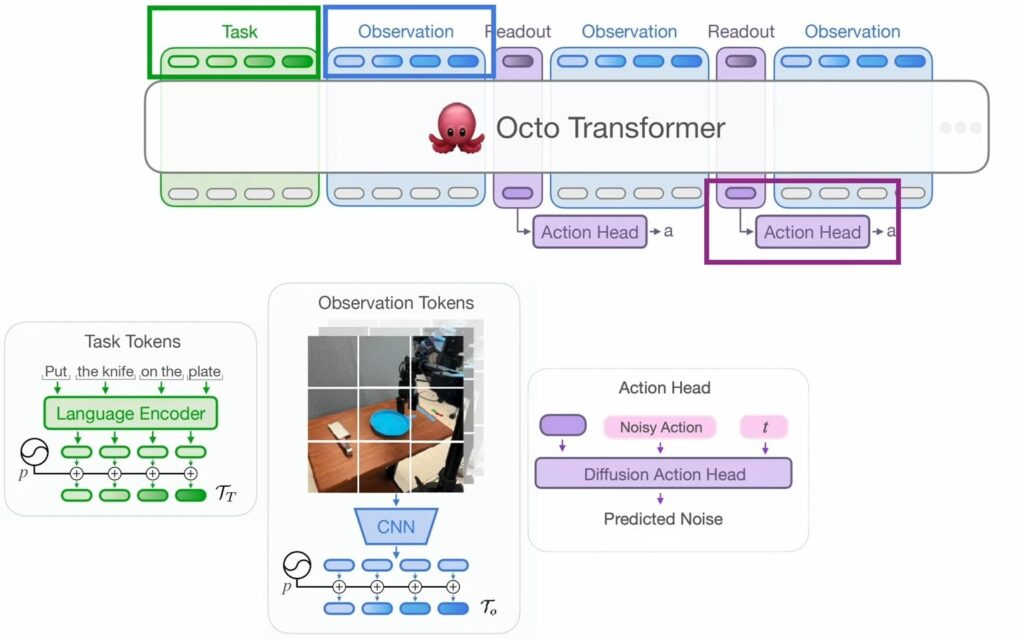
The key to Octo is its modularity. Unlike RT-2, which was tied to a specific Google robot, Octo accepts different configurations: wrist-mounted or overhead cameras, varied action spaces, different robot morphologies. It's like software that runs on any computer, not just the manufacturer's machine.
Data: Octo is trained on 800,000 trajectories from Open X-Embodiment, a collaborative dataset assembled from 22 robot morphologies collected by 21 institutions. That heterogeneity is what enables generalization: seeing many different robots perform varied tasks forces Octo to learn manipulation principles rather than memorized gestures.
Octo: An Open-Source Generalist Robot Policy (Octo Model Team, 2024)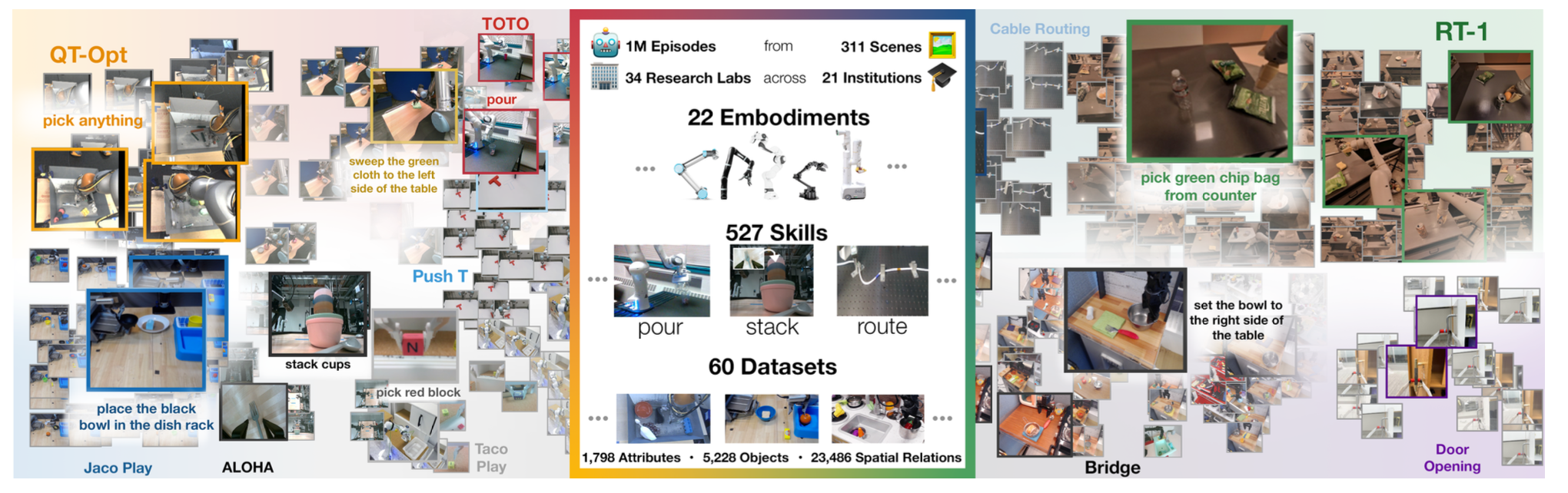
Results: the authors fine-tune Octo within a few hours on a new robot, on consumer graphics cards, and evaluate it across 9 robotic platforms. It is a better starting point than the same model trained from scratch on the same volume of data, which is exactly what pre-training is for. Two sizes exist: Octo-Small (27 million parameters) and Octo-Base (93 million), light enough to run on an onboard computer.
Octo accepts varying configurations: different cameras, different action spaces, different morphologies. You can attach it to a robot without rebuilding the model, where RT-2 was a block bolted to one type of machine.
OpenVLA: The Power of Vision-Language Models
OpenVLA came out of a collaboration between Stanford, Berkeley, the Toyota Research Institute and several other labs. The approach is the opposite of Octo's: rather than building a model from scratch, OpenVLA fine-tunes an existing vision-language model (Prismatic-7B, built on Llama 2) into a robotic controller.
OpenVLA: An Open-Source Vision-Language-Action Model (Kim et al., 2024)Architecture:
- Vision backbone: SigLIP + DinoV2 for rich image encoding. SigLIP provides vision-language alignment (understanding what you see), DinoV2 provides fine spatial information (understanding where things are)
- Language backbone: Llama 2 7B for reasoning and generation. This is the brain that understands instructions and reasons about what to do
- Action tokenization: the robot's continuous actions (position x, y, z, rotation, gripper opening) are discretized into 256 bins and added to the model's vocabulary. Generating an action literally amounts to generating a word
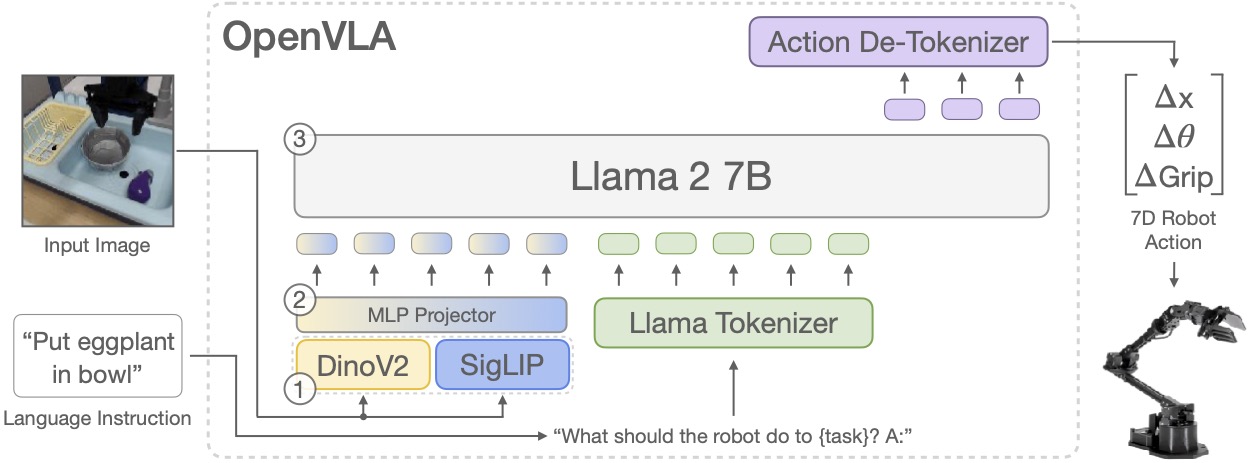
Philosophy: this is exactly the RT-2 paradigm, but open-source. You take a pre-trained VLM that understands the visual and textual world, fine-tune it on robotic data, and it inherits all the world understanding acquired during web pre-training. OpenVLA knows what a pen, a cup, or a recycling bin is, without ever having seen them in a robotic context.
Performance: trained on 970,000 real-world demonstrations, OpenVLA (7 billion parameters) beats RT-2-X (55 billion) by 16.5 points of absolute task success rate across 29 tasks and multiple robot embodiments, with 7x fewer parameters. All of it is published: model, training code, data.
The figure comes from the OpenVLA paper, measured by its own authors, on 29 tasks they chose, on their hardware. That is the normal publication mode in this field and there is no bad faith in it, but a margin measured by the team proposing the method does not have the same standing as one measured by an outsider. See How to read a benchmark score.
OpenVLA follows the RT-2 paradigm but in a public version. Take a pre-trained VLM, fine-tune it on robotic data, inherit its world understanding. Transparent, reproducible, accessible to all.
Comparison: Two Complementary Philosophies
| Aspect | Octo | OpenVLA |
|---|---|---|
| Size | 27 to 93 million parameters | 7 billion |
| Approach | Transformer built from scratch | Fine-tuning a vision-language model |
| Data | Open X-Embodiment | Open X-Embodiment |
| Web knowledge | No | Yes (Llama 2) |
| Inference speed | Fast | Slower |
| Fine-tuning | Easy, hours | Expensive |
| Semantic reasoning | Limited | Strong |
These two models are complementary rather than competing. Octo is lightweight and fast: ideal for embedded applications where latency matters, like a robot that needs to react in real time. OpenVLA offers powerful semantic reasoning: ideal when the robot needs to understand complex instructions and reason about the world. The choice depends on the application and available resources.
Impact on the Community
Before Octo and OpenVLA, only Google and a few large industrial labs could work on VLAs. After: any university lab can download a model, fine-tune it on their own robot in a few hours, and contribute back to the Open X-Embodiment dataset. It's the virtuous cycle of open source.
Standardization: these projects also unified interfaces and data formats. Before, every lab had its own, and two datasets would not combine. That matters more than it sounds: it is what makes independent reproduction possible at all.
Despite their qualities, these models remain confined to simple manipulation: pick and place, opening a drawer, moving an object. Dexterous manipulation with multi-fingered hands, long tasks that require planning, and deformable objects (fabric, rope) remain open problems. On top of which sits the question of transferring to real hardware at all, covered on Sim-to-real.
Outlook
The open ecosystem is accelerating. DROID (a large robot demonstration dataset), LeRobot (Hugging Face's robotics project) and contributions from universities worldwide continually enrich the available data and models. Larger models, richer datasets, steadily cheaper hardware. What will decide the next step, though, is not model size but the volume of real-world data, the bottleneck described on VLA model architecture.
1. Octo and OpenVLA are presented as two opposite philosophies. Which of these descriptions is the right one?
2. OpenVLA (7 billion parameters) beats RT-2-X (55 billion) by 16.5 points of absolute success rate. How does the page suggest reading this figure?
3. Octo is trained on trajectories from 22 different robot morphologies, collected by 21 institutions. Why is this heterogeneity an asset rather than a handicap?
4. You need to equip an embedded robot that must react in real time, with a modest onboard computer. Which of the two models do you pick, and what do you give up?