Moravec's Paradox: Why Grasping Is Harder Than Playing Chess
Picking up a coffee cup? Trivial for you, you do it without thinking. For a robot? It's a nightmare. It must perceive the object in 3D, estimate its exact pose (position and orientation), plan the arm trajectory while avoiding obstacles, control grip force with precision (too much = the cup breaks, too little = it slips), handle unpredictable contacts and friction, and adapt in real time if something doesn't go as planned.
This is Moravec's paradox: tasks you find easy (grasping, walking, seeing) are extremely complex for a robot. Tasks you find hard (playing chess, calculating, storing data) are easy to program. The explanation? Evolution spent hundreds of millions of years optimizing object manipulation. Math is recent: just a few thousand years. AI excels at the recent stuff and struggles with the ancient stuff.
Manipulation combines 3D perception, pose estimation, motion planning, force control, and real-time adaptation, all in a continuous and stochastic world. The slightest error has immediate consequences: a failed grasp, a dropped object, an unexpected collision. There's no "almost succeeded" in robotic manipulation.
Grasping: The Fundamental Problem
Classical approaches: mathematical stability formulas, geometric heuristics, motion planning algorithms. The result: slow, fragile systems that fail as soon as the object isn't exactly the one expected.
Deep Learning: grasping is reformulated as a prediction problem. You show an image to the network, and it predicts where and how to grasp the object. This is a paradigm shift: instead of programming rules, you learn from examples.
Planar grasping (2D): the model predicts a grasp rectangle, position, angle, gripper opening. GG-CNN, one of the reference systems, reports 83% success on unseen objects with adversarial geometry and 88% on household objects moved during the grasp, measured on its authors' own real-world trials. Note the nuance: those are not the same 83% depending on object and protocol.
Closing the Loop for Robotic Grasping (GG-CNN, Morrison et al., 2018)6-DOF grasping: a degree of freedom (DOF) is one independent number you must fix to describe a configuration completely. A full grasp pose needs six: three for position in space, three for orientation. Contact-GraspNet works on 3D point clouds to propose stable poses. AnyGrasp aims at universal grasping, including unknown objects in cluttered scenes.
Contact-GraspNet: Efficient 6-DoF Grasp Generation in Cluttered Scenes (Sundermeyer et al., 2021)"90% grasp success" means nothing on its own. You need to know: how many trials; which objects, and were they in the training set; was the object moving; was the scene cluttered; and is success counted when the fingers close, or after the object has been lifted and carried? The spread between these conventions often exceeds the spread between two methods. See How to read a benchmark score.
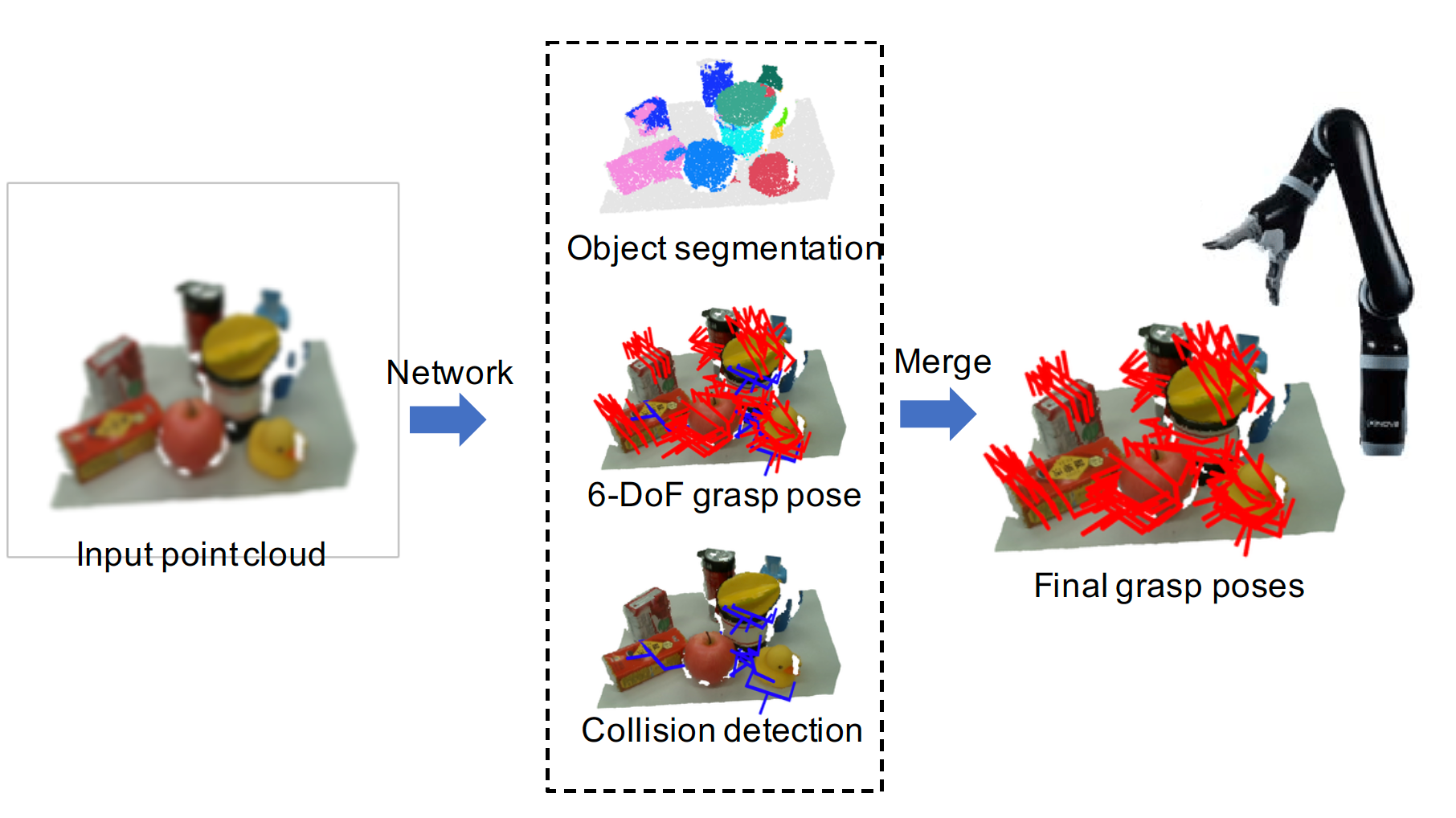
RGB-D sensors (a colour camera (red, green, blue) plus a depth sensor measuring the distance to each point) are the norm in grasping. A 3D point cloud gives the geometry of the scene: object shapes, distances, flat surfaces. A colour image alone is ambiguous: is that cup 30 cm away or 60?
An important qualification, because it is widely misread: this necessity applies to grasping, where fingers must land on a surface to the millimetre. It does not apply to robotics as a whole. In navigation, knowing the door is "at the far left" is enough to get there: Robostral Navigate does without any depth sensor by pointing at a spot in the image rather than measuring a distance.
Learning Through Interaction: 800,000 Grasp Attempts
The field's most iconic experiment is Sergey Levine's and colleagues' at Google: between 6 and 14 robotic arms, left to grasp objects for two months, for a total of over 800,000 attempts. The network does not learn "where to grasp" directly: it learns to predict the probability that a given motion of the gripper will end in a successful grasp, which then lets it correct the trajectory continuously during the approach.
A remarkable detail, usually forgotten: the system works from images of a single colour camera, with no depth sensor and no prior calibration between camera and arm. The network learns the correspondence between what is seen and what is commanded, hence the paper's title, "hand-eye coordination."
Learning Hand-Eye Coordination for Robotic Grasping with Deep Learning and Large-Scale Data Collection (Levine et al., 2016)This is real learning by experience, no pre-programmed formulas. The robot discovers on its own that optimal grasp angles depend on the object's shape, that some surfaces slip more than others, and that an object's center of gravity isn't always in the middle.
Dexterity: From 2 Fingers to 5
Most industrial robots use a parallel gripper (2 fingers). It's reliable but limited: impossible to handle an egg without breaking it, impossible to flip an object in hand, impossible to use tools. Dexterous manipulation with multi-fingered hands (3 to 5 fingers) opens an entirely different level of sophistication.
OpenAI, hand and Rubik's Cube (2019): a Shadow Dexterous Hand (24 degrees of freedom) learned to manipulate a Rubik's Cube purely by reinforcement learning in simulation, with massive, progressively widening domain randomization for real-world transfer. The result was spectacular, but the system was expensive, slow and fragile, under tightly controlled conditions. Worth noting, because it is exactly the confusion this field invites: the cube-solving algorithm was classical and supplied; what the network learned was to turn the faces without dropping the cube.
Solving Rubik's Cube with a Robot Hand (OpenAI, 2019)DexMV: learning dexterous manipulation from videos of human hands. The model watches a human manipulate an object and learns to do the same. DexPoint: uses 3D point clouds as representation for dexterous manipulation, capturing the fine geometry of fingers and objects.
In industry, the vast majority of robots use simple grippers (parallel or suction cup). Dexterous manipulation remains confined to research labs. The reasons: high cost of robotic hands, maintenance complexity, and above all a lack of reliability. When a production line needs to run 24/7, simplicity wins over sophistication.
Learning by Imitation: Large-Scale Teleoperation
Learning from Demonstrations (LfD): a human teleoperates the robot (via a controller, haptic gloves, or a force-feedback device), and the observations (camera images) and actions (arm movements) are recorded simultaneously. A model then learns to reproduce these demonstrations.
Diffusion Policy: applies diffusion models (the ones that generate images by progressively transforming noise) to action generation. Instead of predicting one action, it represents the whole distribution of plausible actions. That matters because there are often several good ways to do the same thing (grasp from the left or from the right): a model forced to output only one has to average the two, which means aiming between them, which means missing.
Diffusion Policy: Visuomotor Policy Learning via Action Diffusion (Chi et al., 2023)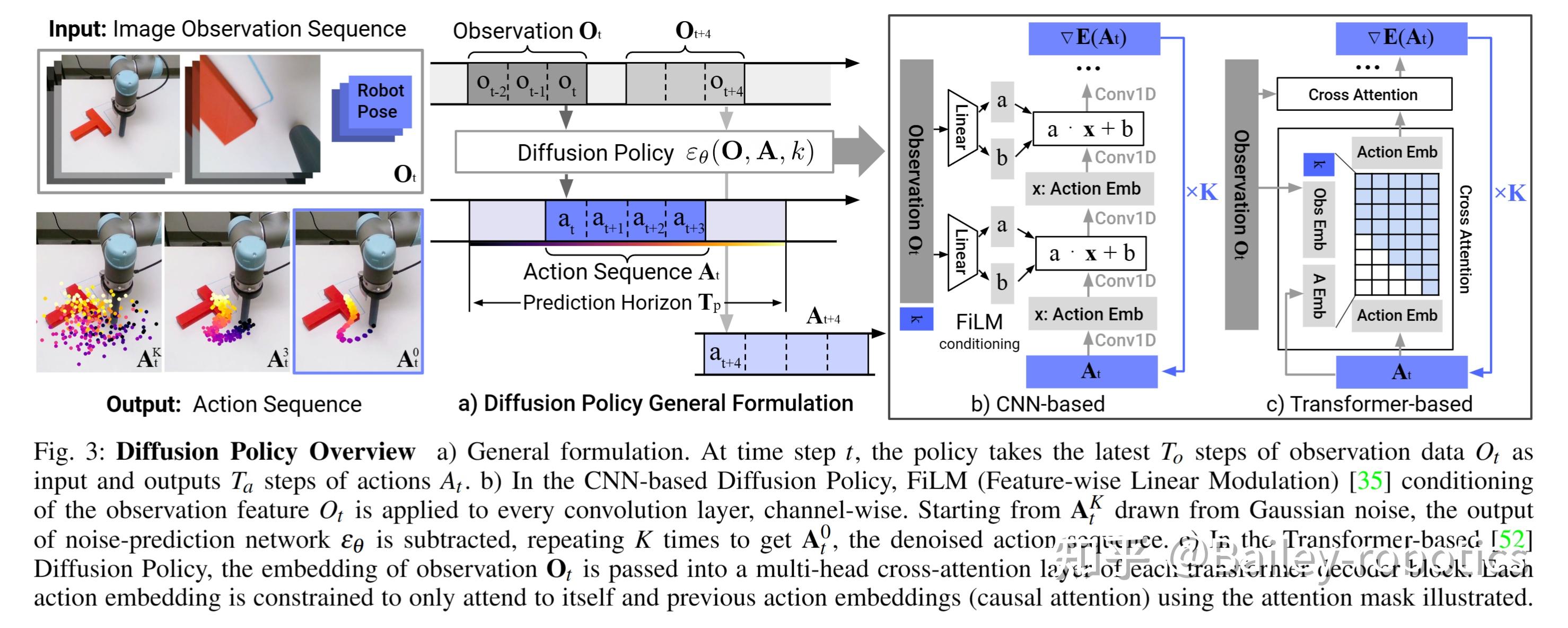
Action chunking (implemented by ACT): instead of predicting a single action at each time step, you predict a block of future actions and execute them in sequence before looking again. In the original paper the block is 100 steps long. Movements are smoother and errors accumulate less. It's like planning a whole sentence rather than building it word by word.
Learning Fine-Grained Bimanual Manipulation with Low-Cost Hardware (ACT / ALOHA, Zhao et al., 2023)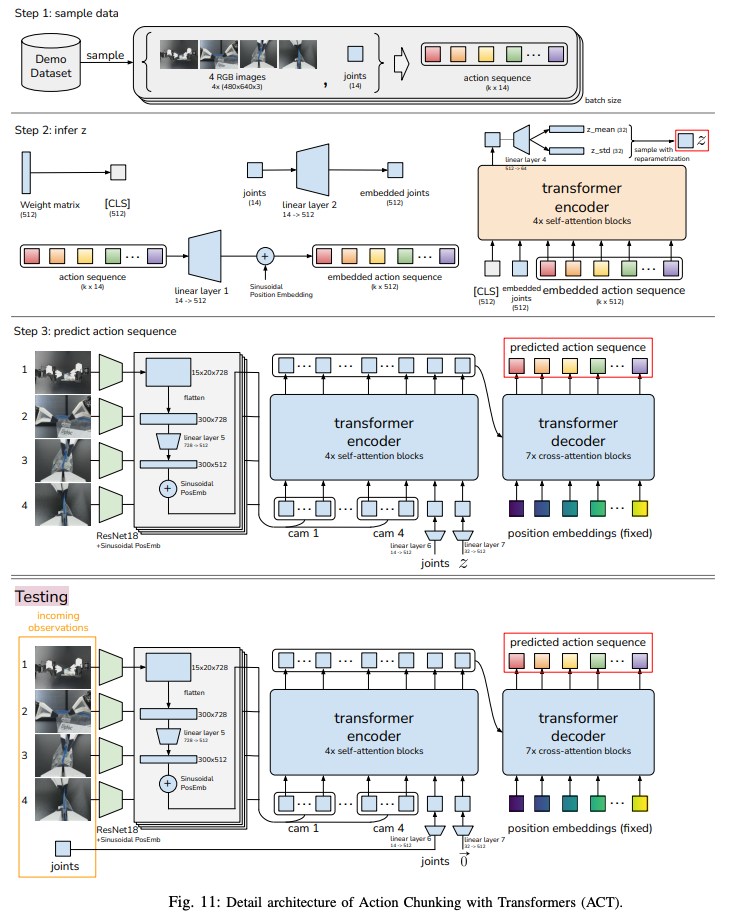
Industrial Applications and Trends
Bin picking: grasping objects in bulk from a bin (logistics, automotive). Assembly: inserting components, screwing, wiring. Palletizing: stacking boxes and crates. Inspection: manipulating objects to examine them from all angles. Sorting: automatic object sorting (recycling, distribution centers).
The 2024-2025 trend is clear: foundation models (VLA) combined with large-scale teleoperation are producing the first truly versatile manipulation robots. Physical Intelligence (Pi), Covariant, and Figure AI are all betting on this convergence.
VLA stands for Vision-Language-Action. Such a model takes the scene image and an instruction in ordinary language, and directly produces the arm's commands. It is the end of processing chains with dozens of separate modules: one model that perceives, decides and acts. See VLA model architecture.
1. OpenAI's hand that solves a Rubik's Cube is one of the most famous demos in the field. What did the neural network actually learn?
2. Two labs each announce a 90 percent grasping success rate. Can you conclude their systems are equally good?
3. Why is picking up a cup harder to automate than playing chess, when for a human it is the other way around?
4. To grasp an object there are often several good trajectories: from the left or from the right. Why is that a problem for a model that predicts a single action, and what does Diffusion Policy change?
5. RGB-D sensors (colour plus depth) are the norm in grasping. Can you conclude that all of robotics needs to measure distances?