The Problem in One Sentence
Training a robot in simulation is cheap, fast, and safe. The real world does not behave like the simulation. All of modern robotics lives inside that gap, and inside the attempts to cross it.
One word recurs throughout: a policy is simply the learned program that decides what the robot does given what it perceives. It is what training produces, and it is what we try to move from the simulator onto the real machine. That move is called sim-to-real transfer.
Why Simulation: Millions of Trials Against a Few Hundred
Collecting robot data in the real world is slow, expensive, and sometimes destructive. A physical robot manages a few hundred attempts a day, needs a person watching it, and every failed attempt can break the machine or its surroundings. In simulation: millions of trajectories in a few hours, in parallel on graphics processing units (GPUs, chips built to run enormous numbers of identical calculations at once), with zero material risk.
The most striking example remains OpenAI's robot hand solving a Rubik's Cube in 2019. The figure the authors report is roughly 13,000 years of equivalent experience accumulated in simulation. There is nothing magic about that number: it comes from 920 machines of 32 cores each running in parallel for months, each playing out attempts far faster than real time. Collecting the same experience on a physical hand was simply impossible.
Solving Rubik's Cube with a Robot Hand (OpenAI, 2019)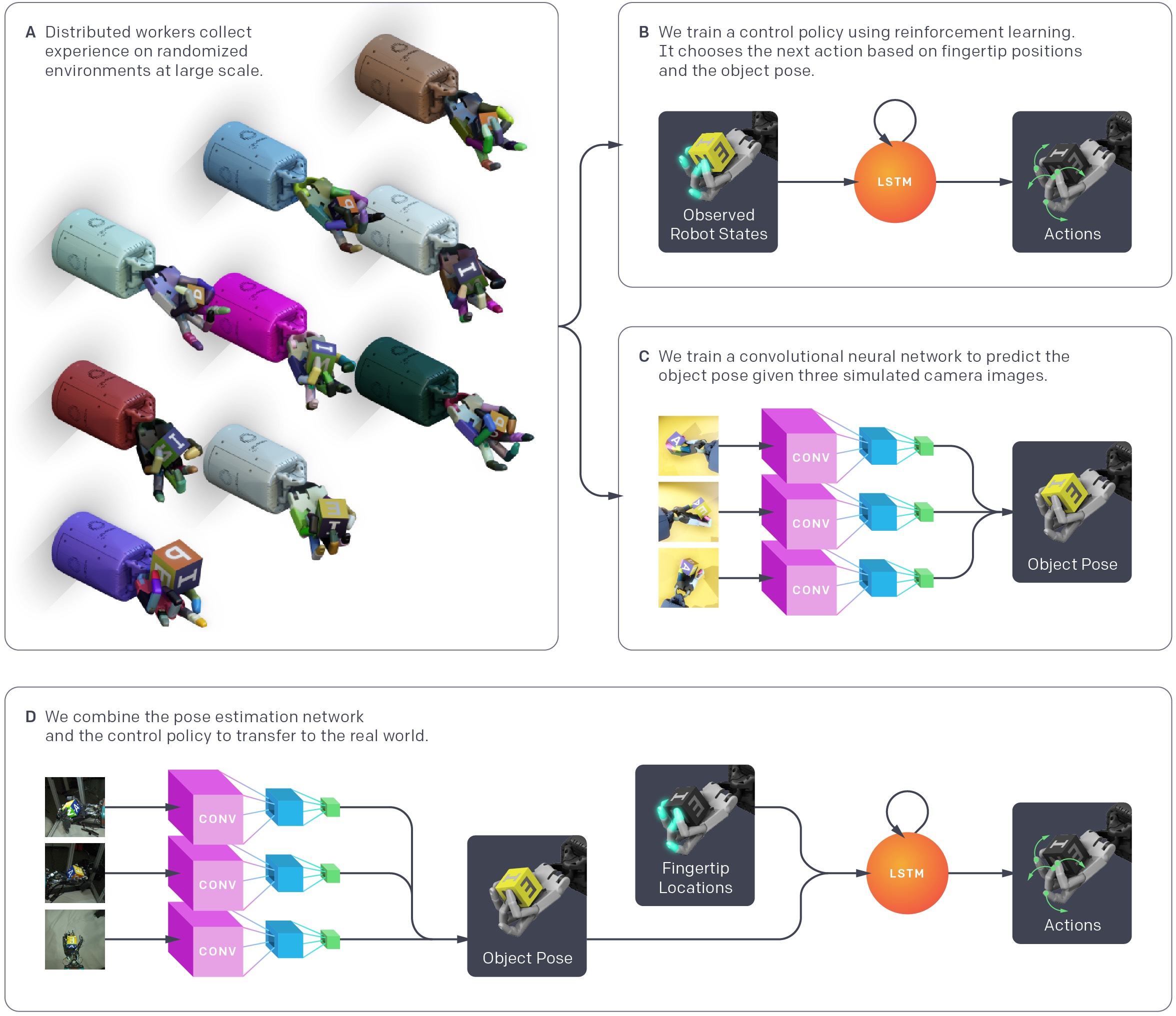
13,000 years of equivalent experience for a single hand. That is out of reach in the real world, even with an army of robots. Simulation provides the data scale needed to train robust policies. Without it, most recent advances in robotics would not have happened.
The immediate flip side, and the whole subject of this page: that experience never happened. It was computed, not lived.
The Main Simulators
NVIDIA Isaac Sim
NVIDIA's flagship platform, built on the Omniverse engine:
- Photorealistic rendering: real-time ray-tracing producing images nearly indistinguishable from reality. This is important for training vision models that will need to work in the real world
- GPU-accelerated physics: thousands of environments run in parallel thanks to PhysX, the GPU-optimized physics engine. The reference locomotion work runs on the order of 4,000 robots simultaneously on a single card
- Isaac Lab: the integrated reinforcement-learning training toolkit, designed for manipulation and locomotion, released as open source
- ROS integration: native connection with ROS (Robot Operating System, in practice a library for passing messages between modules), the robotics industry standard
- Digital twins: replication of real environments (factories, warehouses) for testing policies before deployment
Isaac Lab, the successor to Isaac Gym, is built for training robotic foundation models. It supports large-scale reinforcement learning (thousands of parallel agents), imitation learning, and VLA evaluation. It also builds in the domain-randomization tools described below, actuator models and sensor simulation at different rates. A version 3.0, shown in early access in 2026, runs on the new Newton physics engine (see below).
Isaac Lab: A GPU-Accelerated Simulation Framework for Multi-Modal Robot Learning The basics of reinforcement learning are on Reinforcement learning, and the infrastructure that makes it work at scale on Agent training infrastructure.
MuJoCo
The name is short for Multi-Joint dynamics with Contact. It is the reference simulator of academic robotics research:
- Developed by Emo Todorov, acquired by DeepMind in October 2021 and made free immediately, then released as open source on GitHub in May 2022. A move that democratized research
- High-fidelity physics: precise modeling of contacts, friction, and mechanical constraints. Contact simulation is notoriously difficult, and MuJoCo is recognized as one of the best
- Speed: ultra-fast even on CPU, making it ideal for RL requiring millions of episodes. No expensive GPU needed to get started. MuJoCo has since gained versions that run on graphics cards too: MJX (written with Google's JAX library) and then MuJoCo Warp, developed with NVIDIA
- Numerical stability: its integrator is particularly robust in the face of complex contacts and impulsive forces
- Academic standard: the vast majority of RL robotics publications use MuJoCo. If you read a paper on locomotion via RL, chances are the experiments were run on MuJoCo
MuJoCo Playground (Google DeepMind, February 2025) shows what the move to graphics cards changes: a collection of ready-made environments (quadrupeds, humanoids, hands, arms) where a policy trains in a few minutes on a single graphics card, then goes straight onto the real robot without retraining, including policies that steer by camera images. That direct transfer is only demonstrated on the tasks and robots the authors chose, but it shows how far the entry cost of simulation-based robotics has collapsed.
MuJoCo PlaygroundHabitat (Meta)
Specialized in navigation and interaction in indoor environments:
- Built from 3D scans of real apartments and houses, not from floor plans drawn by an engineer. The environment genuinely looks like somewhere people live
- Habitat 3.0: introduces virtual humans that interact with robots, enabling training of socially appropriate behaviors
- Social navigation: the robot learns to navigate in the presence of humans, not to bump into them, to politely go around them
- Rearrangement: object tidying tasks in a house (putting away groceries, clearing the table)
The Newcomers: Genesis and Newton
Genesis was released as open source in December 2024 by a consortium of some twenty academic and industrial labs. It is first of all a physics engine written in Python that brings together, in one tool, simulation methods usually kept apart (rigid bodies, liquids, cloth, soft materials). Its authors claim spectacular speeds, up to 430,000 times real time for a robot arm in a simple scene, a demo figure that does not hold for a realistic scene. The project also announced a generative layer able to build scenes and tasks from a plain-language description; that part was due to be released gradually, after the physics engine.
Newton is an open physics engine launched in 2025 by NVIDIA, Google DeepMind and Disney Research, then handed to the Linux Foundation (the foundation that hosts Linux and many open projects) in September 2025. Its version 1.0, billed as production-ready, was presented in spring 2026. It includes MuJoCo Warp among its solvers and adds simulation of deformable objects (cables, cloth), which had been sorely missing. The striking fact is less technical than political: the two leading players in robot simulation, NVIDIA and Google DeepMind, have lined up behind one shared, open engine.
Other simulators: PyBullet (lightweight and free, good for prototyping), Gazebo (integrated with ROS, industrial robotics standard), SAPIEN (specialized in articulated objects like drawers and doors).
The Reality Gap: The Great Unsolved Challenge
The reality gap is the difference between what happens in simulation and what happens in the world. Four sources of divergence, in the order in which they knock robots over:
- Friction. It is the worst-modelled quantity in all of contact physics. An object that slides in simulation does not slide the same way in reality, and real friction changes with dust, humidity, and wear, within the same day.
- Lighting. Even with ray tracing, simulated images differ from real ones: reflections, shadows, ambient light, backlight. A model that learned to recognize an object by its exact colour fails the moment the lamp changes.
- Mechanical play and delay. A real motor does not go exactly where it is told, nor exactly when. There is backlash in the gears, lag in the command, wear, and nonlinearity. The simulation obeys to the millimetre and the millisecond.
- Sensor noise. A real camera has grain, blown highlights, latency; a position sensor has error. In simulation, measurement is perfect by construction, and a model trained on perfect measurements has never learned to doubt.
On top of which come the objects themselves: wet, deformable, dented, they behave nothing like their idealized models.
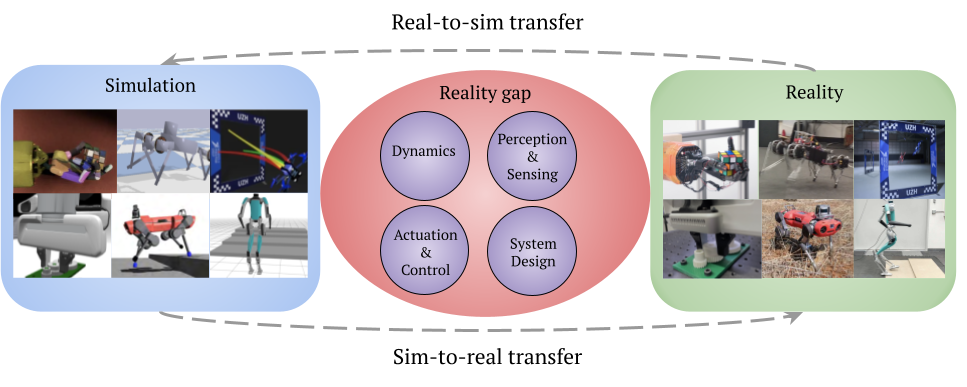
The consequence is brutal: a policy that succeeds almost every time in simulation can succeed only one time in five on the real machine if the gap is left untreated. How far it falls depends entirely on the task and the hardware, be wary of any single number presented as a law.
If you take one thing from this page, take this.
A system validated only in simulation demonstrates nothing about its real behaviour. That is not a note of caution; it follows logically from everything above. A simulator is a model written by people; it contains only the phenomena its authors thought to put in it. A dangerous behaviour caused by a phenomenon absent from the model cannot appear in simulated trials, however many you run. Ten million trials in a world without dust say nothing about a dusty floor.
So this is a problem of proof, not merely of engineering. Faced with a safety or performance promise, the question is not "how many trials?" but "on what?", and if the answer is "in simulation", the number describes the simulator. Compare that with the ordinary machine-safety requirement of testing on the real equipment under its conditions of use.
The textbook case in this course: Robostral Navigate is trained entirely in simulation (about 2.4 million trajectories across 350,000 generated scenes) and its published results come from a benchmark that is itself simulated. Its page says so explicitly: no field-measured success rate is given. That is not a criticism of this model in particular, it is the normal state of the field, and precisely what you need to be able to read.
The Fixes Actually Used
Domain Randomization: Giving Up on Aiming Precisely
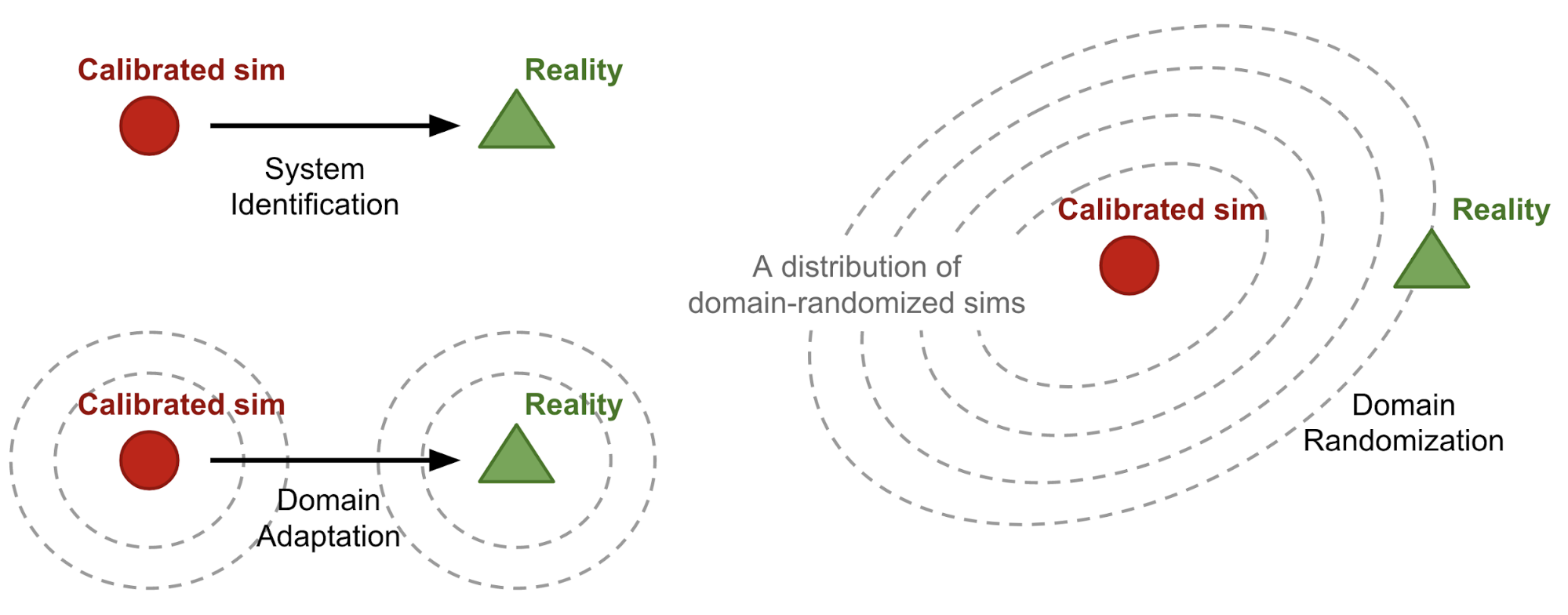
This is the main fix, and its idea is counter-intuitive. Instead of trying to make the simulation accurate, you make it variable: at each training episode, fresh parameters are drawn at random.
What gets varied, episode after episode:
- textures and colours of objects and background;
- lighting: direction, intensity, hue;
- physical parameters: friction doubled or halved, mass shifted by 20%, joint stiffness;
- noise added to sensors and motors: the position sensor is a little wrong, the motor does not go exactly where told;
- starting positions: the robot never begins in quite the same place.
The reasoning fits in one sentence: if the robot can rely on no particular feature of the simulation, it is forced to learn what does not vary. You are not training it to succeed in one world, you are training it to succeed across a family of worlds; the real world then stands a chance of being one more member of that family.
The analogy is a pianist. Practise only on your own piano and you will play badly on another, because you learned your piano's quirks along with the piece. Practise on thirty pianos and you have learned the piece alone, and the thirty-first will not surprise you.
One important variant raises the spread of the variations progressively as the robot succeeds, rather than fixing it in advance: automatic domain randomization, the method used for the Rubik's Cube. The simulator becomes an adversary that hardens the exam whenever the student improves.
It protects against phenomena somebody thought to vary. It does not protect against those absent from the simulator, a dangling cable, a reflection on a wet floor, a child walking through. And it has a cost: the wider you make the family of worlds, the more the policy becomes cautious and mediocre everywhere instead of excellent somewhere. That is the field's central trade-off, and it is not solved.
Domain Adaptation: Bringing the Representations Together
Instead of varying blindly, you can pull the two worlds toward each other:
- Image translation with a generative network: a generative adversarial network (GAN, two networks, one making images, the other trying to unmask them) turns simulated images into real-looking ones;
- Feature alignment: forcing the model to produce the same internal description of a scene whether it came from simulation or reality;
- Fine-tuning on real data: finishing training on a small set of trajectories collected on the physical robot. The most effective fix, and the most expensive.
System Identification: Correcting the Simulator
Instead of making the robot indifferent to inaccuracies, you can correct the simulation so it matches the real robot:
- measure the robot's physical parameters (exact mass of each link, friction of each joint);
- calibrate the dynamics model automatically by optimization, comparing simulated against measured trajectories;
- build a precise digital twin of the robot and its environment.
One especially effective variant, popularized by ETH Zurich on the ANYmal quadruped: do not model the motors with equations, train a small network on real measurements of the motor and plug that network into the simulation. You replace the worst-modelled part of the physics with measurement. See Locomotion and autonomous navigation.
World Models: Simulating Without a Physics Engine
All the simulators above share one principle: engineers write down the equations of physics, and the computer applies them. Since 2025 another route has been gaining ground: the world model, a network that has learned what the next moments of a scene look like by watching huge amounts of video. Give it an image and an action, and it predicts the video of what happens next. No need to model everything by hand: dust, reflections and soft objects are all in the videos. The principle is covered in World models.
- NVIDIA Cosmos (January 2025): a family of world models released with open weights, trained on the order of 20 million hours of video. It includes models that predict what comes next in a scene, models that transform a clean but obviously artificial simulator image into realistic-looking video (a modern version of the domain adaptation described above), and a physical reasoning model, Cosmos Reason, now built into GR00T. Cosmos 3, presented at the end of May 2026, brings these functions together in a single model.
- Genie 3 (Google DeepMind, August 2025): it generates, in real time, a three-dimensional world you can move through, at 720p and 24 frames per second, which stays consistent for a few minutes. DeepMind used it to train its SIMA agent in worlds generated on demand. A consumer version, Project Genie, opened in January 2026.
The promise is enormous: a simulator that contains, from the start, everything the world's videos show. But this page's central argument applies with even more force. A world model does not compute physics, it imitates what it has seen: nothing guarantees that an object keeps its mass or does not pass through a table, and its errors build up second after second. A known gap (a physics engine's simplified equations) is swapped for a gap that is harder to pin down (the blind spots of the training videos). Published results use these models alongside real data, not instead of it.
Manufacturing Data Instead of Collecting It
The most concrete use of these tools in 2025-2026 is not training a robot end to end in a virtual world, but multiplying demonstration data, the scarce fuel of VLA models (VLA models). Three recipes coexist:
- Multiply a few human demonstrations in simulation. A person shows a task a dozen times by teleoperation; software replays those movements across thousands of variants of the scene (objects moved, other shapes, other lighting) and keeps only the successful attempts. That is the principle behind MimicGen-style tools, adopted by NVIDIA (GR00T-Mimic).
- Let a video model dream. You provide an image of the robot in a new place and an instruction ("pour the water into the glass"); a world model generates the video of the robot doing the task, then a second network infers the joint movements from it. These "neural trajectories" then serve as training data. This is the DreamGen method, with which NVIDIA says it produced the data for GR00T N1.5 in 36 hours instead of nearly three months of collection.
- Re-skin the images. Keep a simulator's trajectories but replace their overly clean images with generated realistic versions (textures, dirt, lighting), so the vision model is not thrown when it meets the real world.
This synthetic data has the same limit as synthetic data for language models (Synthetic data): it only contains what the generator knows how to produce. It widens the variety around existing demonstrations; it does not invent situations nobody ever filmed. That is why the best systems mix synthetic data, real data and final fine-tuning on the robot.
What Remains Unsolved, Honestly
It needs saying plainly, because announcements do not say it:
- Friction and contact are still badly simulated. That is a physics problem, not a compute problem. None of the simulators named here claims otherwise.
- The robustness/performance trade-off has no solution. The more you randomize, the better the policy survives the unexpected, and the worse it does on the nominal case. You choose; you do not solve.
- There is no reliable measure of the gap. Nobody can look at a policy and a simulator and say in advance how far the score will fall. You find out by trying it on the machine.
- Real collection remains indispensable. The systems that work best almost always end with fine-tuning on real data, that is, with exactly what simulation was supposed to avoid.
- The long tail escapes simulation. The rare cases (the ones that cause accidents) are precisely the ones nobody thought to model.
Three questions, in this order. Does the number come from simulation or from hardware? If hardware: how many trials, in what environment, with which object? Had the test environment been seen during training? The full checklist is on How to read a benchmark score. A system that never left the simulator has demonstrated nothing about its real behaviour.
Outlook
The trend is toward combining all these approaches with foundation models. NVIDIA is assembling a complete chain: Isaac Sim and Isaac Lab to simulate, Newton for the physics, Cosmos to generate and re-skin video, and GR00T as the generalist model then transferred to real robots. Google DeepMind does the same with MuJoCo, Genie and Gemini Robotics. Genesis and world models promise to generate diverse environments automatically, which lowers the cost of randomization. And Robostral Navigate takes the logic to its end: 350,000 generated scenes, no real collection campaign at all, then a reinforcement-learning stage so the model learns to recover after a mistake, since a model that has only ever seen successful runs has no idea what to do once it strays.
The tools are improving fast. The gap is not closing; it is moving.
1. A spec sheet announces: the system was validated over ten million trials, with a 99 percent success rate, all of them in simulation. What does that number demonstrate about the system's real-world behaviour?
2. Domain randomization draws new textures, lighting, friction, or object masses at random for every training run. What is the reasoning behind this idea?
3. An engineer proposes widening the randomization ranges further, to cover every case. What does the page hold against this strategy?
4. OpenAI's robotic hand accumulated the equivalent of about 13,000 years of experience to learn the Rubik's Cube. How should that figure be understood?
5. For the ANYmal quadruped, ETH Zurich replaced the motor equations with a small neural network trained on measurements of the real motor, plugged into the simulation. What problem does this trick attack?
6. A world model such as Cosmos or Genie 3 learns to predict what comes next in a scene by watching millions of hours of video. Why does that not solve the reality gap?