A startup that wants to give any robot a "brain"
Most of today's robots are specialists: an arm that always screws the same part, a vacuum that always follows the same grid. Change the task or the robot, and everything has to be reprogrammed. Physical Intelligence (often shortened to "π" or "Pi"), a startup founded in 2024, pursues the opposite goal: a single, generalist model you can drop onto different robots to make them perform a wide range of tasks, much like a large language model that can answer almost any question without being programmed for each one.
Their model family is called π0 ("pi-zero") and its successors π0.x. They are Vision-Language-Action (VLA) models. This page assumes you have skimmed the VLA page and the RT-2 page; here we only explain what is specific to π0.
Quick recap: what is a VLA?
VLA stands for Vision-Language-Action. The three words name the two inputs and the one output of a single model.
So a VLA is a single model that takes two things as input (images (what the robot's cameras see) and a natural-language instruction ("fold this towel," "put the plates away")) and produces actions as output: the commands sent to the robot's motors to move its arms, fingers, and base.
The core idea, inherited from RT-2, is to reuse a vision-language model (a VLM) already trained on billions of web images and texts. That model already "knows" what a cup, a towel, or a cupboard is. We extend it so that, in addition, it generates motion. The robot thereby inherits an understanding of the world that no amount of robot demonstration could have taught it.
Robotics' real problem: generating continuous actions
This is where π0 sets itself apart, and it is the heart of the matter. Generating text means picking the next word from a finite dictionary: there is a limited number of possible words. Generating a motor action is a different beast entirely. A robot's movement is continuous: a joint angle can take any real value, and these values must be produced very often (dozens of times per second) for the gesture to be smooth.
Early VLAs sidestepped this by chopping the space of movements into bins (the "discrete tokenization" approach: a continuous position is mapped to one of, say, 256 possible values, as if you rounded it). Convenient, since you reuse the language model's machinery as-is, but coarse: a fine, smooth gesture passes poorly through a grid of 256 steps.
Discretizing a continuous trajectory is like drawing a smooth curve out of staircase steps. For screwing, pouring water, or folding cloth, those "steps" translate into jerky, imprecise motion. Fine manipulation demands a genuinely continuous output.
π0's innovation: generating actions by flow matching
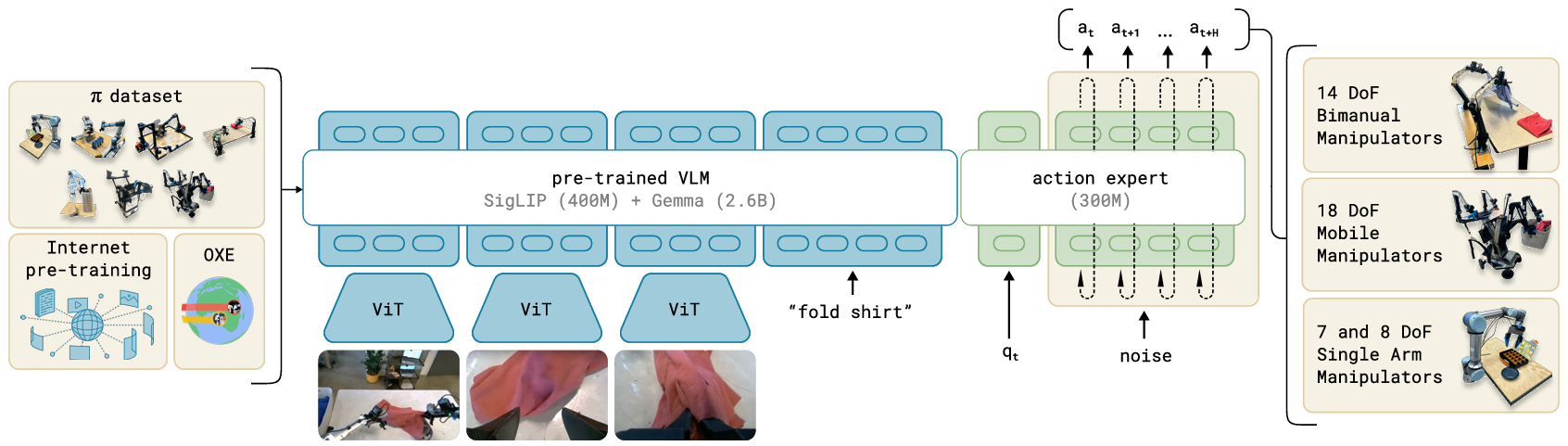
Rather than tokenizing, π0 generates actions with a flow-matching mechanism, the same family of techniques covered in the flow matching page, but applied not to images, to action trajectories.
The intuition is this. Instead of producing the action directly, the model learns to gradually transform noise into a coherent action trajectory. It starts from a random draft (noise) and "cleans it up" over a few steps, sliding it toward a plausible gesture, conditioned on what the robot sees and on the instruction. This is precisely the spirit of modern image-generation models, transposed to motion.
Concretely, the model predicts not a single isolated action but a block of future actions (a trajectory chunk). It can be written as a continuous drift, from noisy draft to clean gesture:
Every symbol, in words:
- is the starting point: a block of trajectory drawn at random, pure noise;
- is the destination: the clean block of trajectory, the one that goes to the motors;
- is a progress dial between 0 and 1, not the robot's clock, but how far along the cleaning is;
- is the half-cleaned trajectory at that point;
- is the learned velocity field: the function, parameterized by the network's weights , that answers "which way should this trajectory be nudged?" It is the part that gets learned during training; everything else is computed fresh at use time;
- means add up all those small nudges from start to finish.
The whole sentence: start from a random draft and add every correction the network recommends, given the image and the instruction, until a plausible gesture comes out. In practice nobody computes an exact integral: a handful of small steps is enough.
This formulation brings two decisive advantages for robotics:
- genuinely continuous, smooth outputs, suited to high-frequency control (the motors receive fluid commands, not plateaus);
- the ability to represent several valid gestures for the same situation (there is often more than one good way to grasp an object), whereas a deterministic output is forced to average them, and produce a blurry gesture.
π0 can be summed up as a division of labor: a VLM (on the order of a few billion parameters) digests the image and the instruction and understands the scene; a flow-matching module grafted onto it turns that understanding into a smooth motor trajectory. The first knows "what" to do, the second knows "how" to move.
Being generalist: learning across many robots and tasks
Like Octo and OpenVLA (see the Octo / OpenVLA page), π0 is trained on large multi-robot, multi-task data. The logic is the same as in NLP: the more different robots performing varied tasks the model sees, the more it extracts transferable manipulation principles rather than memorized recipes. A model that has seen a hundred ways to grasp objects across ten different robots stands a chance of grasping a new object on an eleventh robot.
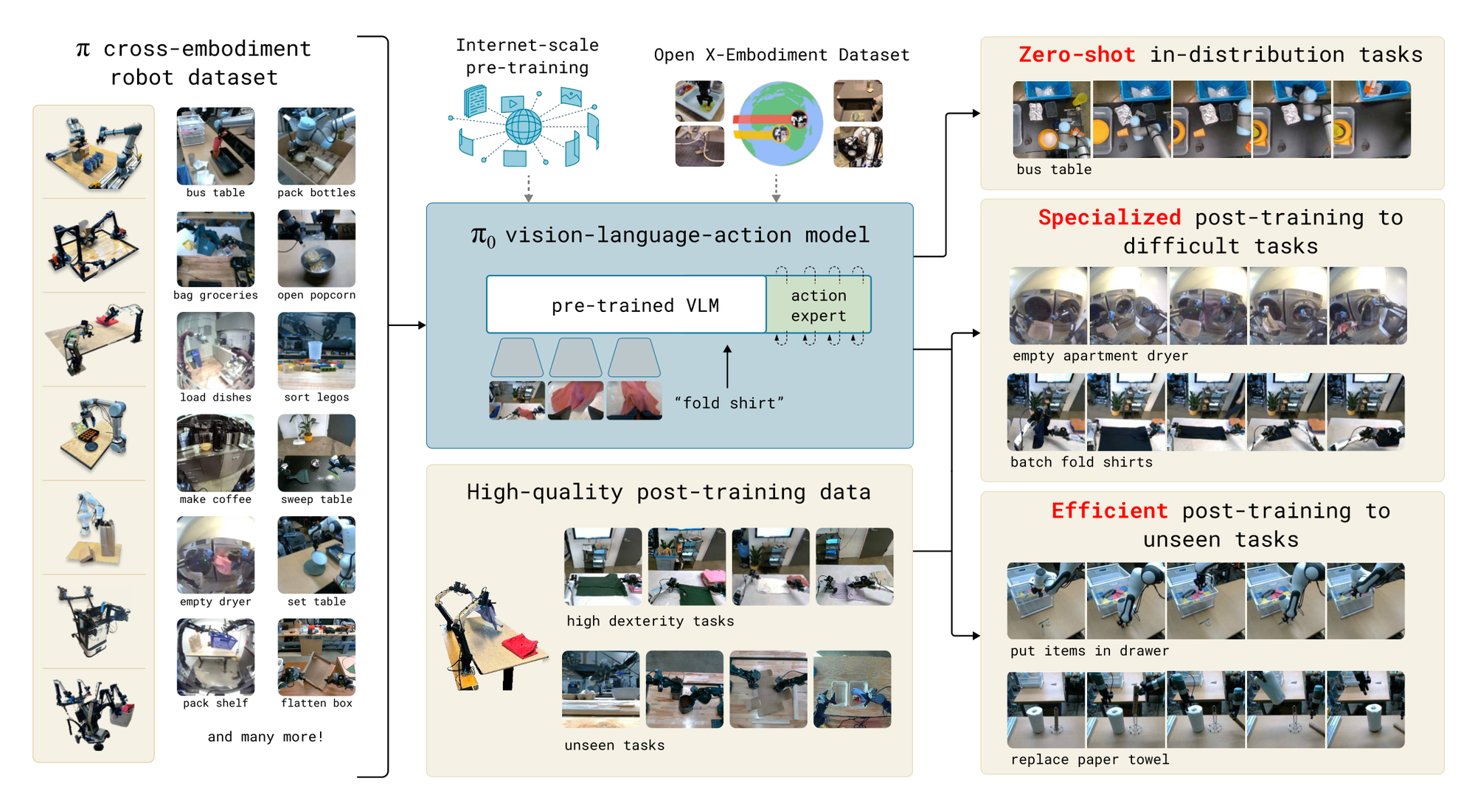
This is also what distinguishes Physical Intelligence's ambition from older demonstrations tied to a single robot (like RT-2 on Google's in-house robot): aiming from the outset for transfer across robots and across tasks.
π0.7 and compositional generalization
In April 2026, Physical Intelligence introduced π0.7, a 5-billion-parameter model (a 4-billion vision-language backbone plus an 860-million action module) whose paper claims signs of compositional generalization. The term deserves a plain-language explanation.
Compositional generalization is the ability to recombine already-learned skills to accomplish a task never seen during training. Picture a robot that has separately learned to "open a drawer," "grasp a fork," and "drop an object into a bin." If it can chain and adapt these building blocks to carry out a brand-new household task (in a new kitchen, on a slightly different robot) without dedicated retraining, then it generalizes compositionally.
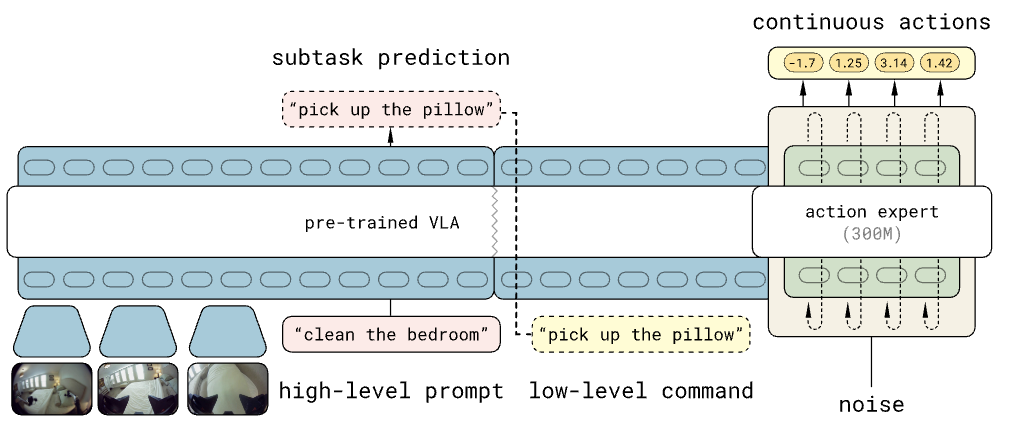
Most current robots mainly succeed at what they were shown. Compositional generalization points toward a robot that invents the right sequence when facing a new situation, by assembling known skills, exactly what a human does without thinking. It is the shift from "redo" to "combine to handle the unknown," and that is precisely what separates an automaton from a truly versatile assistant.
A caveat: these are signs, not solved generalization. And caution is doubly warranted here, because "recombining skills" is a qualitative claim: it is demonstrated by successful examples, never by a single success rate. Faced with such a claim the useful questions are always the same, across how many novel tasks, chosen by whom, with what failure rate, and had the new hardware been seen during training? See How to read a benchmark score.
Where π0 sits in the VLA landscape
| Model | Action generation | Distinguishing trait |
|---|---|---|
| RT-2 | Discrete tokens (actions = text) | Transfers web knowledge to robotic control |
| OpenVLA | Discrete tokens (256 bins) | Fine-tuned 7B VLM, fully open-source |
| Octo | Diffusion head | Lightweight, modular, multi-robot |
| π0 / π0.x | Flow matching (continuous trajectories) | VLM + smooth high-frequency actions; generalist aim |
π0 continues the same lineage as RT-2 and OpenVLA (a VLM turned into a controller) but shifts the effort toward the quality and continuity of the gesture rather than semantic understanding alone. Octo had already explored a generative head (diffusion) for actions; π0 pushes that idea further with flow matching, which is simpler and faster to sample from.
Why it matters
- For robotics, the bottleneck is not only "understanding the instruction" (VLMs already do this well) but "producing a fine, smooth, reliable gesture in the physical world." π0 attacks this bottleneck head-on.
- Choosing flow matching for actions illustrates an elegant transfer of ideas: a technique born to generate images is used here to generate motion. This is exactly the kind of conceptual bridge that moves a whole field forward.
- One standing caveat, though: the tasks shown (folding laundry, clearing a table) are performed in chosen environments, and nothing published says how many attempts failed. See Sim-to-real on what a demonstration is worth.
- Compositional generalization, if it holds up, is what could move robots from single-task machines to versatile assistants.
Key takeaways
- π0 is a generalist VLA: images + a natural-language instruction in, continuous motor actions out, in a single model.
- Robotics' core problem is generating continuous actions, not text: a smooth movement passes poorly through a grid of discretized values.
- π0 generates actions by flow matching: it gradually transforms noise into a smooth action trajectory, conditioned on the image and the instruction, the image-generation technique applied to motion.
- It is trained on large multi-robot, multi-task data to extract manipulation principles transferable across robots and tasks.
- π0.7 (April 2026, 5 billion parameters) claims signs of compositional generalization: recombining learned skills to succeed at a task never seen during training.
- It is a milestone because it points toward "combine" rather than "redo", the line between an automaton and a truly versatile assistant; but these are early signs, yet to be confirmed.
1. Why does pi0 abandon the 256-bin discretization of actions that worked so well for RT-2 and OpenVLA?
2. How does pi0's action module concretely produce a trajectory (flow matching)?
3. A robot has separately learned to open a drawer, grasp a fork, and drop an object into a bin. What would you need to observe to speak of compositional generalization?
4. pi0.7 claims signs of compositional generalization. How does the page suggest reading this claim?