A Story: The Test You Play Instead of Read
Picture two exams. In the first, you're handed a sheet with a figure on it and you write down the answer. You think as long as you like, then turn in your paper. In the second, you're dropped in front of a video-game console you've never seen. No manual. You have to press buttons, watch what changes on screen, work out the rules by playing, and eventually win.
The first exam is the old ARC-AGI: a fixed grid, you find the transformation, you answer. The second is ARC-AGI-3: you no longer analyze an image, you act inside a world that reacts to your moves. It's the first major format change since ARC-AGI was created in 2019, and it sends the best AIs' scores crashing.
ARC-AGI is run by the ARC Prize Foundation (site arcprize.org), continuing François Chollet's work on measuring intelligence. The ARC-AGI family aims to measure fluid intelligence (the ability to reason about novel things from very few examples) rather than memorized knowledge. The figures and timeline below come from the foundation; treat them as indicative at launch (ARC-AGI-3 announced/deployed in 2026).
A Reminder: What ARC-AGI Measures (and Why It's Hard)
Most AI benchmarks reward knowledge: have we seen this kind of problem before, can we retrieve it from memory? A model trained on half the internet knows a lot, so it does great. That's exactly the trap our page on ARC, HellaSwag, and WinoGrande describes: those tests end up saturated, everyone scores 90%+, and they no longer separate anything.
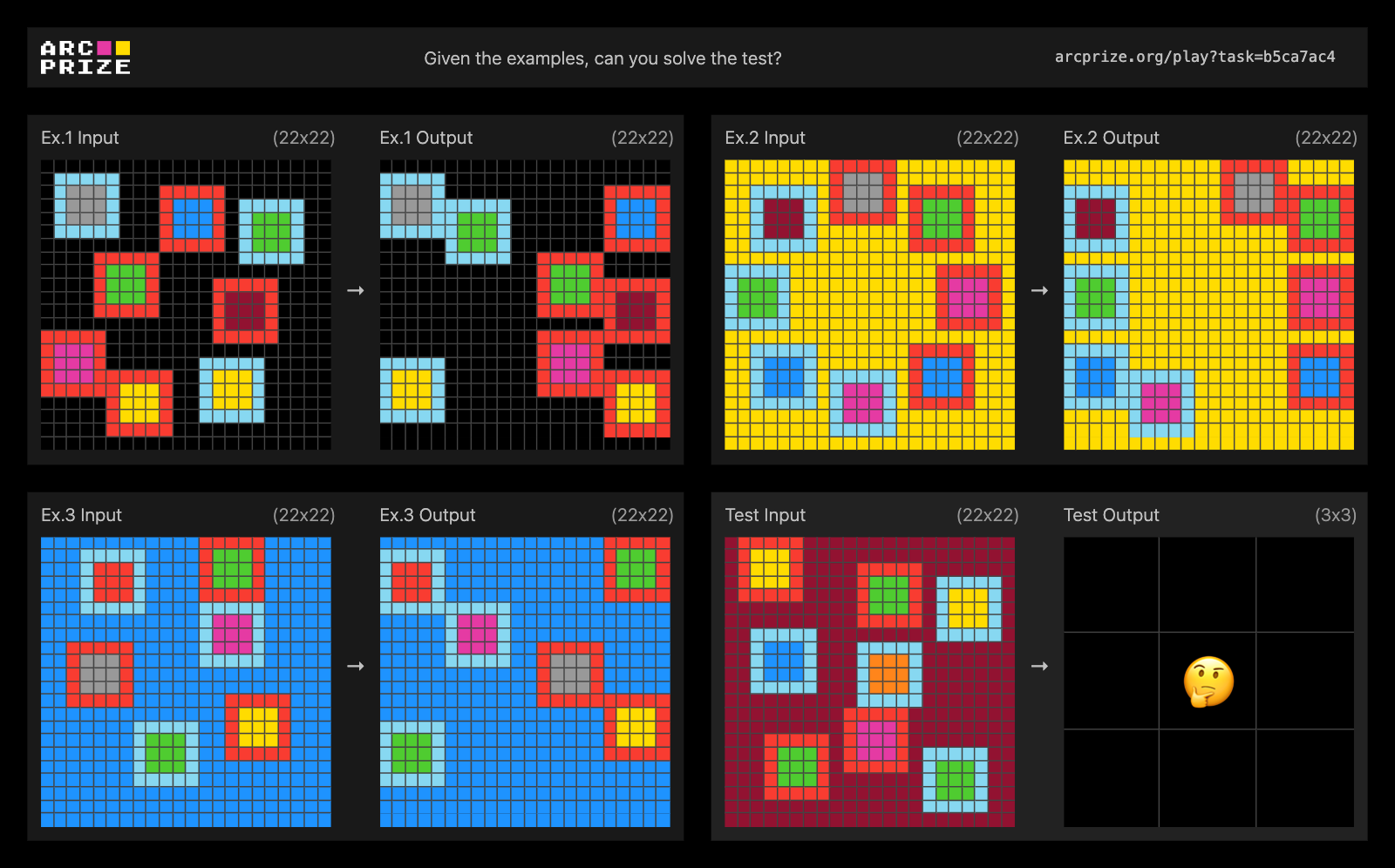
ARC-AGI aims at something else. Each task is a small, never-seen visual puzzle:
- you're shown 2 or 3 examples of a transformation (input grid → output grid);
- you must infer the rule;
- then apply it to a new grid.
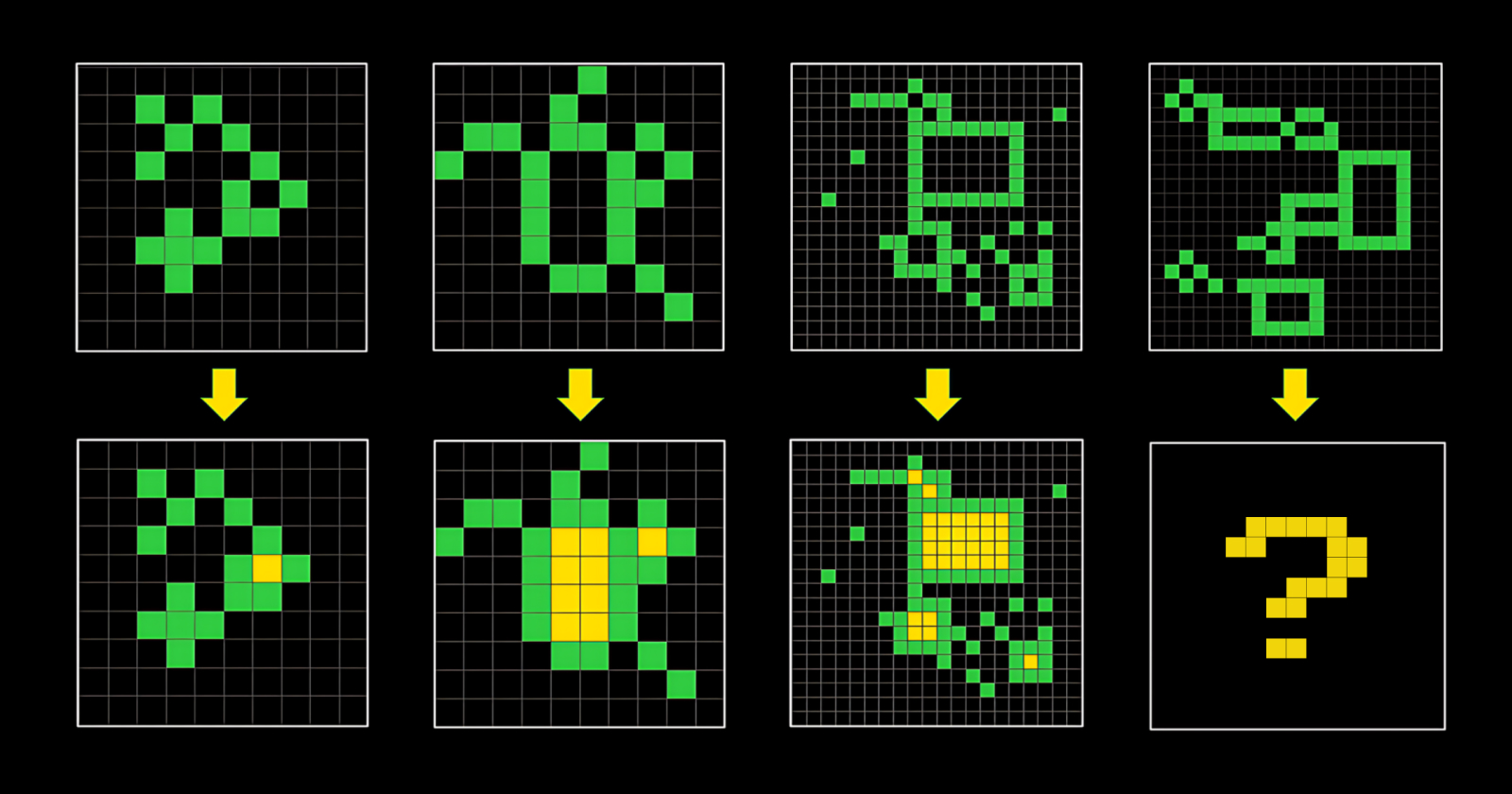
The rule changes for every task. No encyclopedic knowledge helps. You have to abstract a principle from almost nothing, then generalize it. That's what we call fluid intelligence.
ARC (AI2 Reasoning Challenge) = school-science MCQ, long since saturated. ARC-AGI (Abstraction and Reasoning Corpus) = abstract visual grids, much harder. Same acronym, completely different subjects. This page is about the ARC-AGI family.
ARC-AGI-2 confirmed how hard this is. The best models topped out on the order of 30 to 50%, while humans solve the vast majority of tasks. That gap is the whole point of ARC-AGI: it points to something machines still don't do well.
ARC-AGI-3: From Static to Interactive
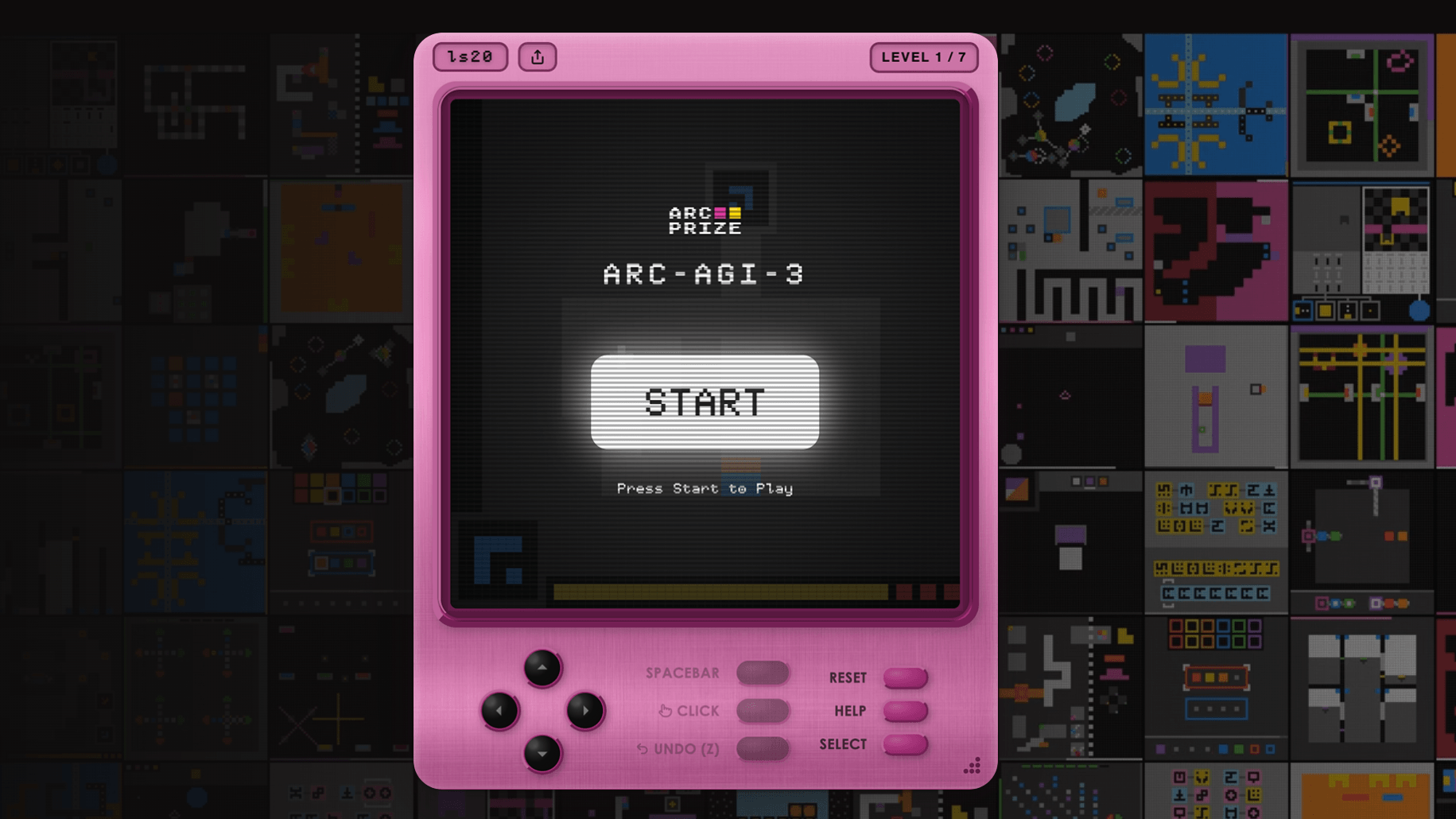
ARC-AGI-1 and 2 stayed static puzzles: one image in, one answer out. ARC-AGI-3 breaks that mold. The task becomes interactive and agentic: instead of staring at a frozen grid, the AI is placed inside a mini-environment (think of a tiny video game with unknown rules) and must:
- Observe the state of the screen;
- Choose an action (move, press, shift an element);
- Observe the new state that results;
- Repeat, step after step, until the goal is reached.
Nobody hands it the rules. It has to discover them by acting, like a human picking up a controller for the first time.
Static benchmark (ARC-AGI-1/2):
   [input grid]  ->  single answer, in one shot

Interactive benchmark (ARC-AGI-3):
   observe -> act -> observe -> act -> ... -> goal
   (a multi-step loop, rules to be discovered)
Why "Interactive" Measures What Static Misses
A static puzzle mostly tests perception + one-shot reasoning. But much of real intelligence lives in the loop of action → consequence → action. Three abilities only show up there:
-
Planning. Reaching the goal takes a coherent sequence of actions, not a single good move. You must anticipate: "if I do this, then that, where will I be?" A single-answer benchmark cannot see this skill.
-
Exploration. When the rules are hidden, you must experiment, try an action just to see what it does, form a hypothesis, test it. That's the opposite of reciting a known answer. A static test punishes mistakes; an interactive test rewards using mistakes well as a source of information.
-
Working memory. Over many steps, you must remember what you've already learned ("pressing here opens the door"), track where you are, and not make the same blunder twice. An isolated question requires no memory between moves.
In other words, the interactive format shifts the measurement: from "can you recognize the right pattern?" toward "can you drive a behavior toward a goal in a novel world?" That's exactly the skill expected of agents (see our page "AI Agents: Taxonomy and Concepts"), and precisely where today's models stumble.
On an MCQ, a model can "guess right" fairly often. In a multi-step environment, luck collapses: chaining ten good decisions at random is nearly impossible. That's a structural reason the interactive format is more discriminating, and harder to game.
The Human / AI Gap at Launch
The striking number for ARC-AGI-3: at launch, humans score ~100%, while the best frontier models score below 1% (figures presented as indicative at launch by the foundation).
That gap is dramatic, and instructive. The same models that write code, solve math olympiads, and pass bar exams are nearly unable to play an unknown mini-game that a child grasps in a minute. Why?
- A human carries a physical and causal intuition ("things move, push, open") and applies it instantly to a new environment.
- A human loops naturally: try, observe, adjust, without needing the problem stated in text.
- Models, by contrast, shine mainly on tasks where the answer can be stated in one shot. Holding a goal across many steps, integrating feedback from the environment, stays fragile.
| Saturated benchmark (e.g. ARC, HellaSwag) | ARC-AGI-2 | ARC-AGI-3 (at launch) | |
|---|---|---|---|
| Format | Question → answer | Grid → answer | Observe/act loop |
| Mostly measures | Memorized knowledge | Abstract reasoning | Planning + exploration + memory |
| Best models | ~90–96% (saturated) | order of 30–50% | < 1% |
| Humans | ~95% | very high | ~100% |
The values above come from the ARC Prize Foundation (arcprize.org) and should be read as orders of magnitude, especially for ARC-AGI-3 whose launch scores will move fast. We do not cite an arXiv identifier here, lacking a certain reference; see the foundation's official site for details and updates.
Why It Matters
A benchmark is only valuable if it separates: as long as everyone passes, it measures nothing (that's the whole point of our page on saturated benchmarks). By dragging the best models below 1%, ARC-AGI-3 opens a huge gap to close, a clear research target for the years ahead.
More deeply, it shifts evaluation toward what really matters for agents: acting over time, in an environment that responds. It's also a signal about where the field is heading: the advances that matter won't be "memorize better" but "explore, plan, and remember better in interactive environments", exactly what this benchmark makes visible and measurable.
Key Takeaways
- ARC-AGI measures fluid intelligence (reasoning about novelty from few examples), not memorized knowledge, hence its lasting difficulty.
- ARC-AGI-3 (2026) is the first major format change since 2019: from static puzzles to interactive/agentic mini-environments where the AI must explore and act over multiple steps.
- Interactive reveals what static misses: planning, exploration (learning by trying), and working memory, the very skills that define agents.
- At launch: humans ~100%, best models < 1% (indicative figures from the ARC Prize Foundation), a huge gap, and thus a sharp research target.
- Contrast with saturated benchmarks (ARC, HellaSwag): chaining many good decisions by luck is nearly impossible, making the test more discriminating and harder to game.
- Source to consult: ARC Prize Foundation, arcprize.org, treat launch scores as provisional.