The Three Tests That Defined an Era
ARC, HellaSwag, and WinoGrande were for years the gold standards for evaluating language models. Each tested a different dimension of intelligence. Each was considered "hard." And now? The best models score near perfection on all of them. This is the story of how a good test becomes obsolete very quickly in the world of AI.
These three benchmarks were at the core of the Hugging Face v1 leaderboard. Along with MMLU, GSM8K, and TruthfulQA, they were THE standard for years. If a model performed well on these six tests, it was considered good. Until all models were good, and the tests lost their discriminating power.
ARC: Basic Science Put to the Test
ARC (AI2 Reasoning Challenge), launched in 2018 by the Allen Institute for AI.
The concept: science questions at the elementary and middle school level. Simple format: 3-5 choice MCQ. The questions seem simple on the surface, but some require 3-4 chained reasoning steps. For example, understanding why metals conduct electricity requires connecting atomic structure to macroscopic properties.
The dataset contains 7,787 questions, divided into two subsets:
- ARC-Easy (5,197 questions): solvable by simple information retrieval algorithms. A basic search engine can often find the answer.
- ARC-Challenge (2,590 questions): basic search methods fail. You need reasoning, not just retrieval.
It's on ARC-Challenge that real models are tested.
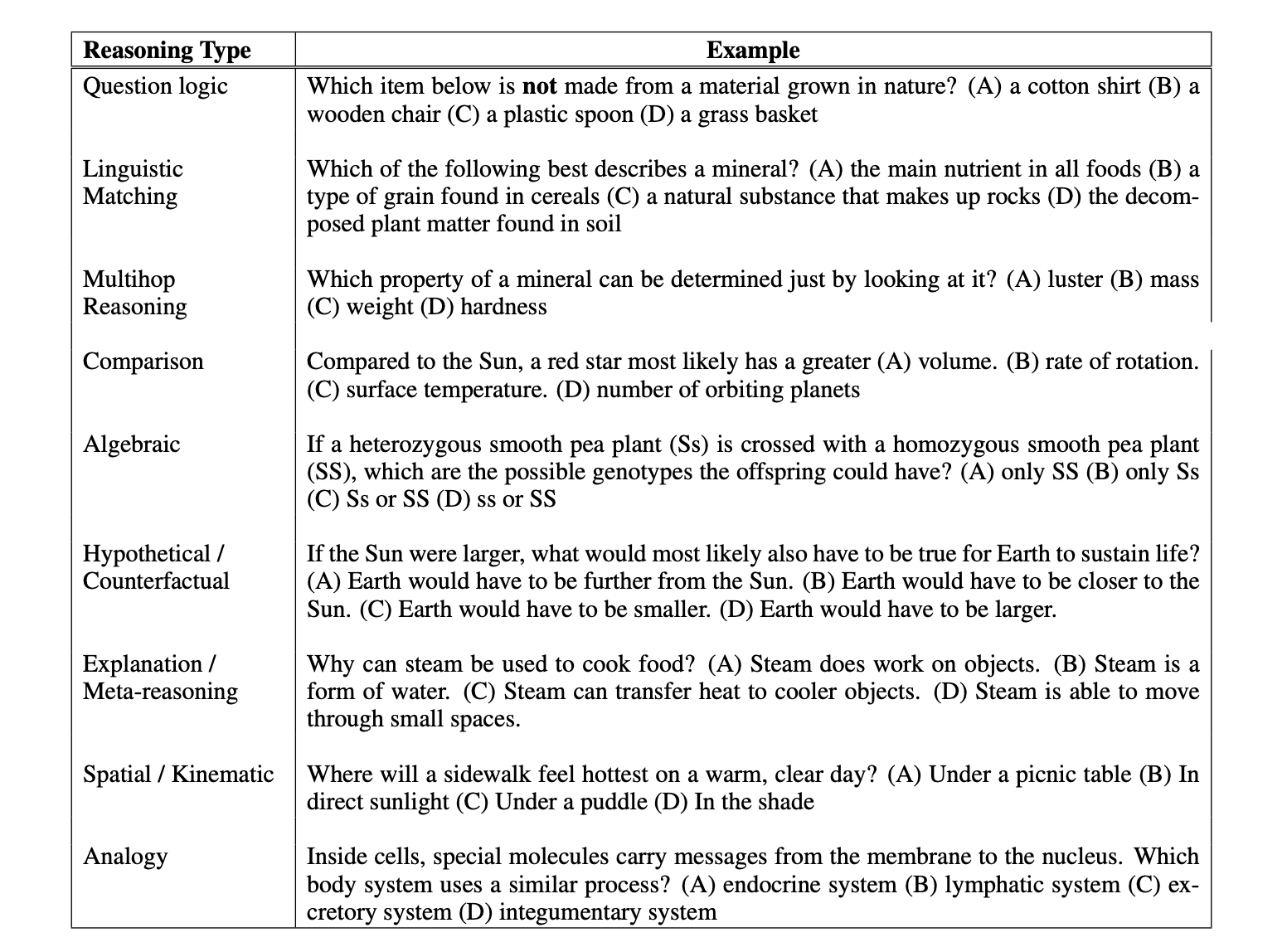
ARC (AI2 Reasoning Challenge) and ARC-AGI (Abstraction and Reasoning Corpus, by Francois Chollet) are completely different despite sharing the same acronym. ARC tests textual school-level science knowledge (text-based MCQ). ARC-AGI tests "general" intelligence through abstract visual grids (finding the transformation pattern). The best models solve 50-75% of ARC-AGI. It's a much harder and fundamentally different benchmark.
Current scores on ARC-Challenge:
- GPT-3 (2020): 51%. One in two. Mediocre.
- GPT-4 (2023): 96%. Near perfect.
- LLaMA 3.1 405B: 96%. Same level.
ARC-Challenge is saturated. It's no longer a test that distinguishes modern models. It's become a simple baseline check.
HellaSwag: Situational Common Sense
HellaSwag (Zellers et al., 2019) tests something more subtle: situational common sense. The ability to understand how an everyday situation normally unfolds.
The format: you're given the beginning of an ordinary activity (making a bed, cooking, fixing a bike). You have to choose the most plausible continuation from 4 options.
Concrete example:
"Someone unfolds a sheet on a bed. They smooth it with their hand. Then: (A) they fold the sheet into quarters, (B) they place a pillow on top, (C) they put the sheet away in the closet, (D) they continue smoothing the sheet."
The correct answer is (B): the logical next step when making a bed is putting the pillow on.
The "hard" part: the three wrong answers aren't absurd. They were generated by an AI model and then adversarially filtered to be maximally deceptive for another model. They look like plausible continuations. That's what sets HellaSwag apart from classic MCQs: the distractors are designed to fool machines, not humans.
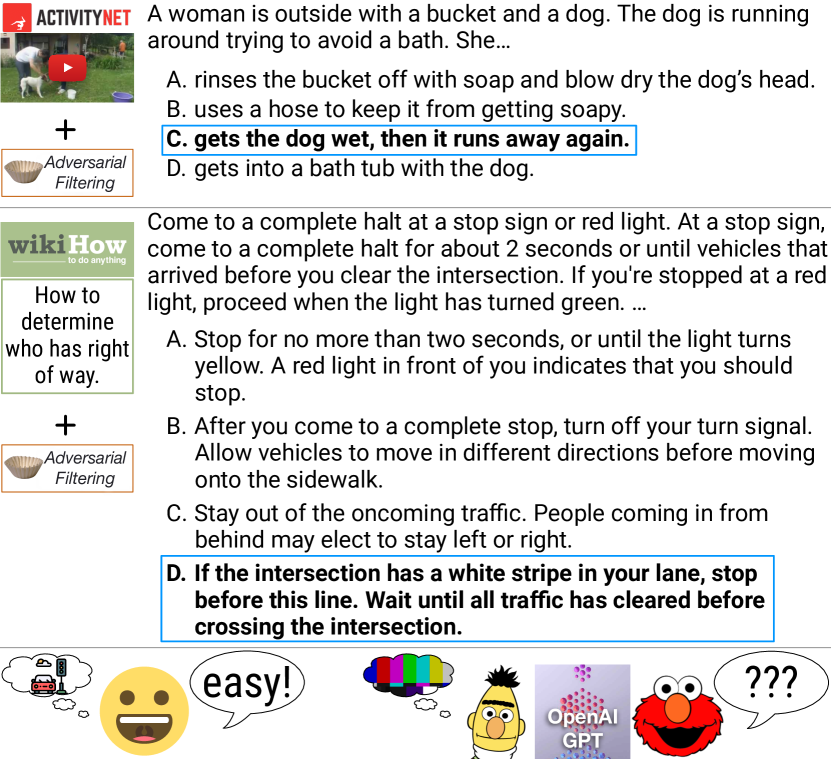
The dataset contains 10,042 questions. The twist: humans succeed at 95% (it's easy for us), but a model that doesn't understand common sense fails on 30-50% of the questions.
Current scores:
- GPT-3 (2020): 78%.
- GPT-4 (2023): 95%.
- LLaMA 3.1 70B: 87%.
Saturated for large models. Smaller models still show differences.
WinoGrande: Who Is "She"?
WinoGrande (Sakaguchi et al., 2019) tests pronominal ambiguity resolution: when a pronoun is ambiguous, what does it refer to?
The classic example:
"The trophy didn't fit in the suitcase because it was too [big / small]."
- If "it" = the trophy (too big to fit) -> "big"
- If "it" = the suitcase (too small to contain it) -> "small"
To solve this, you need to understand the physics (an object doesn't fit in a container) and the logic (what is "too big" or "too small" in this context). This isn't surface-level pattern matching. You have to model the situation.
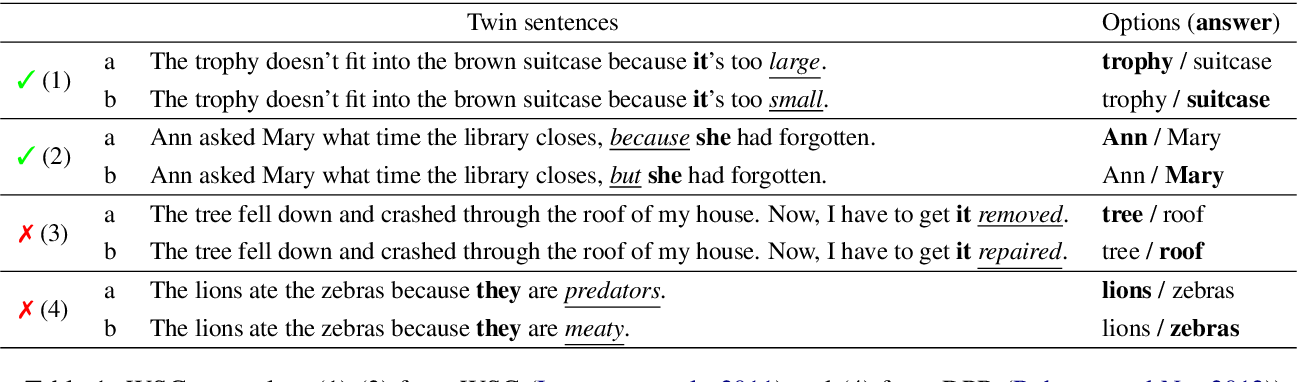
The dataset contains 44,000 sentence pairs. Format: 2-choice MCQ for each pair. Inspired by the Winograd Schema Challenge (2012), which proposed that resolving these ambiguities required genuine "understanding" of language.
Scores:
- GPT-3: 77%.
- GPT-4: 87%.
- Human score: 94%.
WinoGrande isn't fully saturated, but it's getting close. The gap between the best models (87%) and humans (94%) suggests there's still progress to be made in common sense understanding, but the benchmark is losing its discriminating power between recent models.
In 2012, Hector Levesque proposed that resolving pronominal ambiguities required genuine "understanding" of text. It was presented as a potentially more demanding test than the Turing test. WinoGrande is its big data, statistically robust version. And now, models solve it at 87% without "understanding" in the human sense. This raises a profound question: does reliably solving a problem, without understanding it in the strong sense, constitute a form of understanding?
The Benchmark Lifecycle: Birth, Glory, Obsolescence
The history of these three benchmarks illustrates a cycle that keeps repeating:
- A benchmark is created as "very hard" for current models
- The community adopts it, it becomes the evaluation standard
- Models improve. Fast. Very fast.
- In 12 to 24 months, the benchmark is saturated (90%+ for all recent models)
- It becomes useless for distinguishing models
- A new, harder benchmark is created
- The cycle starts again
This cycle is accelerating. ARC and HellaSwag held up for 3-4 years before being saturated. Benchmarks created today risk becoming obsolete even faster, given the pace of progress.
Leaderboard v2: Hugging Face's Response
Hugging Face launched the Open LLM Leaderboard v2 in 2024 to replace the saturated benchmarks:
- IFEval: complex and precise instruction following
- BBH (Big-Bench Hard): genuinely complex reasoning across varied tasks
- MATH: competition-level mathematical reasoning
- GPQA: doctoral-level scientific questions
- MMLU-Pro: MMLU but harder and better filtered (10 choices instead of 4)
- MuSR: multi-step reasoning on long scenarios
ARC, HellaSwag, and WinoGrande illustrate the fundamental problem of AI evaluation: once a benchmark is saturated, reporting it is meaningless. Companies continue to display it in press releases, but it means nothing for differentiating new models. It's like putting "high school diploma" on a PhD candidate's resume: it's just a checkbox that says nothing about actual competence.