Why Math Is the Ultimate Reasoning Test
Math has a unique property in evaluation: an answer is right or wrong. No ambiguity. No style. No "it depends on your perspective." , period.
But what makes math truly interesting as an AI test is that it demands a complete reasoning chain:
- Read and understand a problem in natural language
- Break it down into logical steps
- Execute the calculations correctly
- Verify the coherence of the result
Each step is a potential source of error. A model that succeeds must master all the steps. That's why math benchmarks are so revealing of a model's reasoning ability.
Math demands real reasoning. Not just reciting memorized facts. You have to transform a natural language description into abstract operations, then execute those operations without error. It's fundamentally different from general knowledge (MMLU) or common sense (HellaSwag).
GSM8K: Basic Arithmetic
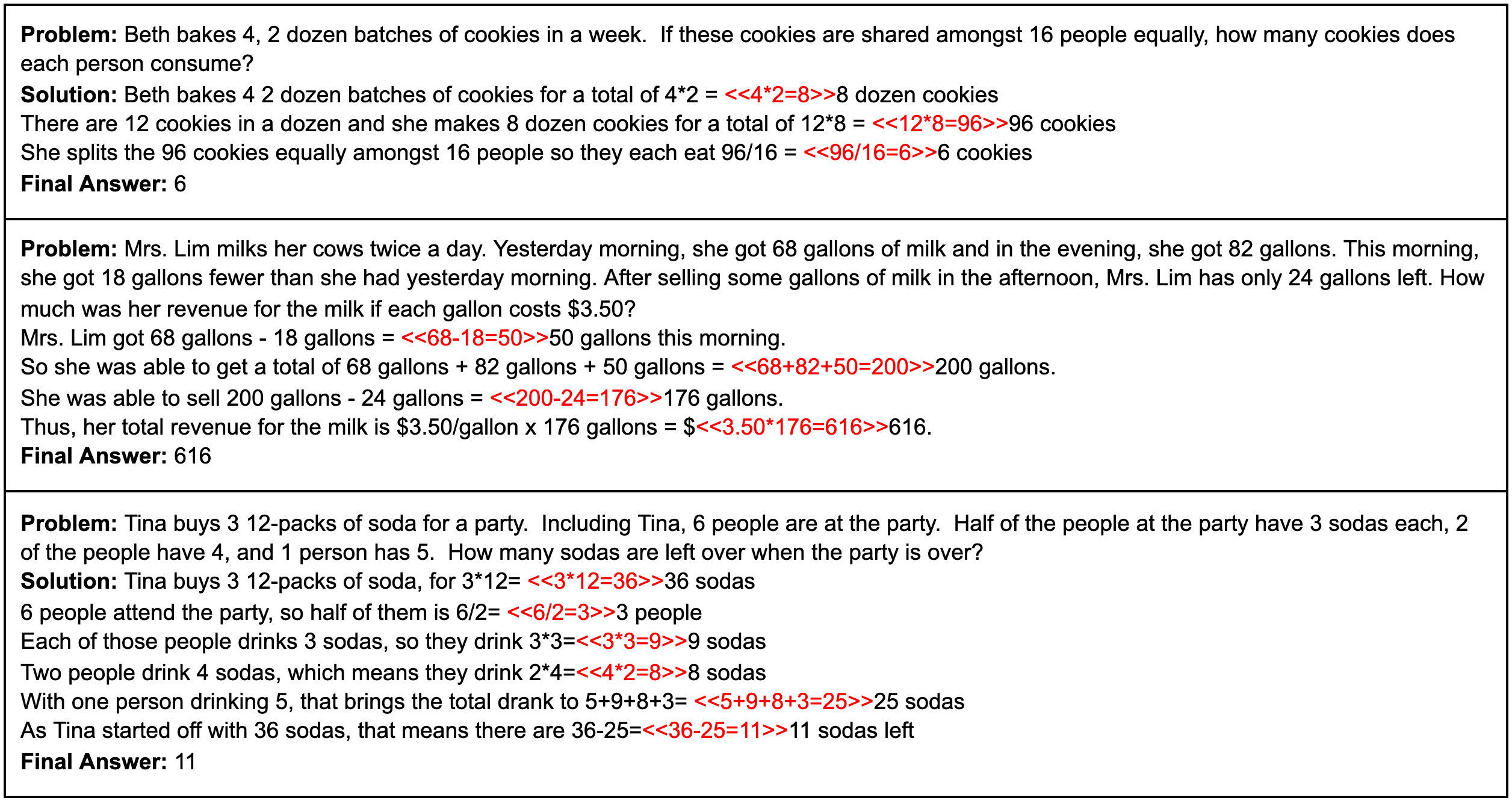
GSM8K (Grade School Math, 8K problems): 8,792 elementary and middle school level problems. Created by OpenAI in 2021.
The format is simple and natural:
- A natural language scenario (e.g., "Alice has 3 apples. Bob gives her 2 more. Then she eats 1. How many apples does Alice have?")
- 2 to 8 reasoning steps required
- Detailed solutions with step-by-step reasoning
- Numerical answers that are automatically verifiable
The problems are accessible for a human (middle school level), but they require the model to maintain coherent reasoning across multiple steps. The difficulty isn't in any individual calculation, but in the logical chain.
The Spectacular Progression of Models
- GPT-3 (2020): 20%. Four problems out of five are wrong. The AI can't do basic arithmetic.
- GPT-3.5 (2022): 57%. Better, but still far off.
- GPT-4 (2023): 92%. Near perfect.
- Claude 3.5 Sonnet (2024): 96%. Saturated.
- o1 (2024): 95%. Even reasoning models can't do better (there's no more room).
- GPT-5.4, Claude Sonnet 4.6, Gemini 3.1 Pro (2026): all 96%+, benchmark totally saturated (2026 update).
GSM8K is now saturated. All recent models score 90%+. It's no longer a test that discriminates between models.
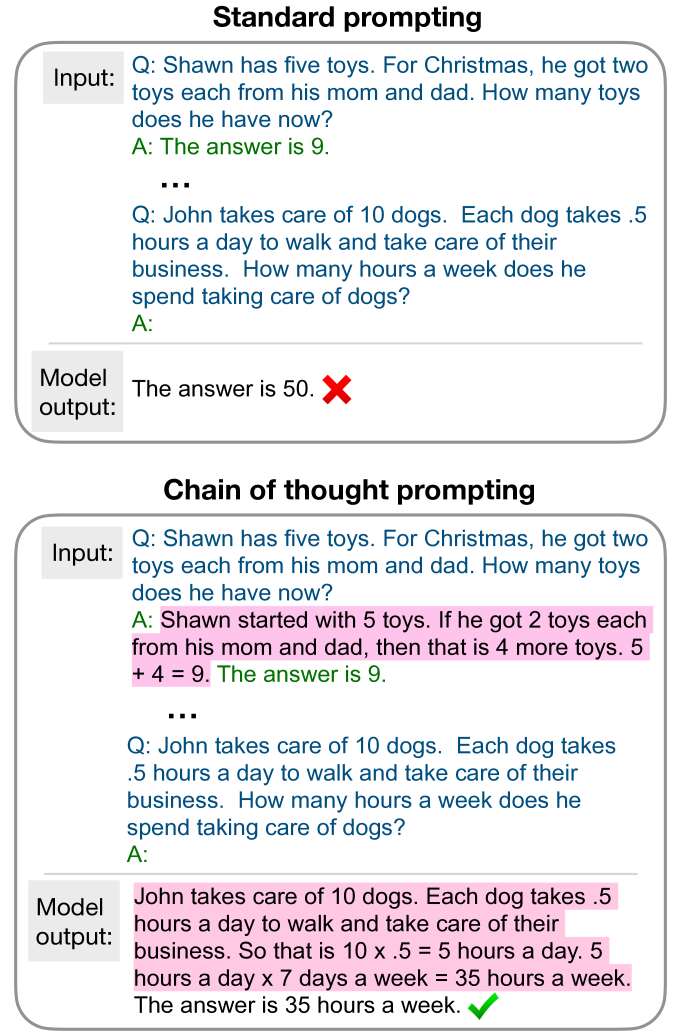
It was on GSM8K that chain-of-thought prompting was demonstrated (Wei et al., 2022). The idea: instead of asking directly for the answer, ask the model to "think step by step." The result on GPT-3? From 20% to 55% correct answers. Tripling performance just by changing the prompt. It's the discovery that changed how LLMs are used, and GSM8K was the testing ground.
MATH: High-Level Competitions
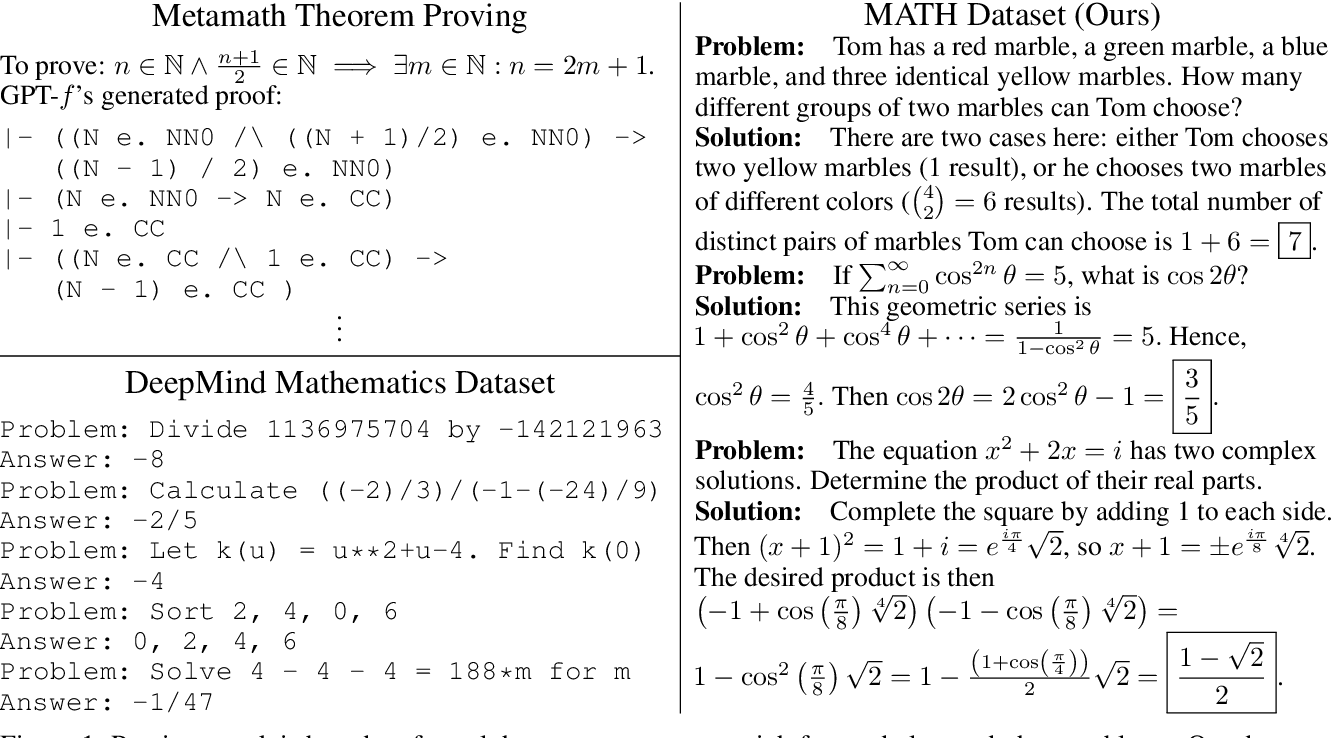
MATH (Hendrycks et al., 2021): 12,500 problems from American math competitions (AMC, AIME, MATHCOUNTS). Much harder than GSM8K.
The problems are categorized into:
- 7 domains: algebra, combinatorics, geometry, intermediate algebra, number theory, pre-algebra, pre-calculus
- 5 difficulty levels (1 = accessible, 5 = very hard)
- Answers are in LaTeX, verified symbolically (not just numerically)
- Creativity and multi-step reasoning required
The fundamental difference from GSM8K: a MATH problem can require a trick, a creative reformulation, or a combination of concepts from different domains. It's not just "apply the operations in the right order."
The Evolution of MATH Scores
- GPT-4 (2023): 42%. Less than half. Competition math holds up.
- Claude 3.5 Sonnet (2024): 71%. Good progress.
- o1 (2024): 94%. The spectacular leap.
- o3 (2025): 96%. Near perfect.
- GPT-5.4 / Gemini 3.1 Pro (2026): 96%+, the MATH benchmark is also approaching saturation for reasoning models (2026 update).
MATH remains discriminating. "Classic" models (without extended reasoning) plateau at 40-75%. Reasoning models (o1, o3, R1) reach 90-96%. The gap directly measures the impact of "compute at inference" on mathematical reasoning.
The Subtlety of Process vs. Result
A fundamental problem: a model can arrive at the right answer through wrong reasoning.
Simplified example: "What is ?" The model writes ", ." The answer is 6, which is correct. But the reasoning is wrong at the first step (). Through error compensation, the final result is correct.
Benchmarks only test the final answer, not the quality of reasoning. This is a fundamental limitation that we don't know how to solve automatically.
The Contamination Problem
GSM8K and MATH have been public since 2021. They circulate massively on the internet: forums, blogs, tutorials, Reddit discussions, educational articles. Models trained on the web have probably seen these problems (or close paraphrases).
Variants have been created to work around this problem:
- MATH-500: subset for quick and controlled testing
- MathOdyssey: original, uncontaminated problems
- OlympiadBench: recent math olympiad problems
- AIME: 15 very hard problems, renewed each year (see the dedicated page)
- FrontierMath: research-level math problems (Epoch AI). The best models solve less than 10%.
- MiniF2F: formal proofs in Lean/Isabelle (models must produce proofs verifiable by a proof assistant)
GSM8K -> MATH -> AIME -> FrontierMath. It's a natural progression: elementary calculation, competition reasoning, research-level reasoning. Today's best models dominate the first three but remain nearly helpless on FrontierMath. That gives the measure of the road ahead.
Saturation and Lessons
GSM8K is dead as a discriminating benchmark. Don't use it to compare recent models anymore.
MATH is approaching saturation for reasoning models (96% for o3), but remains discriminating for classic models.
The general lesson: both benchmarks specifically test math. A model at 96% on MATH can be weak at logical reasoning in other domains, at causal understanding, or at reasoning about ambiguous situations. Math is one form of reasoning, not all of reasoning.
When models reach 90%+ on a benchmark, the benchmark loses its usefulness. GSM8K is dead. MATH is getting there. AIME still holds. FrontierMath will be the next frontier. But this creates a cycle: we create harder benchmarks, models saturate them, we create new ones. It's an arms race between test creators and model builders.
Lasting Impact on Research
GSM8K and MATH played a catalytic role in research on LLM reasoning. Chain-of-thought prompting, self-consistency (voting among multiple reasoning chains), tree-of-thought (exploring a tree of possibilities), and reasoning models (o1, R1) were all evaluated and motivated by these benchmarks.
Even as they approach saturation, GSM8K and MATH remain historical references that have shaped research on reasoning in AI.