The Exam That Became THE Standard
For a long time, measuring a coding assistant meant solving isolated exercises: write a function, pass a few tests (that's the idea behind HumanEval, covered in its own page). Useful, but far from a developer's real job.
SWE-bench changed that. Instead of an artificial exercise, the model is handed a real ticket ("issue") from a real GitHub project (Django, Flask, scikit-learn, and so on) exactly like a bug reported by a user. The model has to read the existing codebase, understand the problem, write a fix (a "patch"), and that patch is only accepted if it passes the project's tests. No opinion, no "close enough": the tests either pass or they don't.
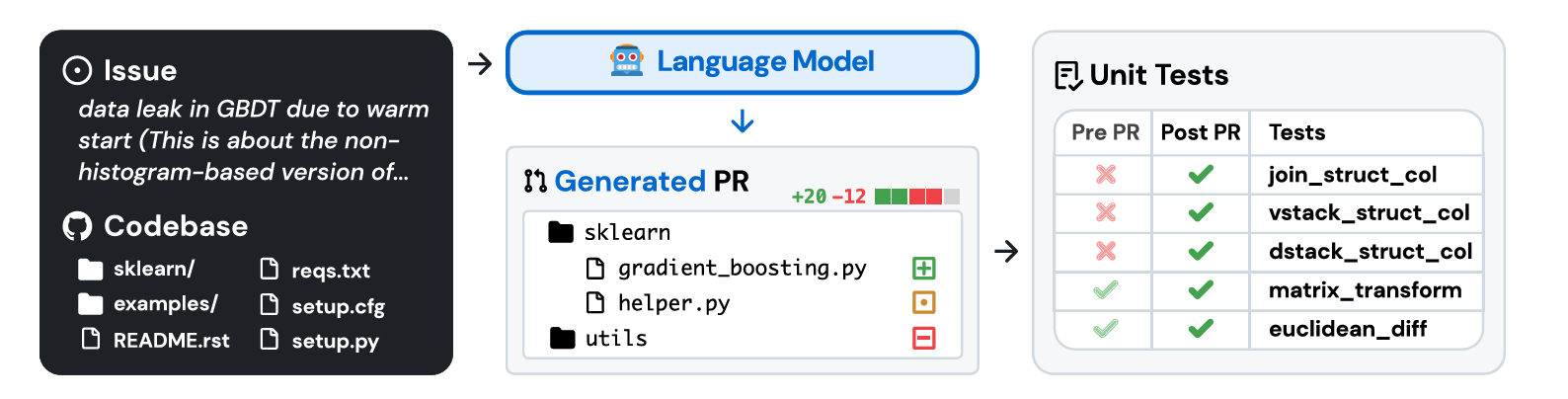
A variant, SWE-bench Verified, adds a quality layer: a subset of tasks reviewed by humans to make sure they are well specified and actually solvable. It is precisely this "verified" version that became, in 2024-2025, the number every lab put forward for its coding agent.
SWE-bench ticked every box of a "good" test: realistic tasks (real repos), objective verification (running tests), and genuine difficulty (the best agents long plateaued around 50%). It was held up precisely as the antidote to saturated benchmarks like HumanEval or GSM8K (see the page on benchmark limits). Which is why it was such a shock when its own flaws were exposed.
February 23, 2026: OpenAI Pulls the Plug
That day, OpenAI announced it would stop reporting SWE-bench Verified as an official metric for its models. For a benchmark that had become an industry standard, that is a real event.
The reasoning came down to two problems, surfaced by their own evaluation team while examining the tasks models were failing:
- Broken or underspecified tests. Auditing the hardest tasks (the ones models miss), they found that roughly 59% of them had tests that were broken, ambiguous, or that didn't actually express what the fix was supposed to do. In other words: a large share of the "failures" were not the model's failures, but defects in the benchmark itself.
- Signs of contamination. Several frontier models showed signs of having already "seen" the solutions, the GitHub repos used are public, and their fixes are sitting somewhere in the training data.
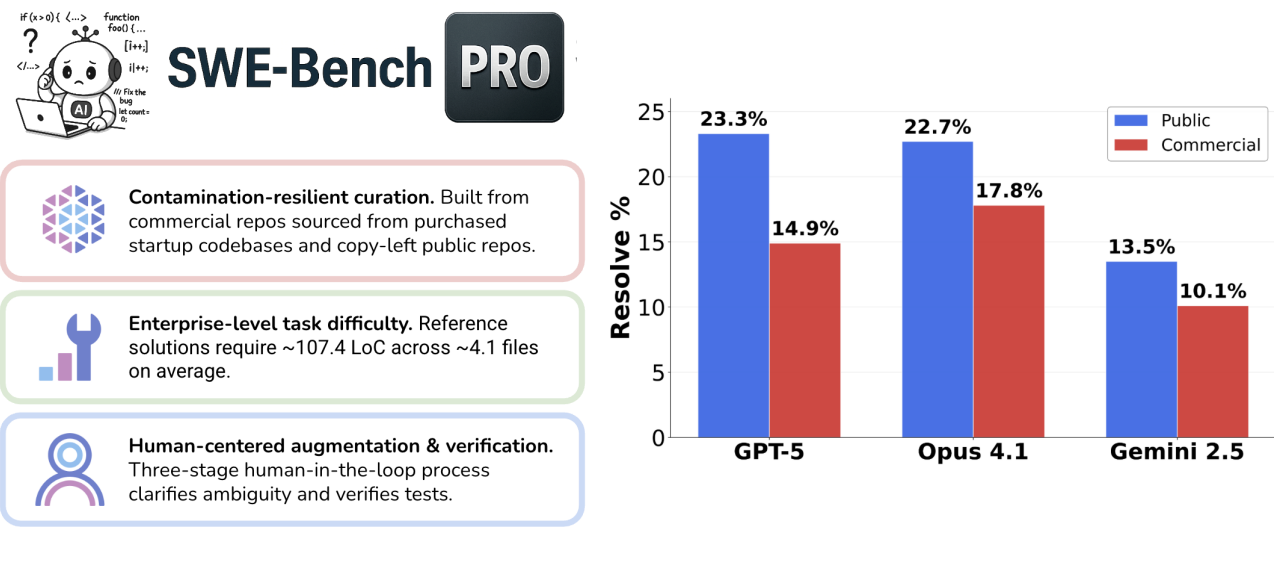
OpenAI's recommendation: move to SWE-bench Pro, a more robust version that is harder to contaminate.
When a lab stops citing the benchmark that made it look good, it isn't out of modesty. It's a public admission that the number no longer measured what we thought. A SWE-bench Verified score of "X%" mixed together, inseparably: genuine competence, points won thanks to shaky tests, and points won through memorization.
Problem #1: "Underspecified" Tests
On SWE-bench, the verdict ("pass/fail") rests entirely on the project's tests. Everything therefore hinges on the quality of those tests. And a test can fail at its job in two opposite ways, both of which distort the score:
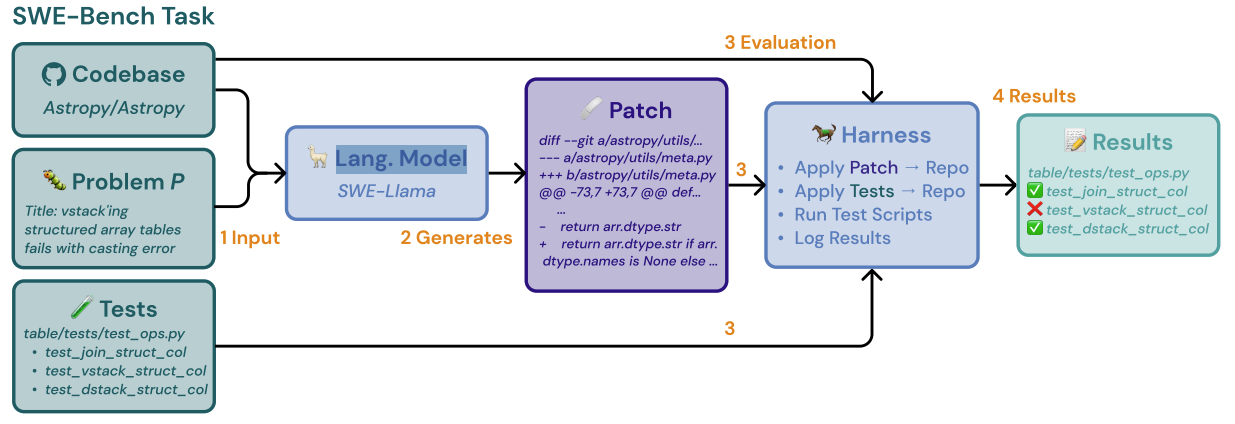
- Too lenient (underspecified). It checks too little. A partial, or even incorrect, fix passes anyway. Result: the score is inflated, the model is credited with a success that isn't one. It's the same trap as the "false positives" people try to eliminate with more robust tests (like MBPP+, discussed in the HumanEval page).
- Broken or too strict. It fails for the wrong reasons: it depended on an environment detail, a library version, or it expected one exact wording that isn't the only correct one. Result: a good fix is counted as a failure, the score is unfairly dragged down.
OpenAI's audit was about this second case: the failed tasks were largely undermined by broken tests. But both flaws coexist, and that's the whole problem, the same benchmark can simultaneously overrate some models and underrate others, depending on how their answers happen to fall against imperfect tests. The final number then loses its meaning.
Picture an exam whose answer key contains mistakes: some correct answers are marked wrong, and some wrong answers are marked right. The final ranking isn't just a bit noisy, it's structurally wrong. Worse: a candidate who "memorized the answer key" (contamination) scores a perfect grade without understanding anything. That's exactly the situation SWE-bench Verified exposed.
Problem #2: Contamination
Contamination (or "data leakage") happens when the model has already encountered the answer during training. It doesn't solve the task: it remembers it.
For SWE-bench, the mechanism is especially direct:
- The tasks come from public GitHub repos. The bugs, the discussions, and above all the actual fixes (the "pull requests" that resolved those issues) are online, publicly.
- Pre-training a large model hoovers up huge portions of GitHub. The official fix for a Django issue is therefore, with high probability, somewhere in the training data.
- The model can then reproduce a patch close to the canonical solution without having truly "reasoned" about the code.
This is the same underlying disease described in the benchmaxxing page, but worse: here the "solution" isn't a multiple-choice answer, it's the exact fix, written by the real maintainers, public and indexed. The older and more famous a benchmark is, the more time it has had to leak into the corpora.
A benchmark must be public to be reproducible and credible. But the moment it's public, it starts leaking into future training data. This tension is unsolvable for a fixed test: its credibility decays mechanically over time. That's why benchmarks that keep refreshing (fresh questions, dated after training) hold up better.
The Lesson: One Number Is Never Enough
The SWE-bench episode isn't an anecdote about one particular benchmark. It's a sharp illustration of a general principle of benchmark credibility:
- A high score can come from genuine competence, weak tests, contamination, or a mix of all three, and from the outside, you can't tell them apart.
- Over-optimizing a single number (benchmaxxing) always ends up draining it of meaning: that's Goodhart's law ("when a measure becomes a target, it ceases to be a good measure").
- Even a benchmark designed to be realistic and objective (running real tests on real repos) doesn't escape these flaws.
The answer isn't to hunt for the perfect benchmark, but to cross-reference multiple sources: several tests, fresh data, human judgment, and above all a trial run on your own tasks. See also the page on benchmark limits.
The Alternatives and Complements Emerging
The controversy accelerated the adoption of more robust tests for coding agents:
| Benchmark | What it measures | Why it holds up better |
|---|---|---|
| SWE-bench Pro | Resolving GitHub issues, hardened version | Reviewed tasks, private/controlled set to limit contamination |
| Terminal-Bench 2.0 | Real tasks in a terminal (shell, infra, ops) | Goes beyond the "code patch": command chains, a live environment, harder to memorize |
| LiveCodeBench | Problems from recent competitions | Dated after training: contamination is impossible |
Terminal-Bench deserves a mention: it evaluates the agent not on "write this fix" but on end-to-end tasks in a real terminal, installing dependencies, running commands, debugging an environment, manipulating files. That's closer to what an engineer does day to day, and far harder to "recite from memory" than an already-published patch.
None of these benchmarks replaces SWE-bench on its own. The point isn't to crown a new champion, but to use a battery of complementary tests (isolated code, issue resolution, shell/infra tasks, fresh data) and to keep a critical eye on every number. A benchmark score is a clue, not a proof.
Key Takeaways
- SWE-bench had become THE reference benchmark for coding agents: solving real GitHub tickets, validated by running real tests. Its SWE-bench Verified variant was the headline number labs leaned on.
- On February 23, 2026, OpenAI stopped reporting SWE-bench Verified, after finding that roughly 59% of the hard, failed tasks rested on broken or underspecified tests, plus signs of contamination across several frontier models.
- "Underspecified" tests distort scores both ways: too lenient, they inflate results (false successes); broken or too strict, they wrongly penalize good fixes. The final number blends real competence with artifacts.
- Contamination is unavoidable for a public, aging test: the fixes for GitHub issues are online and end up in training data. The model can then remember the solution instead of finding it.
- The real lesson is general: a single benchmark number is never enough. Competence, weak tests, and contamination are inseparable from the outside, you have to cross-reference several evaluations and test on your own cases.
- More robust alternatives are emerging: SWE-bench Pro (hardened version), Terminal-Bench 2.0 (end-to-end shell/infra tasks), and fresh-data benchmarks like LiveCodeBench.