Why Code Is the Purest Intelligence Test
With natural language, everything is ambiguous. Which summary is "better"? Which answer is "more helpful"? It depends on who's judging, the context, the preferences. Two human evaluators will often disagree.
With code, it's binary. The program passes the unit tests, or it doesn't. It compiles and produces the right result, or it crashes. There's no gray area, no "it's not bad," no "it depends on your perspective."
HumanEval (Chen et al., OpenAI, 2021) and MBPP (Austin et al., Google, 2021) exploit this property to evaluate the ability of LLMs to write functional code. Not "roughly correct" code. Code that works.
Writing functional code simultaneously requires: understanding a natural language description, breaking the problem down into logical sub-steps, translating into valid syntax, handling edge cases, and attention to detail (one misplaced comma and everything breaks). It's a particularly demanding composite intelligence test.
HumanEval: 164 Python Problems
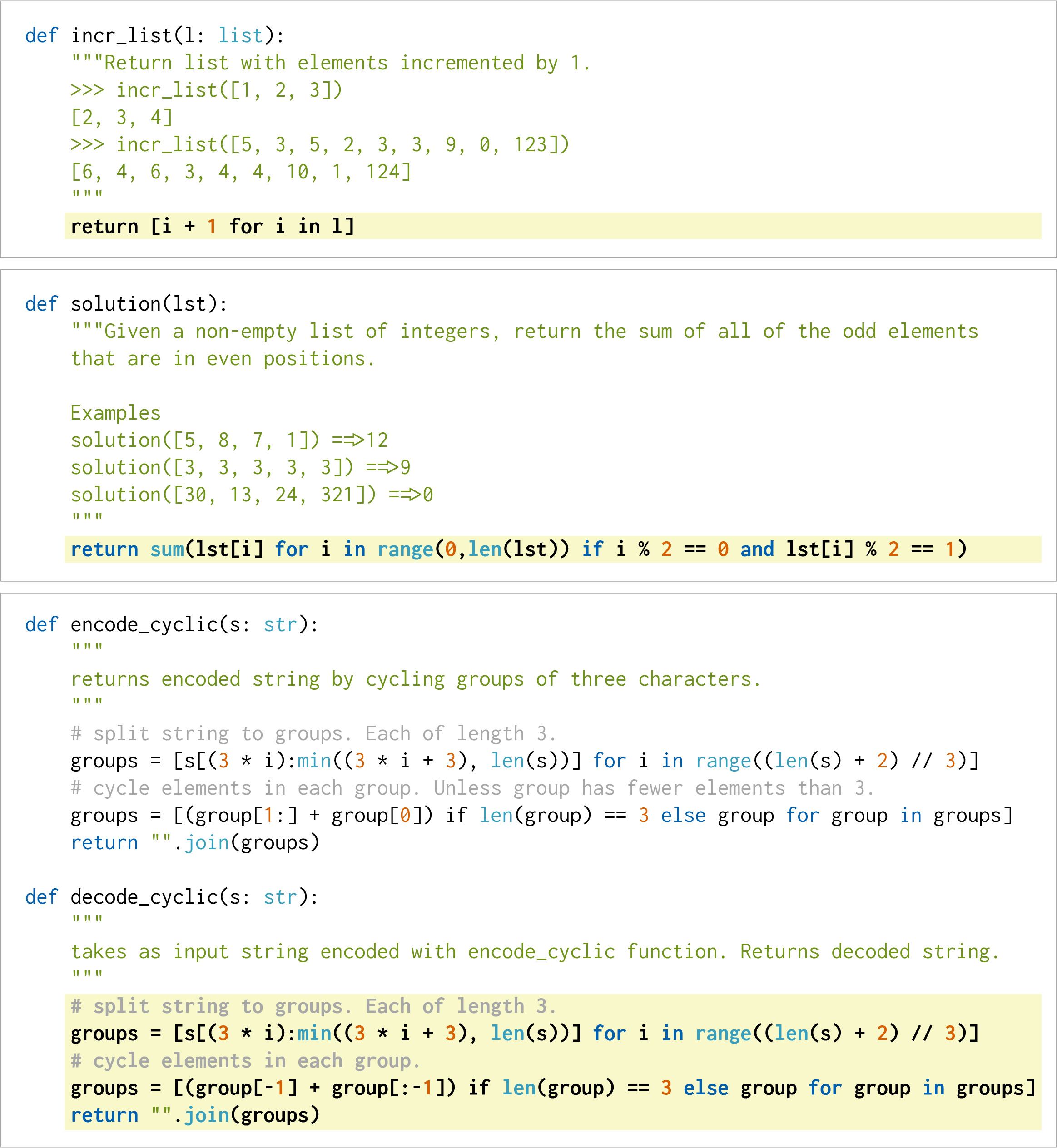
The format is simple and elegant:
- The model is given a function signature (e.g.,
def add(a: int, b: int) -> int:) - A docstring describing in natural language what the function should do
- Unit tests that verify the result
- The model must complete the function body
The problems cover a spectrum: string manipulation, sorting algorithms, searching data structures, mathematical operations, conditional logic. The difficulty ranges from trivial (adding two numbers) to moderate (implementing a specific sorting algorithm).
The key metric: pass@k
- pass@1: the model gets one attempt. The code must work on the first try. It's the most demanding test and the most representative of real-world use (when you ask a coding assistant, you want it to work the first time).
- pass@10: 10 attempts, at least one must pass the tests. Measures the model's ability to explore different approaches.
- pass@100: 100 attempts. Rarely reported, but useful for understanding theoretical limits.
Score Evolution: A Blazing Progression
- Codex (2021): 28.8%. The first specialized code model. A quarter of problems solved.
- GPT-3.5 (2023): 48.1%. Half. The leap toward competence.
- GPT-4 (2023): 67.0%. Two-thirds. Frankly impressive.
- GPT-4o (2024): 90.2%. Nearly perfect.
- Claude 3.5 Sonnet (2024): 92.0%. The best published score at the time of testing.
- DeepSeek-Coder-V2: 90.2%. Open-source catches up.
- GPT-5.4 / Claude Sonnet 4.6 (2026): 95%+. The benchmark is essentially saturated (2026 update).
In three years, we went from "one model in four succeeds" to "nine in ten succeed." In 2026, the best models are approaching perfection on this benchmark.
With pass@10, the best models reach 95-97%. With pass@1, it's 90-92%. The gap reveals the model's ability to diversify its strategies. A model that generates 10 very similar variants won't improve much between pass@1 and pass@10. A model that explores fundamentally different approaches will see a bigger gain.
MBPP: The Broader Complement
MBPP (Mostly Basic Python Programming): 974 Python problems.
Differences from HumanEval:
- Problems are simpler on average (beginner to intermediate level)
- Descriptions are shorter and more direct
- 3 unit tests per problem (vs. more for HumanEval)
- Less context in the problem statements
MBPP+ is a filtered subset of 427 problems with more robust tests. The goal: eliminate false positives (code that passes the original tests by chance but is fundamentally incorrect).
HumanEval and MBPP are complementary: HumanEval tests depth (more complex problems, more context), MBPP tests breadth (many more problems, more variety).
The Limitations: From Benchmark to the Real World
Python only. Real developers write in JavaScript, TypeScript, Java, Go, Rust, C++, and dozens of other languages. A model that's excellent in Python can be mediocre in Go. MultiPL-E translates HumanEval into 18 languages to fill this gap.
Isolated problems. Real development work is about understanding a 100,000-line codebase, navigating between dozens of files, understanding project conventions, finding the bug in a tangle of dependencies. HumanEval? 50 lines max, no external context. It's like judging a surgeon on their ability to tie knots: necessary but not sufficient.
No debugging. Real developers spend a considerable amount of their time debugging existing code, not writing new code. HumanEval only tests code generation. The ability to read, understand, and fix existing code isn't measured.
Limited size. 164 problems is statistically small. A variance of a few percentage points can be enough to change the rankings. Is the difference between 90% and 92% (3 problems difference) significant?
Likely contamination. The 164 HumanEval problems have been public since 2021. They circulate on GitHub, in blogs, and discussions. Recent models have probably seen them in their training data. It's hard to know if a model "solves" a problem or "remembers" it.
SWE-bench: solving real bugs in real open-source repos (Django, Flask, scikit-learn). The model must read existing code, locate the bug, and write a patch that passes the tests. ~50% for the best agents. It's much closer to a developer's real work.
LiveCodeBench: problems from recent programming competitions (Codeforces, LeetCode). No risk of contamination since the problems are newer than the training data.
BigCodeBench: using real libraries (numpy, pandas, requests). Tests the ability to write code that interacts with the Python ecosystem, not just pure algorithmic code.
MultiPL-E: HumanEval translated into 18 programming languages.
From Benchmark Perfection to Production Competence
A model with 92% on HumanEval is not a competent developer. Why?
- Software architecture: HumanEval doesn't test the ability to design systems, choose patterns, or structure a project
- Integration: no tests for interaction with other modules, APIs, or databases
- Maintainability: code that works isn't necessarily code you want to read, maintain, and extend 6 months later
- Real tests: HumanEval's unit tests are simple and predictable. Production tests are complicated, adversarial, with obscure edge cases
- Security: no evaluation of vulnerabilities (SQL injection, XSS, secrets management)
The gap between "solving code exercises" and "being a productive developer" remains significant. Code benchmarks measure a fundamental technical skill, but software development is a much broader activity involving communication, architecture, trade-offs, and judgment.
A model can score 95% on HumanEval and be frustrating to use for real development. The benchmark tests a narrow fraction of the necessary skills. It's a useful indicator (a model at 30% will definitely be bad at code), but not proof of professional competence.